Prompts for Life · Pack 13 · 10 prompt templates

Writing & Communication
AI Prompt Templates

Ten prompts for the messages everyday life demands: the complaint, the chase, the refusal, the negotiation and the apology. The request goes in the first three lines, every claim carries a date, and nothing is sent in anger.

ChatGPT, Claude & Gemini Instant download No subscription Lifetime updates Best in Claude: a formal complaint letter in Word

Get a reply, ask, push back, repair

Run prompt 01 first: it sets the outcome, the reader and the channel, and opens the Message Brief. Then run whichever prompt the week demands.

Four rules in every prompt

These are what stop the AI writing the polite, shapeless message that gets ignored.

One message, one ask

What you want, and the date you want it by, go in the first three lines. A reader who has to hunt for the request often never finds it.

Facts with dates

Every claim carries a date, an amount, a name or a reference number. Organisations argue with impressions and concede to records.

Firm, not rude

No sarcasm, insults or threats. Consequences are stated as plain facts, and only ones you intend to follow through.

Keep the record

Anything agreed by phone is confirmed by email the same day. Copies and dates are kept, and the escalation ladder is known before it is needed.

One year of messages, all ten prompts

Omar Haddad is a 38-year-old civil engineer in Austin. In February 2026 a moving company damaged furniture worth $1,180. His complaint ran 740 words and put the request in the last line; after three emails over seven weeks, the company offered $300 as a goodwill gesture. At 11:40pm one night he drafted a 620-word reply he never sent. Here is what the ten prompts did with that dispute and with a year of ordinary messages: a contractor who went silent, a reference he needed, a rent increase, a refusal and an apology.*

740 words

in his first complaint, the request in the last line

7 weeks

and 3 emails, with nothing resolved

$300

offered against $1,180 of damage

11:40pm

on the angry draft he nearly sent

Step 1 · Getting a reply

Everyday Email & Message (BLUF)

Sets the outcome, the reader and the channel, then writes the message so the request is impossible to miss.

BLUFOutcome and readerSubject line

What Omar brought · his first complaint

“I need the moving company to pay for the damage. My first email was 740 words and asked at the end.”

What the prompt returned

Outcome: $1,180 by 8 May. Reader: the claims team, who can approve up to $500. Channel: email, for the record. The message: 190 words, the request in line two.

First email740 words, request in line 43
Outcome$1,180 for repair or replacement, by 8 May
Readerclaims team to $500; above that, the executive office
Rewritten190 words, request in line 2, six dated facts

The analysis · His request sat in line 43 of 43

BLUF, bottom line up front, puts the request and the deadline in the opening lines and the background after them. It is the standard in military and medical briefings, because a reader who has to hunt for the request often never finds it.

  • 740 words: the first email described the whole move in order, and asked for money in the last line. Nobody read that far.
  • Who can say yes: the claims team could approve $500. A $1,180 claim was never theirs to grant, so it stalled with them for seven weeks.
  • 190 words: the rewrite states the amount and the date in line two, then the six dated facts that support it.

Takeaway: decide the outcome, the reader and the channel first, then put the request in the first three lines.
Step 2 · Getting a reply

Chasing a Reply

Writes the follow-up that gets an answer, and sets the schedule for how often to chase and when to escalate.

Follow-upDeadline with consequenceSame thread

What Omar brought · a silent contractor

“Four messages to the contractor in three weeks. Nothing back.”

What the prompt returned

A 62-word follow-up in the original thread: the quote date, one question to answer, and a date — “if I don’t hear by Friday I’ll book the other contractor”.

Before4 messages in 3 weeks, each one longer than the last
Diagnosisno deadline, and three questions in one message
The follow-up62 words, one question, a Friday deadline
Resulta reply in 2 days

The analysis · Three weeks of silence after four messages

Most silence is not refusal: the message came at a bad moment, or asked for something that took too long to answer. A follow-up works when it makes replying easier than before, gives a date, and says what happens if the date passes.

  • Three questions, no answer: the original message asked about price, timing and materials at once. Answering it was a job in itself.
  • One question instead: "Can you still start the week of 18 May, yes or no?" takes ten seconds to answer.
  • A stated consequence: booking the other contractor was a real alternative, not a threat, so it could be said plainly.

Takeaway: make the next reply a ten-second job, give it a date, and stay in the same thread.

Step 3 · Getting a reply

Scheduling, Rescheduling & Cancelling

Proposes, moves or cancels an appointment without wasting the other person’s time or damaging the relationship.

Two or three optionsNotice periodConfirmation

What Omar brought · a second reschedule

“I have to move a dentist appointment for the second time, and their policy charges for under 24 hours.”

What the prompt returned

A 45-word message: one line of reason, two new times, and an offer to pay the $50 late-change fee the policy sets.

Historysecond change by Omar in three months
Policy$50 fee for changes inside 24 hours
The message45 words, two specific times, fee acknowledged
Resultmoved to Tuesday; fee waived at 26 hours’ notice

The analysis · “When suits you?” makes the other person do the work

Open questions create work for the reader; two or three specific options do not. Rescheduling is judged on notice and on what you offer instead, and any policy or fee is acknowledged rather than ignored.

  • Two times, not a question: the clinic could accept in one click instead of proposing slots and waiting.
  • The fee named first: offering to pay the $50 before being asked is what made waiving it easy.
  • One apology: repeated apologies invite reassurance, which costs the reader more time.

Takeaway: offer specific times, acknowledge the policy, and confirm in two lines once agreed.

Step 4 · Asking

Asking a Favour, Reference or Introduction

Asks for help in a way that is easy to say yes to, and easy to refuse without awkwardness.

Specific askEasy exitDraft they can edit

What Omar brought · a former manager

“I need a reference from my old manager. We haven’t spoken in two years.”

What the prompt returned

A 130-word message: two lines on where he is now, the ask, the 12 May deadline, a way to decline, and a drafted paragraph she could edit in five minutes.

The askone reference letter, about 20 minutes of her time
The risktwo years of silence, and a deadline eight days away
The easy exit“if it isn’t the right time, just say so”
Resultsent in 3 days, edited but almost unchanged

The analysis · A two-year gap and an eight-day deadline

A request is easy to grant when it is specific, small, and comes with the work already done. Giving an honest way to decline raises the chance of a yes, because it removes the pressure to agree.

  • The draft paragraph: Omar wrote what he hoped she could say, in her voice, for her to change or discard. That turned 20 minutes into five.
  • No guilt, no flattery: two lines explain why her in particular: she managed the project the reference needs to cover.
  • The thanks afterwards: the follow-up named what the reference achieved, which is what makes the next ask possible.

Takeaway: ask for one specific thing, do the work in advance, and always leave a way to say no.

Step 5 · Asking

Asking a Professional the Right Questions

Prepares the questions for a doctor, lawyer, accountant or teacher, so a short appointment is not wasted.

Agenda firstRanked questionsTeach-back

What Omar brought · a 12-minute appointment

“Twelve minutes with the doctor and I always forget the thing I came for.”

What the prompt returned

An agenda of three items with the main one first, eight ranked questions, and a page to write the answers and the agreed next step on.

Beforethe main question asked in the last minute, or not at all
The agendathree items, stated in the opening sentence
The questions8, ranked, none answerable with yes or no
Afterthe main question asked in the first minute

The analysis · The question he came for was always asked last

An agenda given at the start — “I have three things, the main one is this” — changes how the time is used. The teach-back method, standard in healthcare, means repeating the answer in your own words to check you understood it.

  • Ranked, not listed: if only one question gets answered properly, it is the one that decides what he does next.
  • The decision questions: what happens if I do nothing, what are the alternatives, and what would change your advice.
  • The follow-up message: a short note afterwards records what was agreed and who does what.

Takeaway: state the agenda in the first sentence and rank the questions, so the important one is never last.

Step 6 · Pushing back

Complaint, Refund & Compensation Request

Builds the dated evidence, writes the complaint with a specific remedy, and escalates it as a formal letter.

Evidence timelineRemedy requestedEscalation ladder

What Omar brought · $1,180 of damage

“They damaged $1,180 of furniture and offered $300 as goodwill.”

What the prompt returned

A 190-word email: $1,180 by 8 May, six dated facts, two repair quotes attached, and the next step named. Then a one-page formal letter, built in Claude as a Word document.

Their offer$300 goodwill: 25% of the claim
The claim$740 + $440 of repair quotes = $1,180
Escalation ladderclaims team, executive office, state regulator, card chargeback, small claims
Result$950 agreed in 9 days: 81% of the claim

The analysis · Seven weeks and three emails produced a $300 offer

A complaint succeeds when it states what was promised, what happened on which dates, and exactly what remedy is wanted, with a deadline. A goodwill offer is what a company gives when it chooses to; an entitlement is what a contract or the law requires.

  • Six dated facts: the move, the damage report and its reference number, the quotes, two ignored emails and the $300 offer, each with a date and a document.
  • A remedy, not a grievance: $1,180 with the arithmetic shown, and a deadline of 8 May, rather than a description of how the move went.
  • The ladder named once: the letter states the next step as a fact. Texas licenses household movers, so the regulator was real, and so was the chargeback.

Takeaway: put the remedy and the deadline first, prove every fact with a date, and know the next rung before you need it.

Step 7 · Pushing back

Saying No & Setting Boundaries

Declines a request clearly, keeps the relationship, and holds the line when the request comes back.

Positive noAlternative offerThe second ask

What Omar brought · a weekend request

“A friend wants help moving on the weekend I’m away. He asked twice.”

What the prompt returned

A 58-word message: what he values, the plain no, and a real alternative — two hours of packing on the Thursday evening.

The patternasked twice; last time Omar agreed and cancelled
The noplain, with no excuse that can be argued with
The alternativeThursday evening, offered because he meant it
The second askone sentence, repeated unchanged if needed

The analysis · The last vague no became a yes, then a cancellation

William Ury’s positive no has three parts: a yes to what you value, a plain no to the request, and a yes to another way forward. A vague refusal invites another attempt; an over-explained one invites an argument about the reasons.

  • No invented excuse: "I'm away that weekend" is true and complete. An invented reason can be solved by the person asking.
  • A real alternative: Thursday packing was offered because Omar would do it, not to soften the no.
  • The repeat sentence: if the ask returns, the same line goes back unchanged. Rewording it looks like negotiation.

Takeaway: name what you value, refuse plainly, and offer only an alternative you mean.

Step 8 · Pushing back

Negotiating a Bill, Rent or Contract

Prepares the case, the number and the words for negotiating a price, a renewal or a bill.

BATNAComparablesTrade, don’t give

What Omar brought · a rent renewal

“My landlord wants $185 a month more. I don’t want to move.”

What the prompt returned

Three comparable units at $1,760 to $1,820 in a 180-word message, a counter at $1,780, and a 24-month lease offered in return.

Proposed$1,740 to $1,925: $185 a month, 10.6%
Comparablesthree units nearby at $1,760, $1,795 and $1,820
BATNAmoving: about $2,900 and a longer commute
Agreed$1,800: $60 more, and a 24-month lease

The analysis · A 10.6% increase, against comparable units at $1,760

Your BATNA is what you will do if the negotiation fails, and it sets how firmly you can push. Anchoring means the first number named shapes the range that follows. Concessions are traded, not given: every movement asks for something in return.

  • A weak BATNA, used honestly: moving would cost about $2,900, so Omar never threatened to leave. The evidence did the work instead.
  • $1,780 named first: below his target, above the comparables, and explained by the three listings in the same message.
  • The trade: a 24-month lease is worth more to a landlord than $60 a month, and cost Omar nothing: he was staying anyway. Saving: $1,500 a year.

Takeaway: bring comparable prices, name your number first, and trade something you can afford for every concession.

Step 9 · Repairing

The Angry Draft: Send, Rewrite or Don’t Send

Takes the message you wrote while angry and decides whether it should be sent, rewritten, spoken, or dropped.

Cost of the draftSBI24-hour test

What Omar brought · 620 words at 11:40pm

“620 words at 11:40pm to the moving company. I want to send it.”

What the prompt returned

Thirteen lines that could be forwarded, two of which would have ended the claim. Recommendation: do not send. The money is a claim, not an argument.

The draft620 words, 4 sarcastic lines, 1 threat he would not carry out
What it would cost2 lines that would have closed the claim file
The decisiondo not send; make the claim in prompt 06 instead
Result$950 recovered instead of a reply he would regret

The analysis · Two lines would have ended a $1,180 claim

Anything written can be forwarded, screenshotted and read years later by people it was not meant for. SBI — Situation, Behavior, Impact — states what happened, what the person did and the effect, without accusation.

  • What he actually wanted: the money. The draft wanted to be right, which is a different outcome and could not be granted by the person reading it.
  • The threat he would not carry out: suing over $1,180 in a court he had not checked. Stating it and not doing it would have cost him credibility in the negotiation.
  • The 24-hour test: would I read this aloud to them, would I mind their manager reading it, is any part irreversible. The draft failed all three.

Takeaway: decide what you want before you decide what to send, and never write a threat you will not carry out.

Step 10 · Repairing

Apology & Repair

Writes an apology that repairs the damage, in the form the research shows actually works.

Six elementsResponsibility firstOffer of repair

What Omar brought · a missed birthday

“I missed my friend’s birthday dinner. I’d already cancelled on her twice.”

What the prompt returned

A 120-word message: responsibility first, one line of explanation, the pattern named, and a specific repair — a date he had already booked.

The patternthird cancellation in five months
Responsibilityfirst and longest, with no "but"
Explanationone line, because more would excuse
Repaira booked date, not an open offer to make it up

The analysis · Two earlier cancellations made the third one mean something

Roy Lewicki’s research identifies six elements of an apology: regret, explanation, responsibility, repentance, an offer of repair, and a request for forgiveness — and finds responsibility and repair the strongest.

  • No conditional wording: "I'm sorry if you felt let down" puts the fault in her reaction. "I let you down" does not.
  • Explanation kept to one line: past that point, an explanation becomes an excuse and asks her to manage his feelings.
  • A date, not an offer: he booked the table before sending the message, so the repair was a fact she could accept or change.

Takeaway: lead with responsibility, keep the explanation short, and offer a specific repair rather than a promise.

The finale · what prompts 06, 08 and 09 produce

What Omar sent

Three outputs from Omar’s Message Brief: the formal complaint letter from prompt 06, the rent negotiation from prompt 08, and the decision on the angry draft from prompt 09.

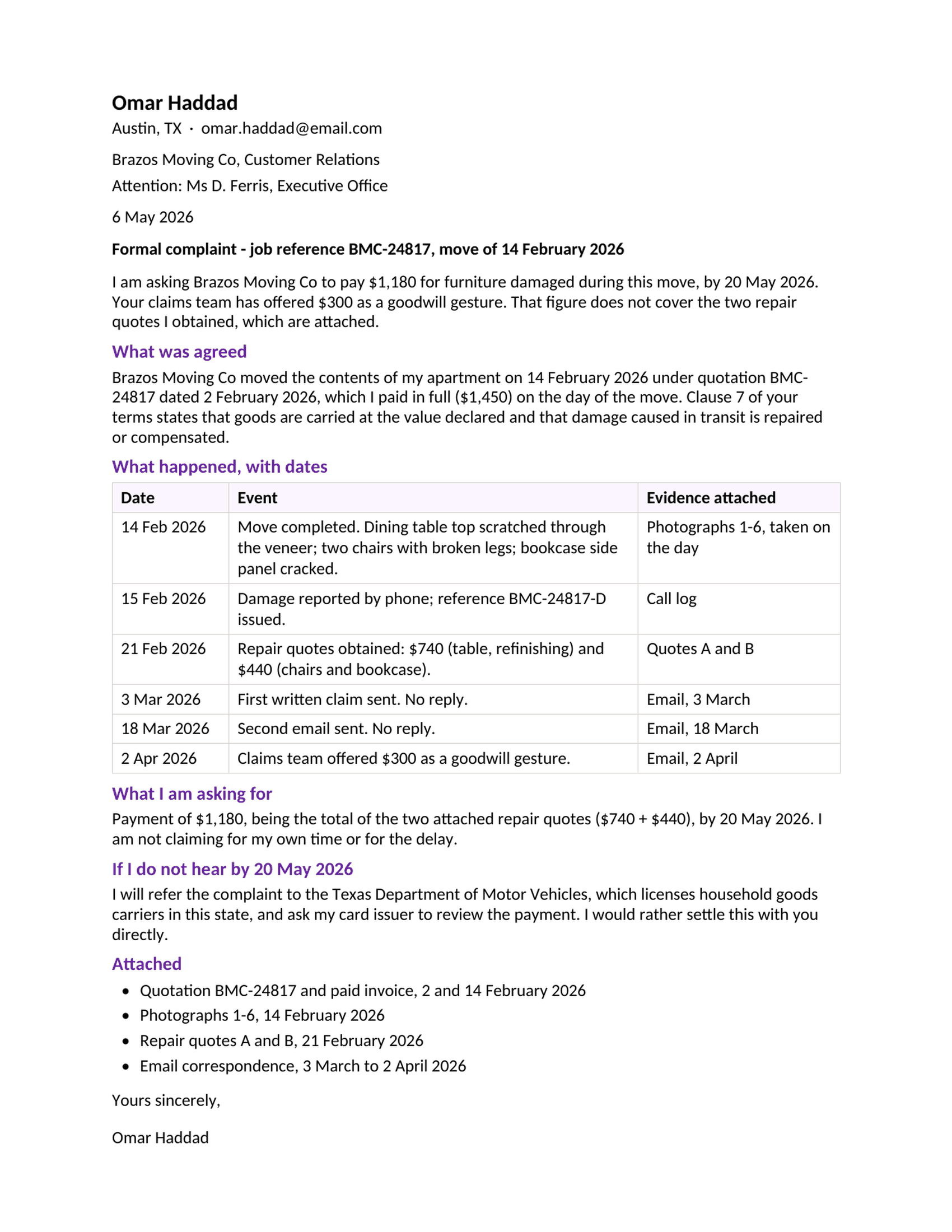
Formal complaint — Brazos Moving Co

Sent to the executive office after the $300 goodwill offer

Formal-Complaint-Brazos-Moving.docx
One page · 6 dated facts

One-page formal complaint letter with the request and deadline first, a dated timeline table, the claim calculation and the list of documents attached
The Word letter built in Claude to prompt 06’s specification.

Rent renewal — $185 a month proposed

Comparables, counter and the trade offered in return

Agreed: $1,800
$1,500 a year saved

UnitMonthly rentDetail
His apartment, renewal offer$1,9252 bed, 940 sq ft, current building
Comparable, same street$1,7602 bed, 910 sq ft, listed 3 weeks
Comparable, two blocks east$1,7952 bed, 950 sq ft, listed 5 weeks
Comparable, same building$1,8202 bed, 940 sq ft, listed 2 weeks
His counter$1,780with a 24-month lease
Agreed$1,800$60 increase; $1,500 a year saved against the proposal

The message, 180 words. One line on four years as a tenant with no late payments; the three listings with their dates; $1,780 named; and a 24-month lease offered in return.

The BATNA, used honestly. Moving would cost about $2,900 and add 20 minutes each way, so no threat to leave was made. The listings carried the argument.

Agreed in writing the same day. $1,800 from 1 September 2026, fixed for 24 months, confirmed by email with the dates and amount spelled out.

620 words at 11:40pm — what it would have cost

Five of the thirteen lines flagged

Recommendation
Do not send

Line in the draftWhat it isWhat it would cost
“I assume nobody there reads email”Sarcasm about the readerMoves the argument from the damage to him
“Your so-called professionals”Insult to the crewForwardable; makes goodwill harder to approve
“I will see you in court over this”A threat he would not carry outClaim files close when litigation is mentioned
“This is the worst company in Texas”Unprovable claimInvites a defence instead of a settlement
“$300 is an insult and you know it”Attacks the offer, not its shortfallSays nothing the reader can act on

What he actually wanted. $1,180. The draft wanted to be right, which the reader could not grant.

The 24-hour test. Would I read this aloud to them; would I mind their manager reading it; is any part irreversible. The draft failed all three.

Decision: do not send. The money is a claim, not an argument. He made the claim with prompt 06 instead, and recovered $950.

Prompt output, formatted for this page. In other AI tools the prompts return the same content as text; the figures come from whatever you paste in. Omar Haddad and the companies named are fictional, so every number here is ours to show you.

Pack 13 · Writing & Communication

Ten prompt templates, one running brief

  • Everyday emails that get a reply, chasing, scheduling and cancelling
  • Asking for favours, references and introductions, and questions for professionals
  • Complaints and refunds, with the formal letter built in Word in Claude
  • Saying no, negotiating a bill or rent, the angry draft, and apologies
  • Text file and formatted PDF · ChatGPT, Claude and Gemini · best in Claude

$15

One-time purchase · instant download

Get the pack

* Omar Haddad, Brazos Moving Co, the people named and all figures on this page are fictional and used for illustration only. Output depends on the information you supply and the AI tool you use. Consumer, tenancy and employment rights and time limits differ by country and state; nothing here is legal advice.

More Prompts for Life

Nine packs for everyday life, from career and money to travel and health, each written to the same standard with its own worked example.

See all Prompts for Life
Back to The Prompt Library