Value the most common deals
Stock, sale, acquisition, buyout, SaaS company or startup round: choose from 8 deal types, and the DCF model generator uses the methods that deal calls for.
DCF model generator · built for Claude · live Excel model
12 of 12 quality checks passedAutomate your company valuation. Choose the type of deal and who will read the result, then paste the financials. The AI valuation model generator cleans up the earnings, builds three forecast cases, values the business with more than one method and checks every number. In Claude, you get a working Excel valuation model with live formulas and a short memo with the answer on page one.
One-time price · instant download · no subscription
Free guide: How to value a company with a DCF, step by step
“Calder Packaging, $310M revenue, $40M EBITDA. The seller wants 10.0x. Our hurdle is a 20% IRR.”
A live Excel model and a 2-page memo
 See all 6 examples

Why it works
Four things the AI valuation model generator does for every deal, from a listed share to a buyout.
Stock, sale, acquisition, buyout, SaaS company or startup round: choose from 8 deal types, and the DCF model generator uses the methods that deal calls for.
Every calculation is a live formula, with a Checks sheet and a case selector, so you can change one input and watch the value move.
DCF, comparable companies, precedent deals and LBO returns sit together on one football field chart, with the price drawn across them.
The Excel valuation model generator uses only your figures, flags anything missing and runs 13 checks before the files are built.
AI valuation model examples
Each tab shows one real run of the AI valuation model generator: the input, the 8 steps and images of the finished Excel model and memo. Click a tab to switch deal.
A private equity fund wants to buy a packaging company, but the seller’s price may be too high for the fund’s target return.
What the deal team typed
How the AI valuation model generator valued this deal
Step 1 of 8
Two quick answers, then a short summary for you to confirm.
AI valuation model generator
Why it matters: the question is not what Calder is worth in general, but what price lets the fund earn 20% a year.
Step 2 of 8
Each type of deal is valued differently. The method is agreed before any number is calculated.
AI valuation model generator
Why it matters: of the three, only the price paid today is in the committee’s control.
Step 3 of 8
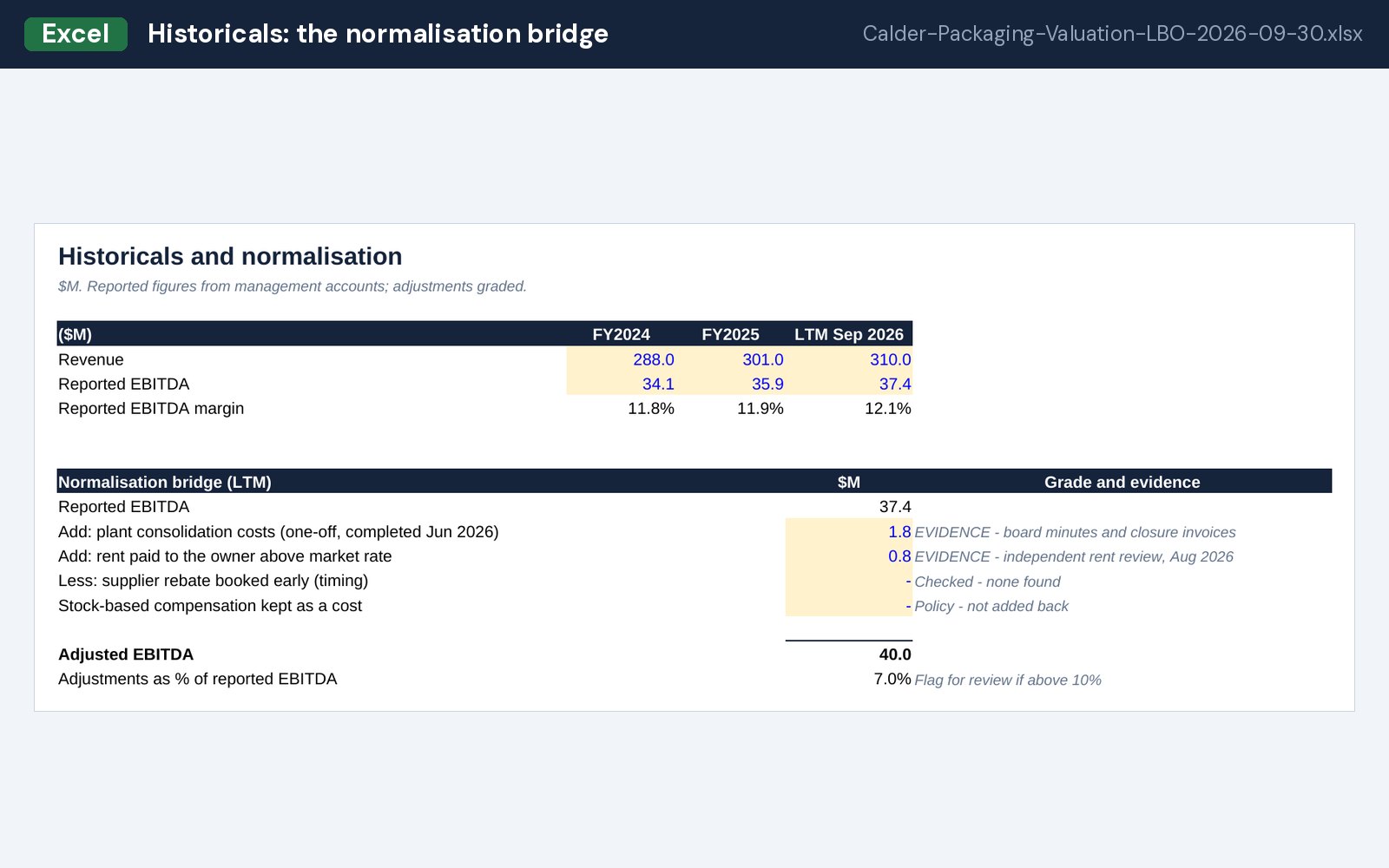
One-off costs come out; costs that come back every year stay in.
AI valuation model generator
The adjustments are 7% of reported earnings, below the 10% level that usually draws questions from lenders.
Why it matters: at 10.0 times earnings, every $1M of earnings adds $10M to the price, so each adjustment needs evidence.
Step 4 of 8
A low, a middle and a high case, each built from named business drivers.
AI valuation model generator
Middle case, year 5: earnings of $54.3M. Shall I use the middle case?
Why it matters: the committee approves the business plan before any value is calculated.
Step 5 of 8
Every calculation is shown, so you can follow it line by line.
AI valuation model generator
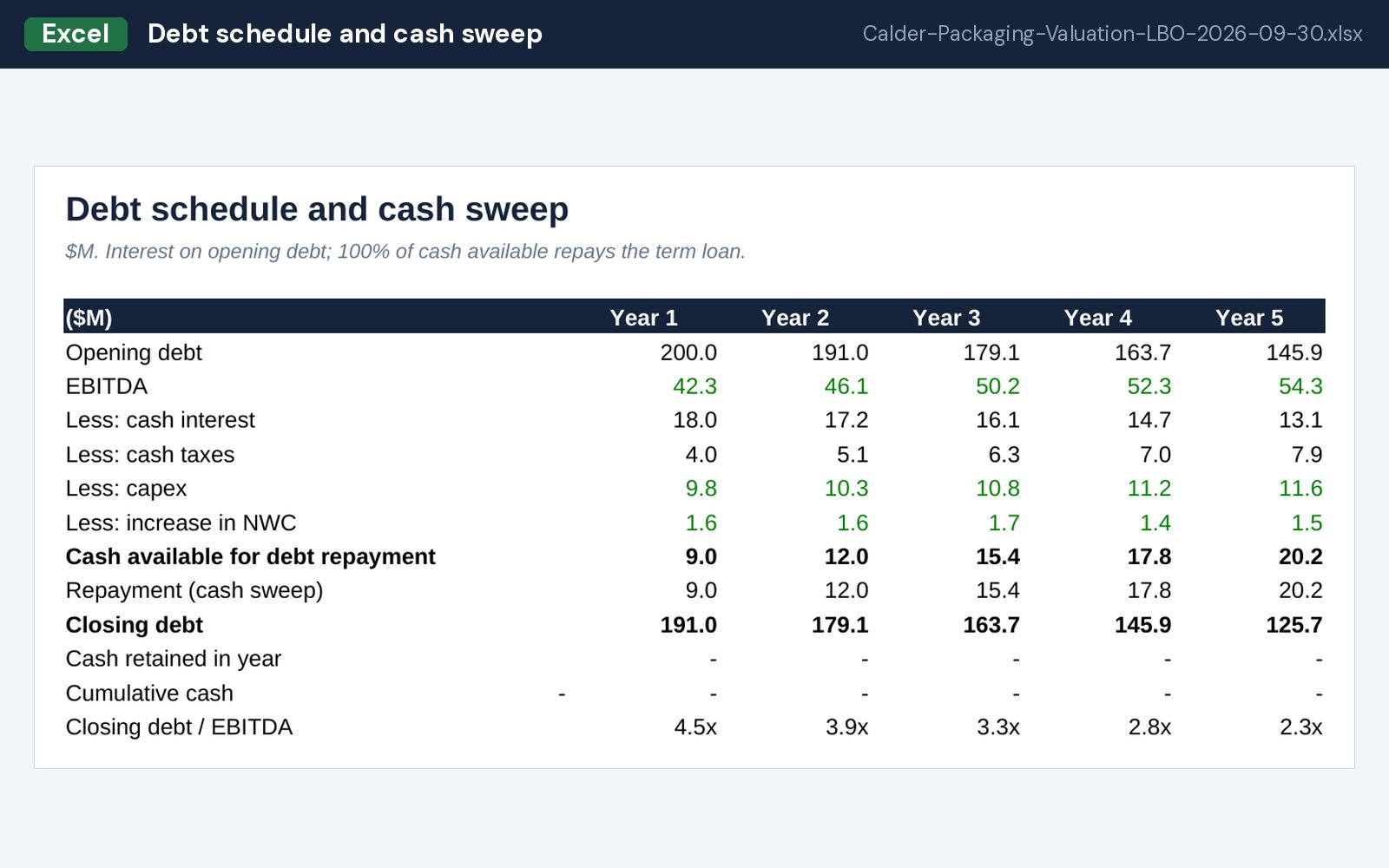
Sale in year 5 at 10.0 times earnings: $543.4M, minus $125.7M of debt still owed = $417.7M.
Why it matters: even if everything goes to plan, the asking price misses the target by 5.5 points.
Step 6 of 8
One chart puts every method side by side, with the price drawn across it.
AI valuation model generator
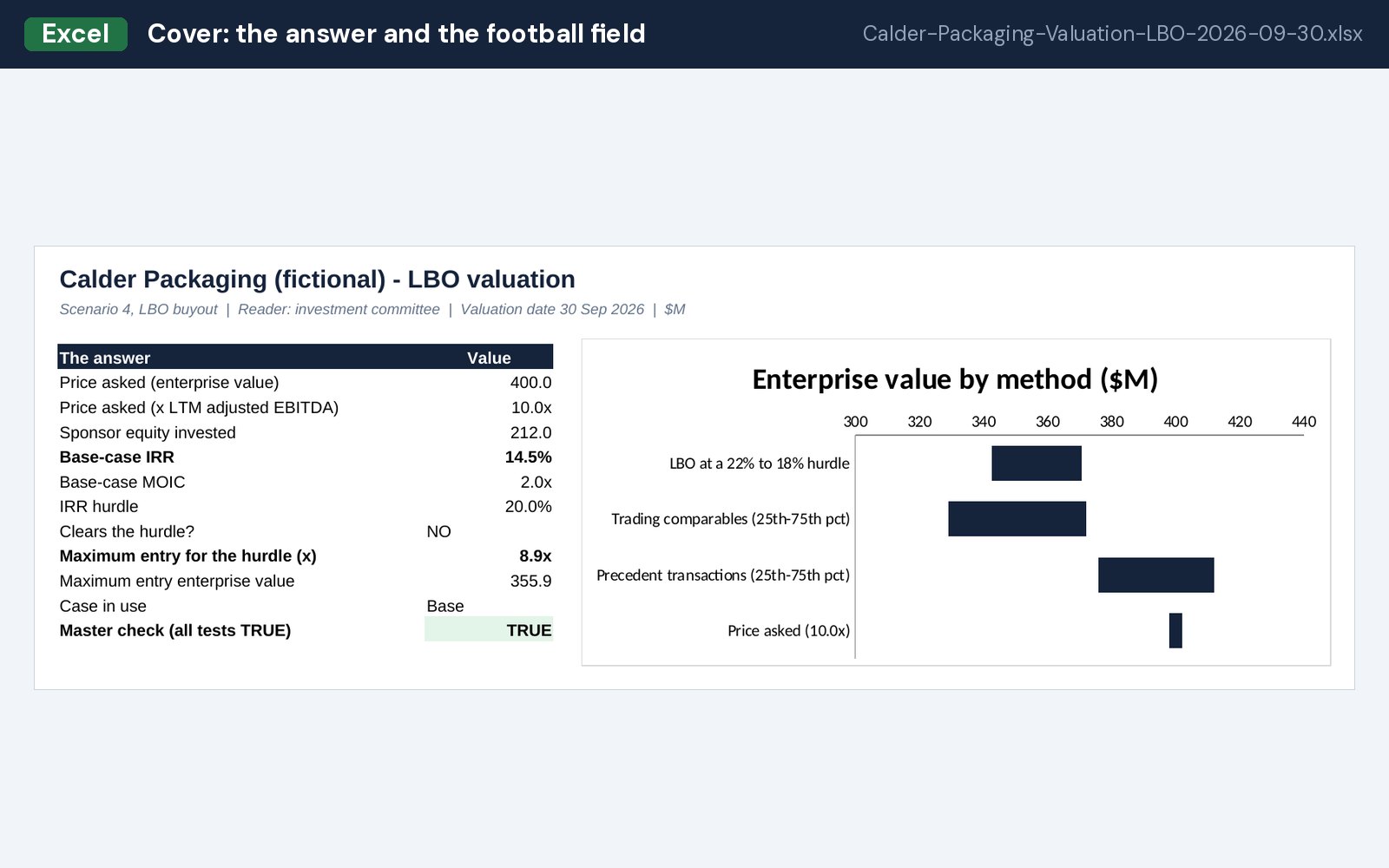
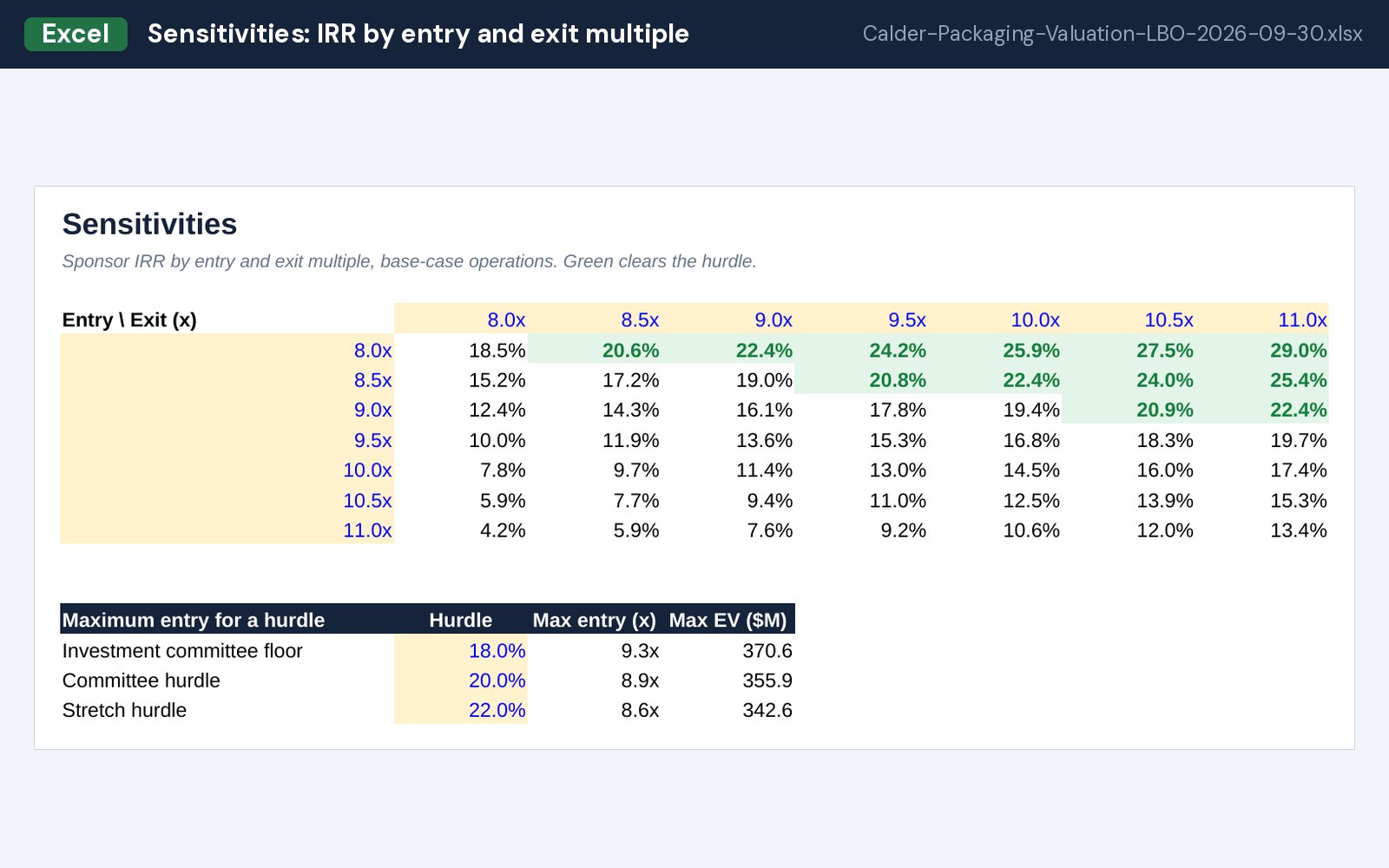
The fund earns 20% only at 8.9 times earnings, $356M or less. At $400M, Calder would have to sell for 12.0 times earnings, or earn $65.3M in year 5.
Why it matters: the most the fund can pay and still earn 20% is $356M, $44M below the seller’s price.
Step 7 of 8
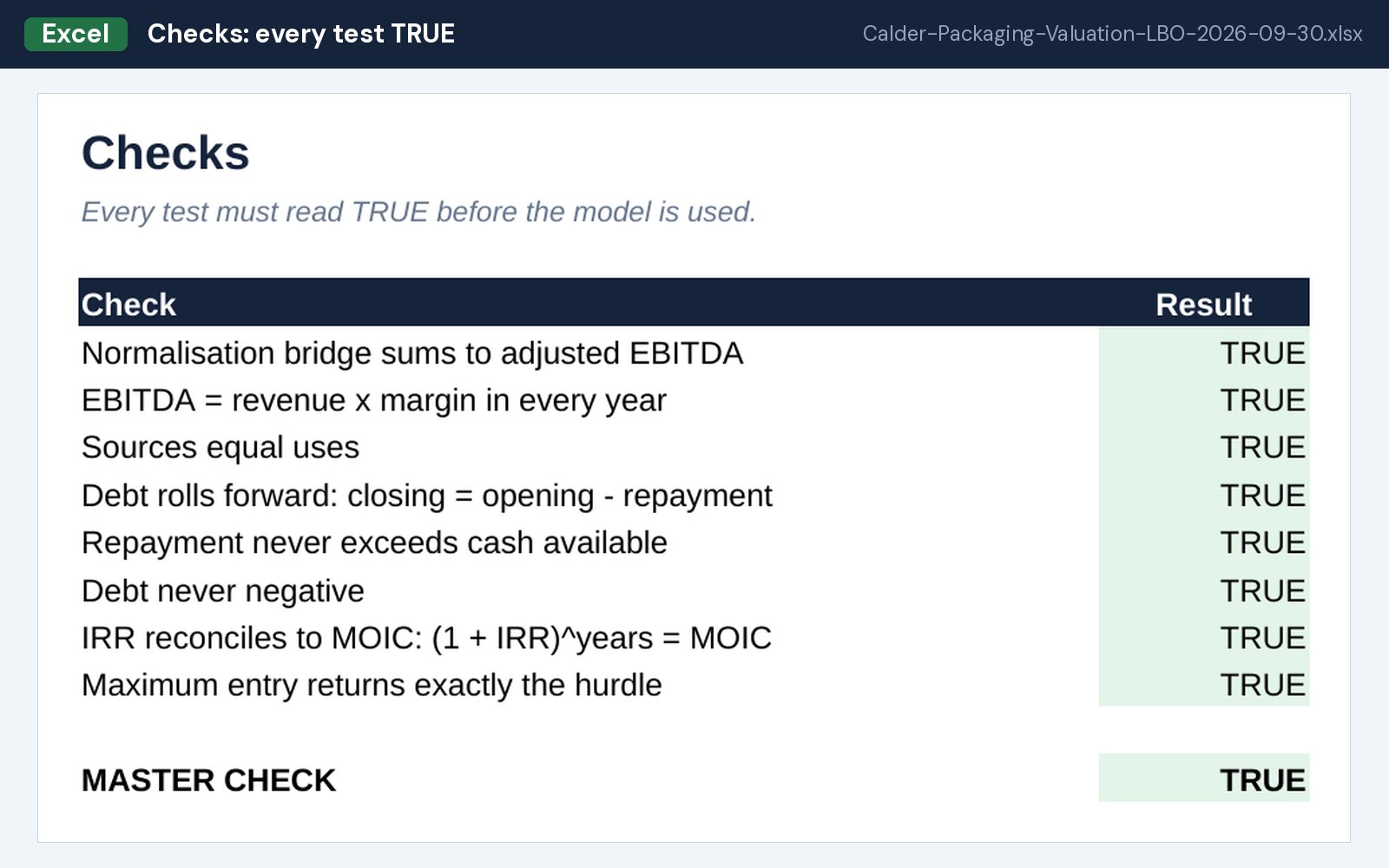
Thirteen checks, plus a Checks sheet in the Excel model that must read TRUE.
AI valuation model generator
Master check on the cover of the Excel model: TRUE
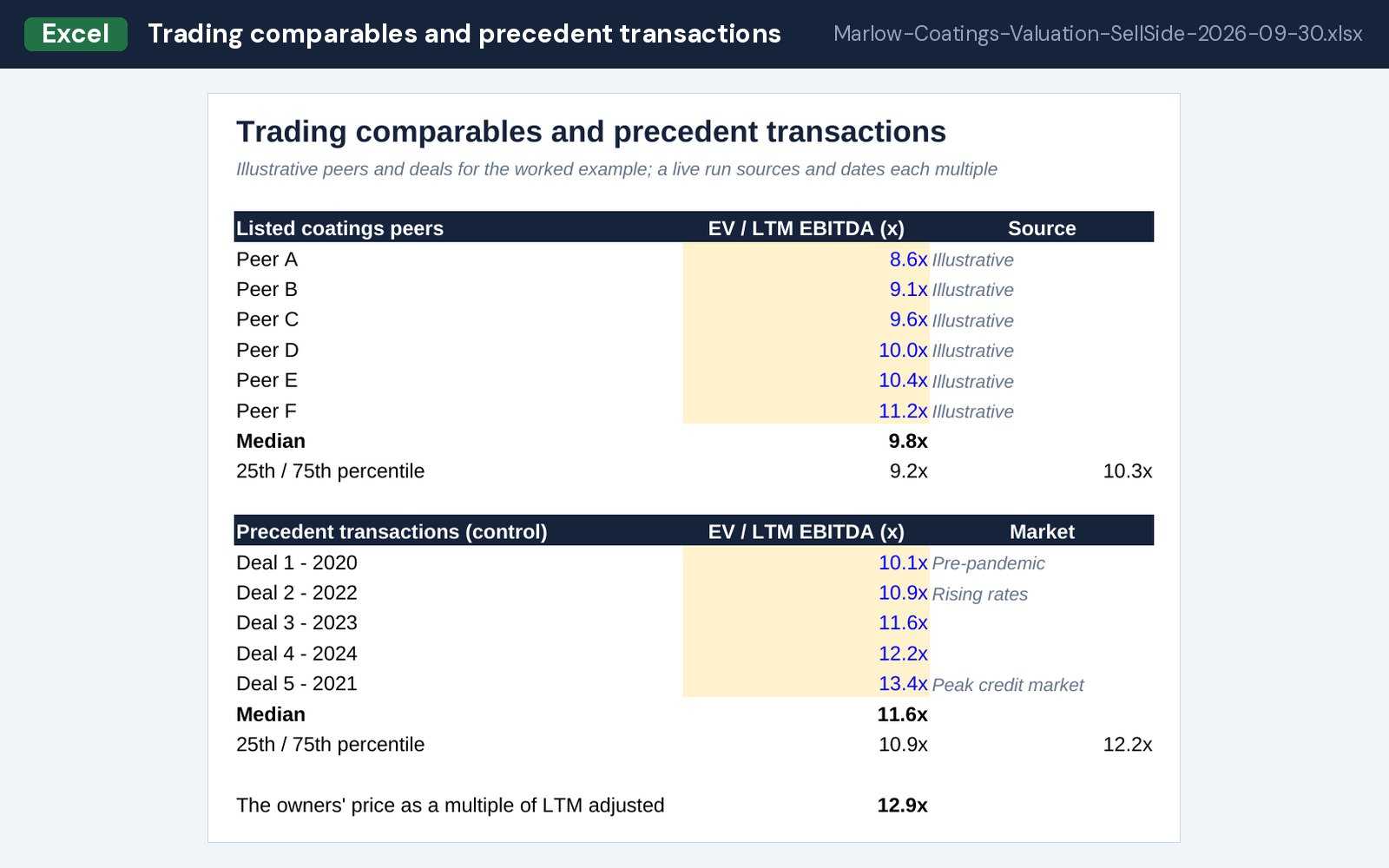
Flagged: the listed-company and deal multiples on this page are illustrations. A live run sources and dates each one.
Why it matters: the committee can change the price in one cell and trust the return to move with it.
Step 8 of 8
A live Excel model and a 2-page Word memo with the answer on page one.
AI valuation model generator
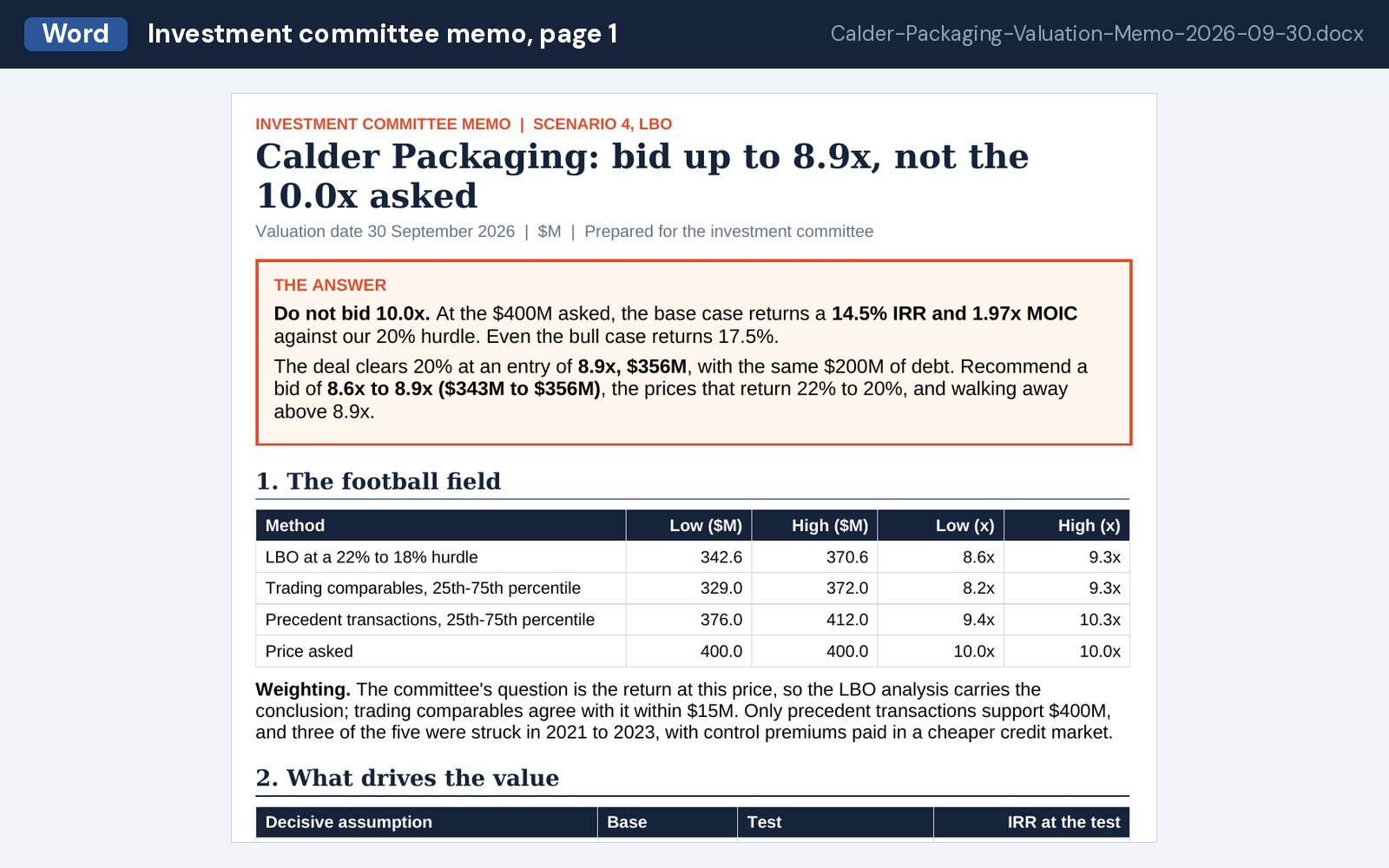
The answer: bid 8.6x–8.9x earnings ($343M–$356M), and walk away above 8.9x.
Next: paste the memo into the AI PowerPoint generator for the committee presentation.
Why it matters: the fund negotiates with a number the seller has to justify.
The finished Excel model and memo
Images of the real Excel and Word files from this run. Click a title, or swipe through them.
Investment committee memo, page 1
An investor wants to know whether a $48 share price is justified by the company’s own cash flows.
What the investor typed
How the AI valuation model generator valued this deal
Step 1 of 8
Two quick answers, then a short summary for you to confirm.
AI valuation model generator
Why it matters: a value below $48 means the market expects more than the filings show, and the memo says how much more.
Step 2 of 8
Each type of deal is valued differently. The method is agreed before any number is calculated.
AI valuation model generator
Why it matters: the deciding numbers are named first, so the memo can show how much each one moves the value.
Step 3 of 8
One-off costs come out; costs that come back every year stay in.
AI valuation model generator
Why it matters: every dollar added back raises the value per share, so only the one backed by evidence is added.
Step 4 of 8
A low, a middle and a high case, each built from named business drivers.
AI valuation model generator
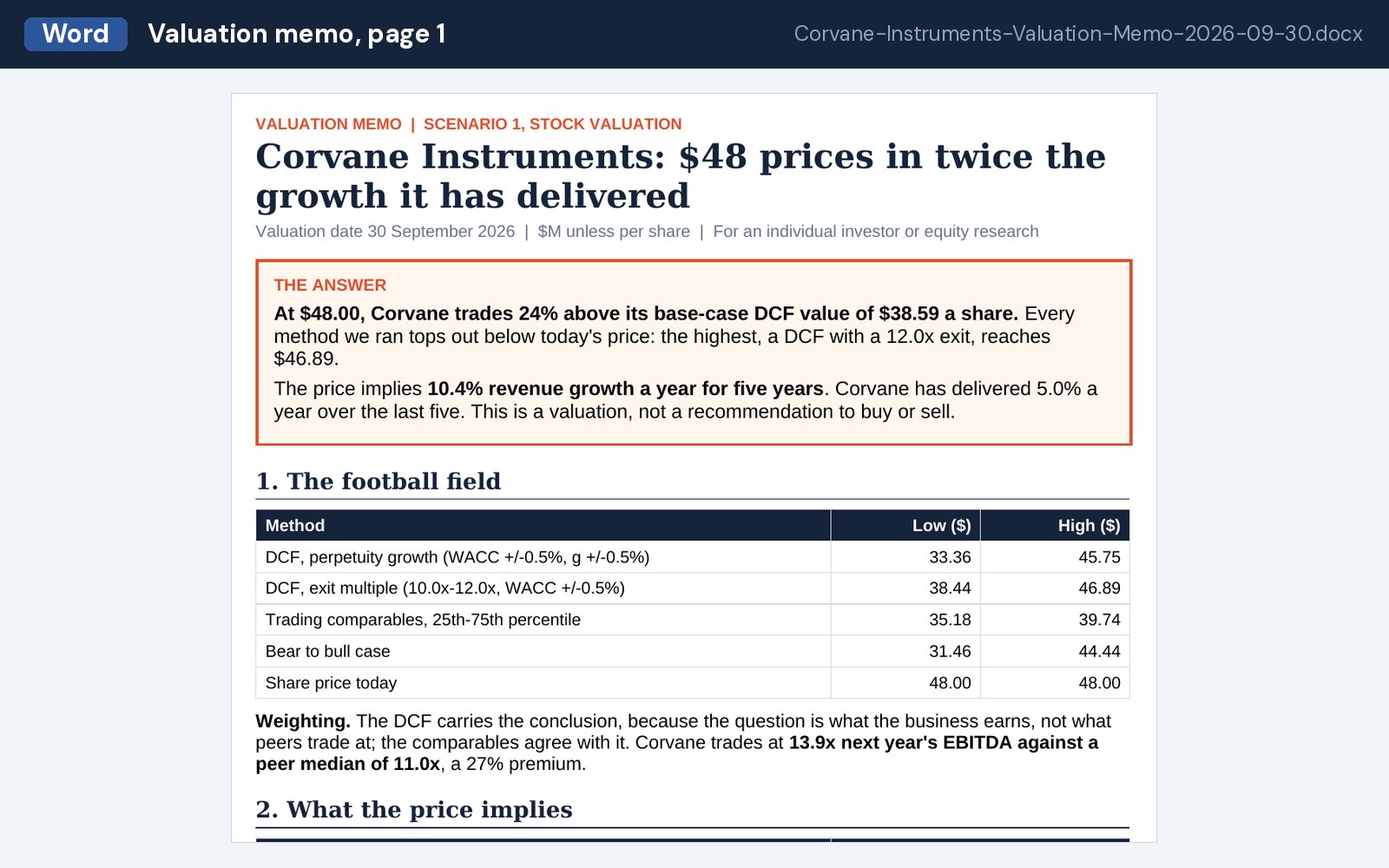
Low and high cases: $31.46 and $44.44 a share. Shall I use the middle case?
Why it matters: even the high case values the share below today’s $48.
Step 5 of 8
Every calculation is shown, so you can follow it line by line.
AI valuation model generator
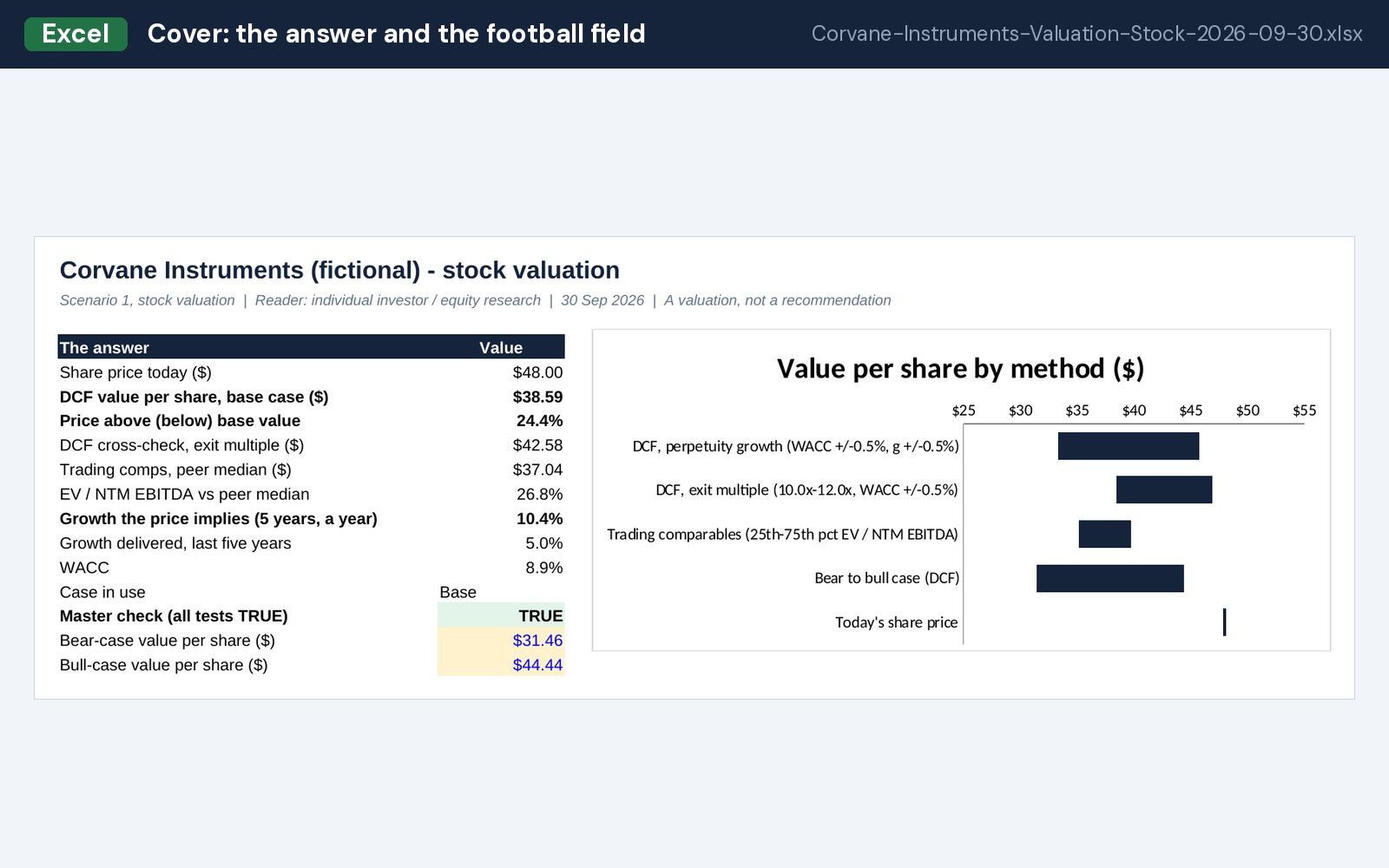
$6,504M − $900M of debt + $300M of cash = $5,904M, divided by 153.0M shares = $38.59. The long-term value is 75% of the total, below the 80% warning level.
Why it matters: the market price is $9.41 a share above the middle-case value.
Step 6 of 8
One chart puts every method side by side, with the price drawn across it.
AI valuation model generator
To be worth $48, Corvane must grow 10.4% a year for five years. It has grown 5.0%. The share trades at 13.9 times next year’s earnings; similar companies trade at 11.0 times.
Why it matters: to be worth $48, Corvane would have to grow twice as fast as it has.
Step 7 of 8
Thirteen checks, plus a Checks sheet in the Excel model that must read TRUE.
AI valuation model generator
Master check on the cover of the Excel model: TRUE
Why it matters: a reader can change growth in one cell and watch the $38.59 move.
Step 8 of 8
A live Excel model and a 2-page Word memo with the answer on page one.
AI valuation model generator
The answer: $48 is 24% above the middle-case value of $38.59. A valuation, never a buy or sell recommendation.
Why it matters: the reader leaves with one question: can Corvane grow 10.4% a year, against a record of 5.0%?
The finished Excel model and memo
Images of the real Excel and Word files from this run. Click a title, or swipe through them.
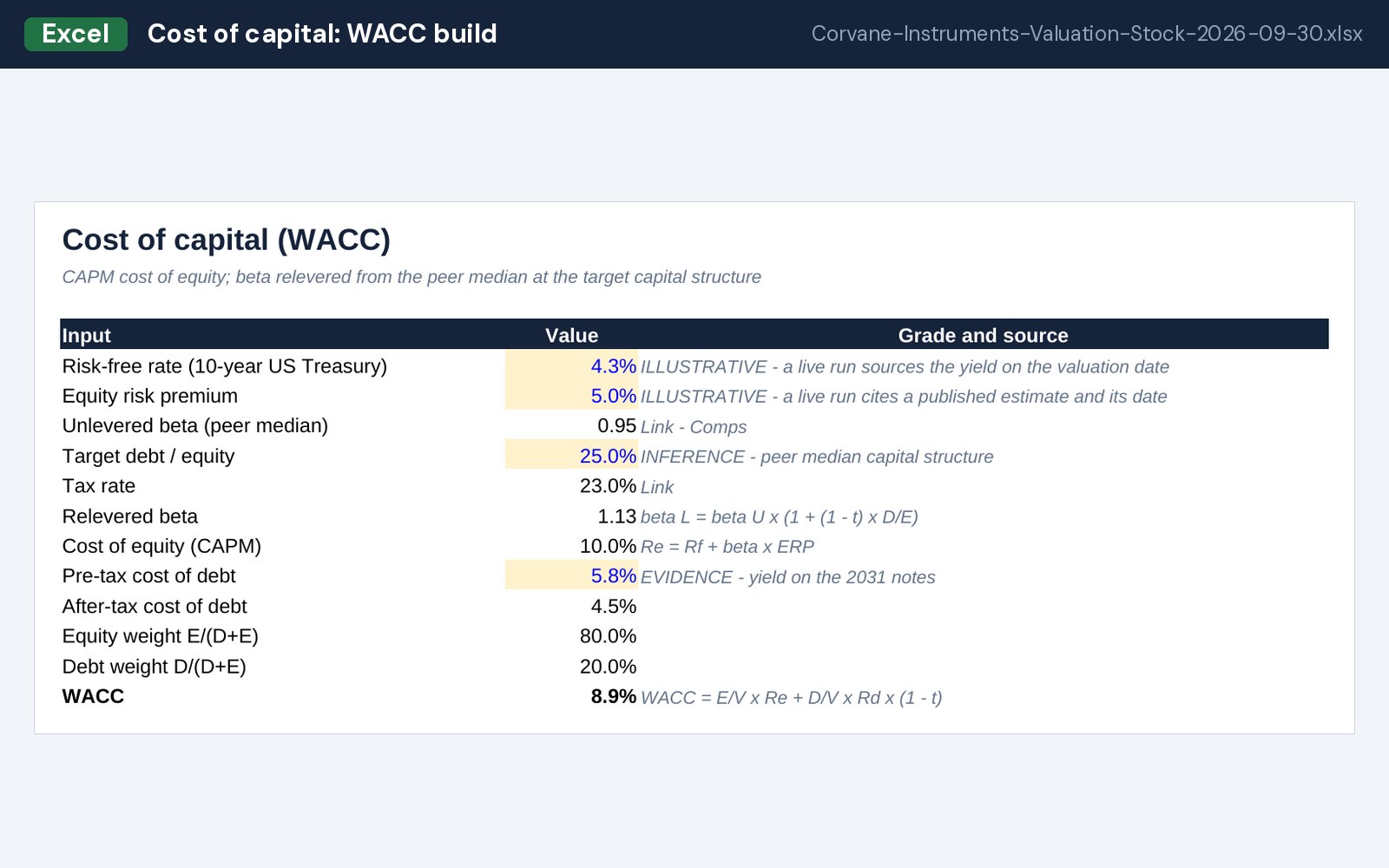
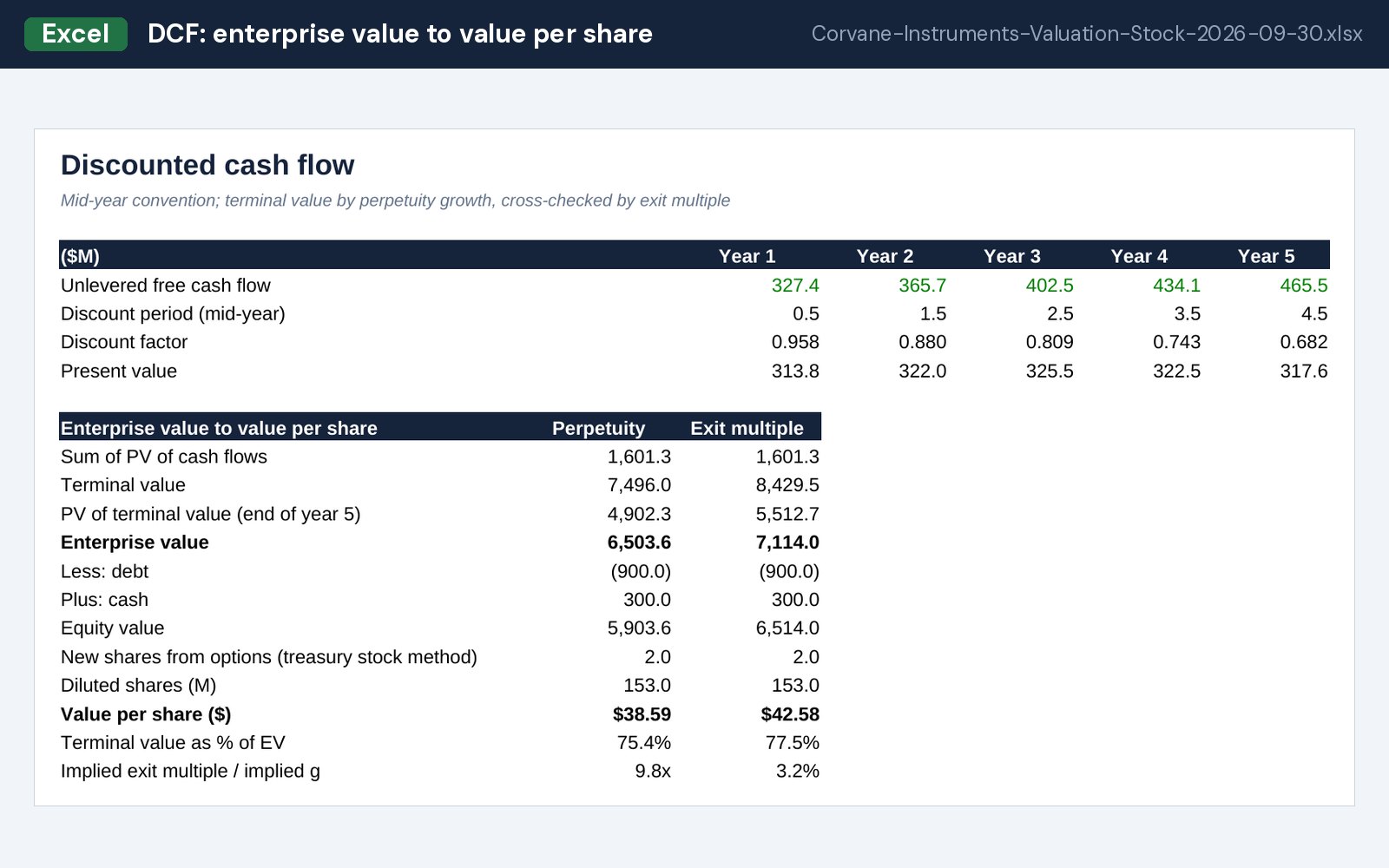
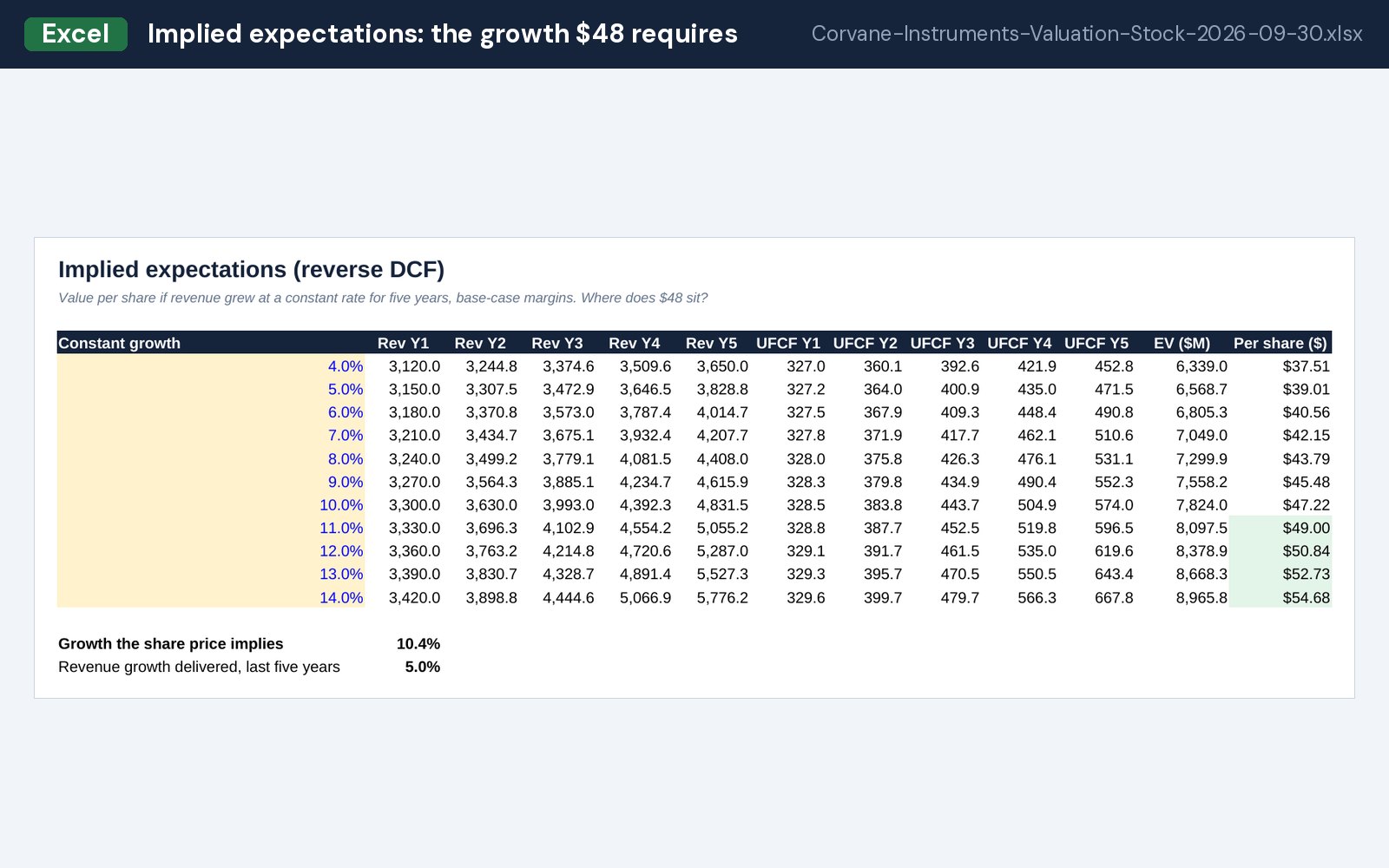
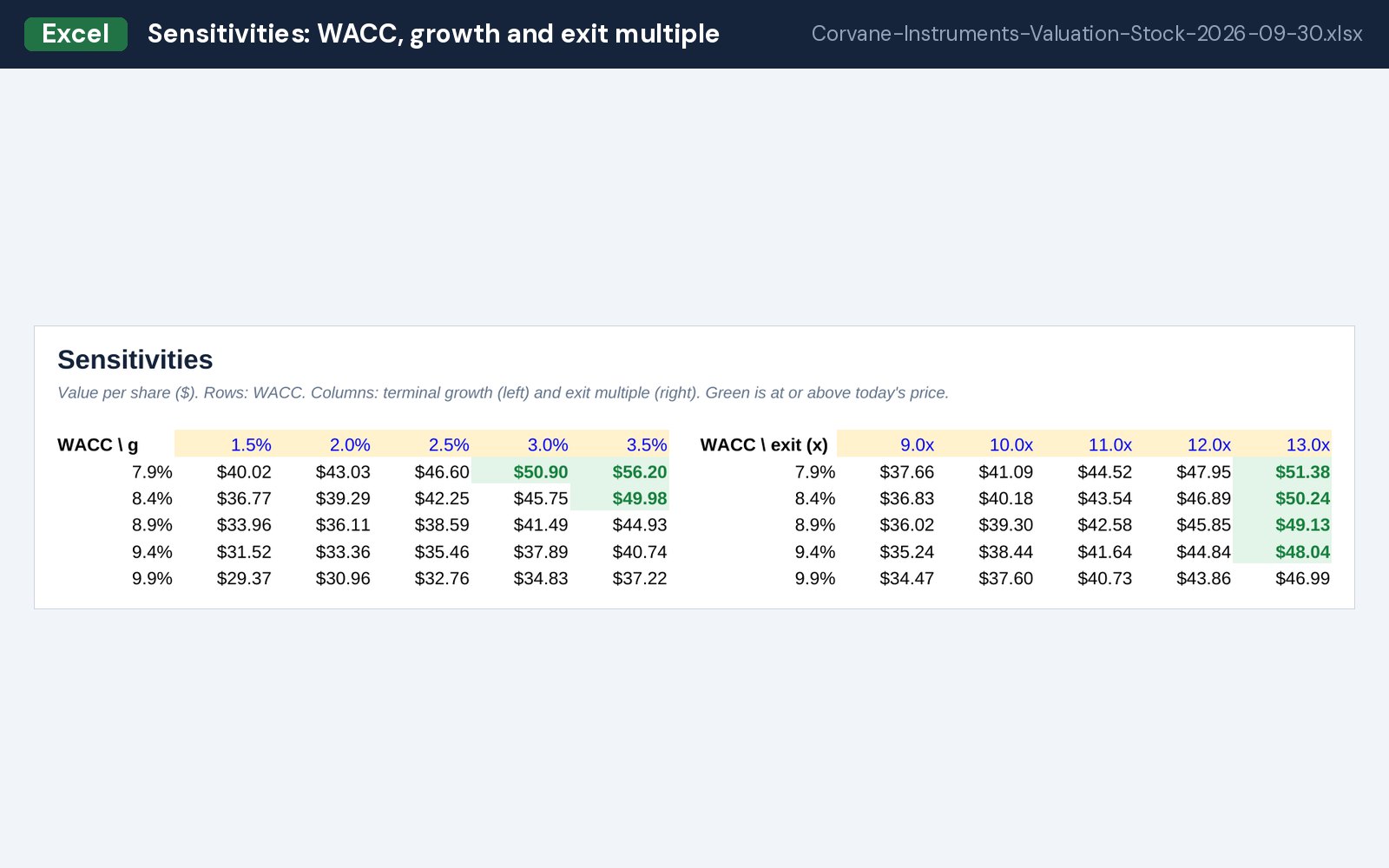
Valuation memo, page 1
A founder wants to raise $4M at a $20M valuation and needs to know whether investors will accept it.
What the founder typed
How the AI valuation model generator valued this deal
Step 1 of 8
Two quick answers, then a short summary for you to confirm.
AI valuation model generator
Why it matters: investors will compare that 33 times with what the growth can support.
Step 2 of 8
Each type of deal is valued differently. The method is agreed before any number is calculated.
AI valuation model generator
Why it matters: the growth path, the sale price and the investors’ target return decide whether $20M stands.
Step 3 of 8
One-off costs come out; costs that come back every year stay in.
AI valuation model generator
Why it matters: every sale value here is a multiple of recurring revenue, so counting one-off fees would inflate the price.
Step 4 of 8
A low, a middle and a high case, each built from named business drivers.
AI valuation model generator
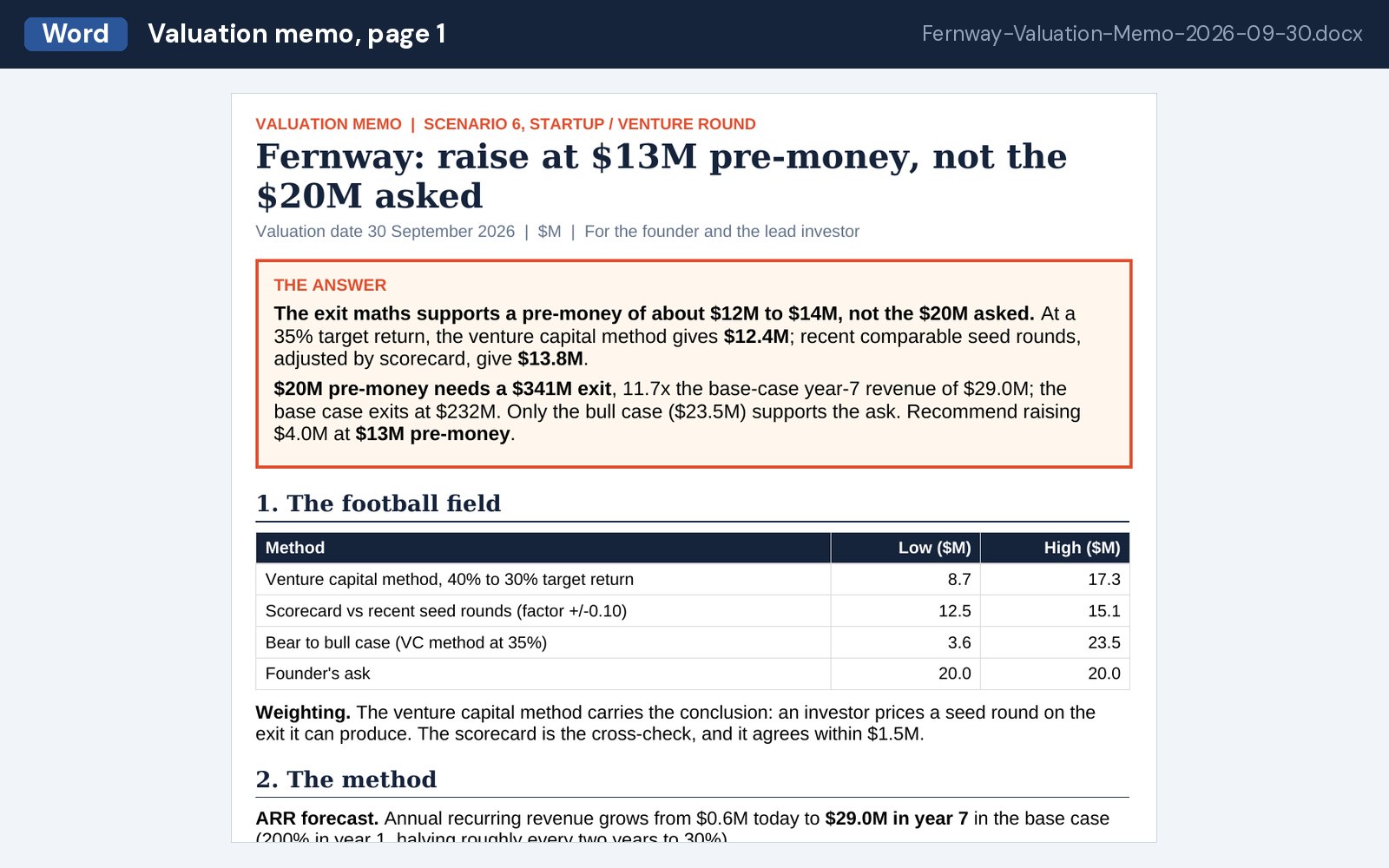
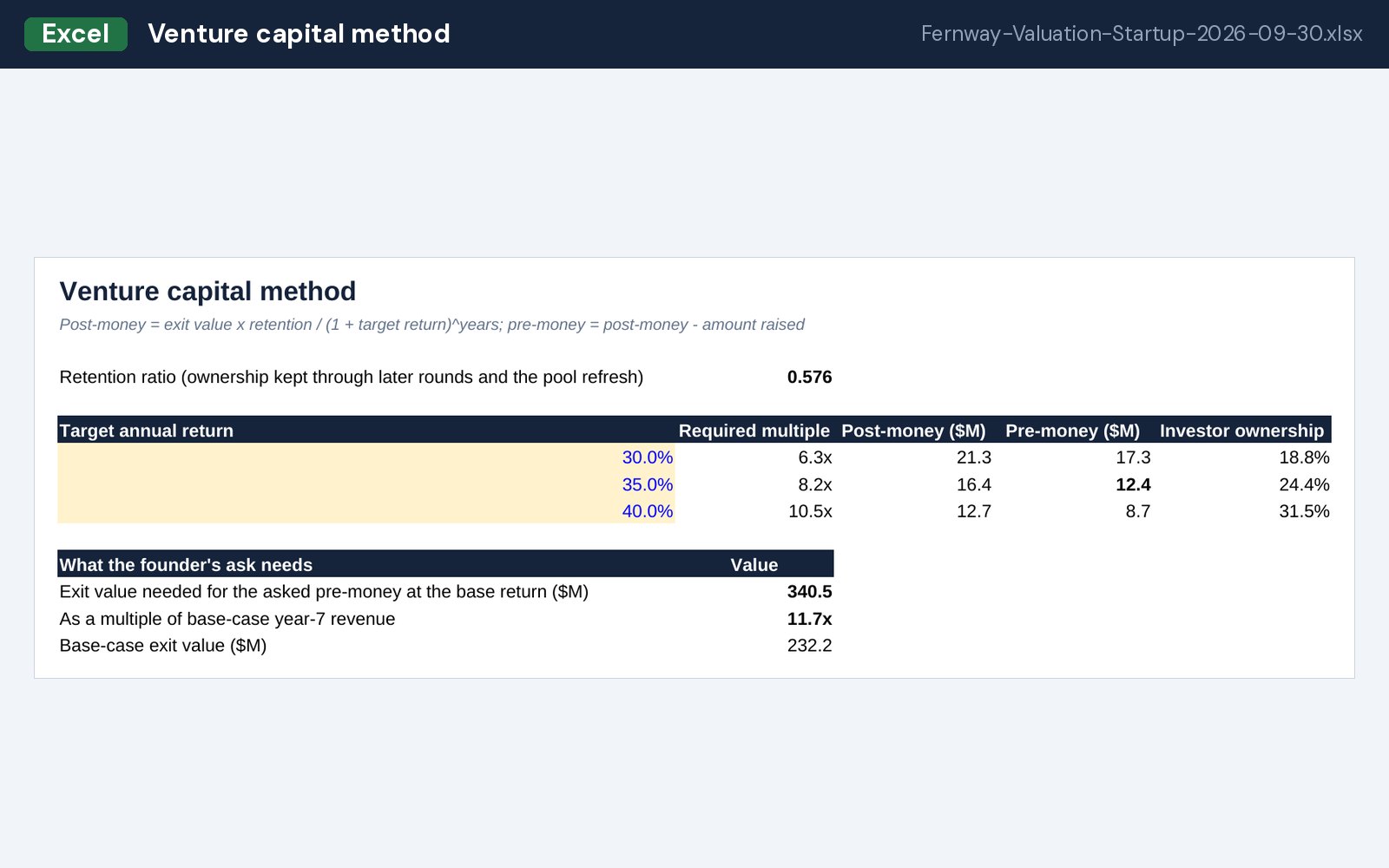
Middle case: a sale in year 7 at 8 times revenue = $232M. Shall I use it?
Why it matters: $232M is the prize the investors’ return is measured against.
Step 5 of 8
Every calculation is shown, so you can follow it line by line.
AI valuation model generator
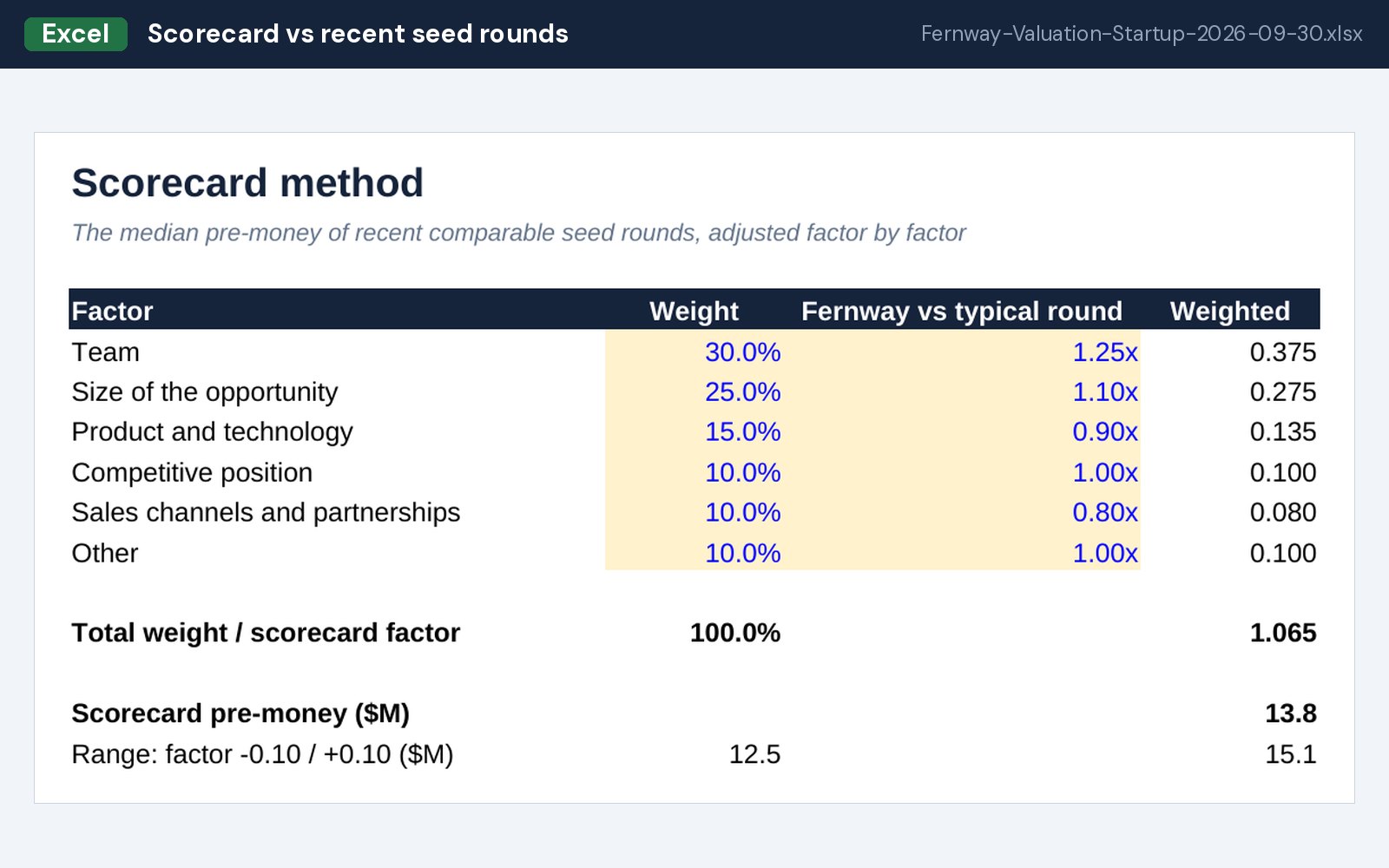
Recent seed rounds of similar companies point to $13.8M.
Why it matters: the middle case supports $12.4M, $7.6M below the founder’s $20M.
Step 6 of 8
One chart puts every method side by side, with the price drawn across it.
AI valuation model generator
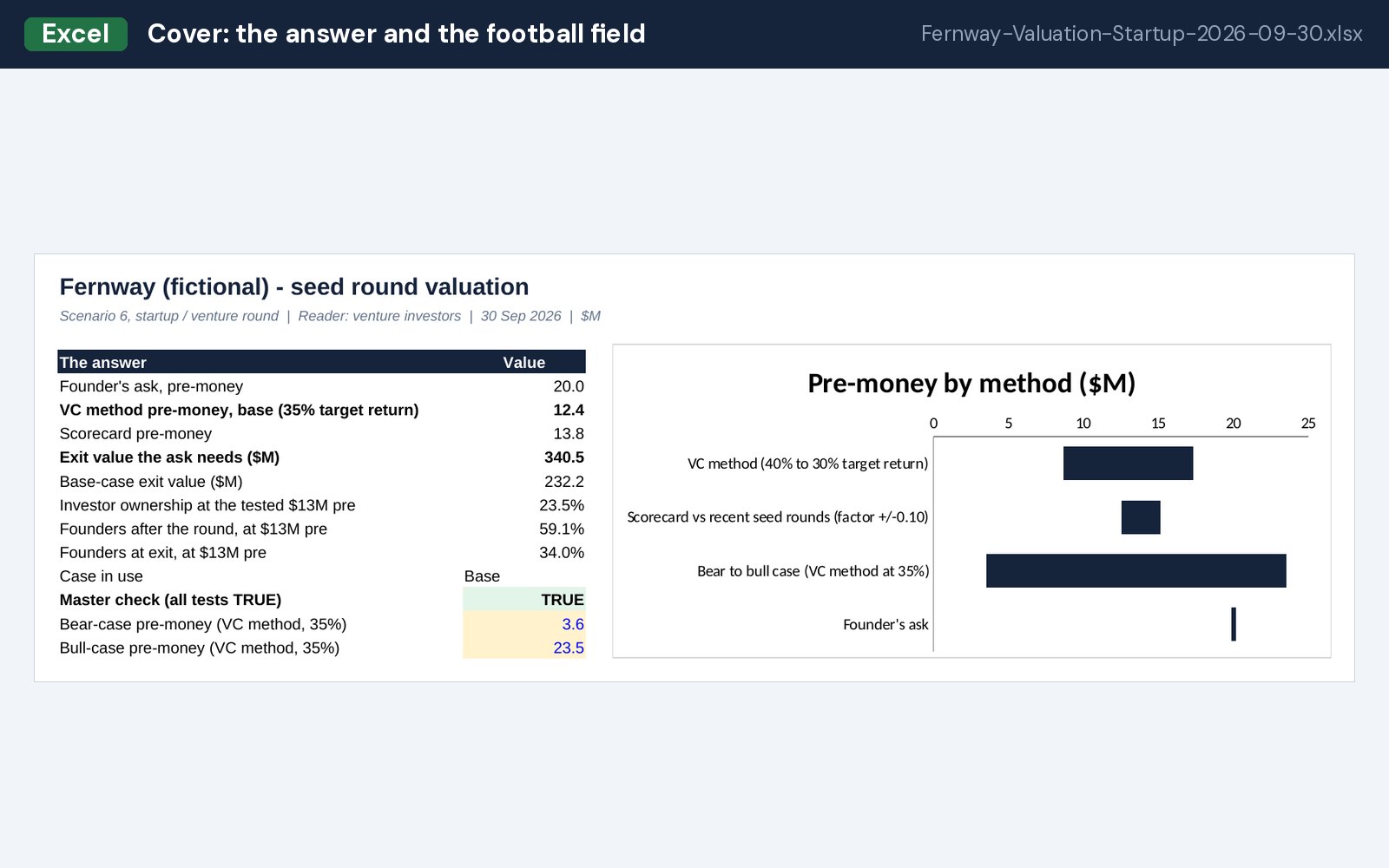
Only the high case reaches $20M. At $20M, Fernway would need to sell for $341M: 11.7 times its year-7 revenue.
Why it matters: the founder priced on the high case; investors price on the middle case.
Step 7 of 8
Thirteen checks, plus a Checks sheet in the Excel model that must read TRUE.
AI valuation model generator
Master check on the cover of the Excel model: TRUE
Why it matters: a founder can test any valuation in one cell and see both ownership stakes move.
Step 8 of 8
A live Excel model and a 2-page Word memo with the answer on page one.
AI valuation model generator
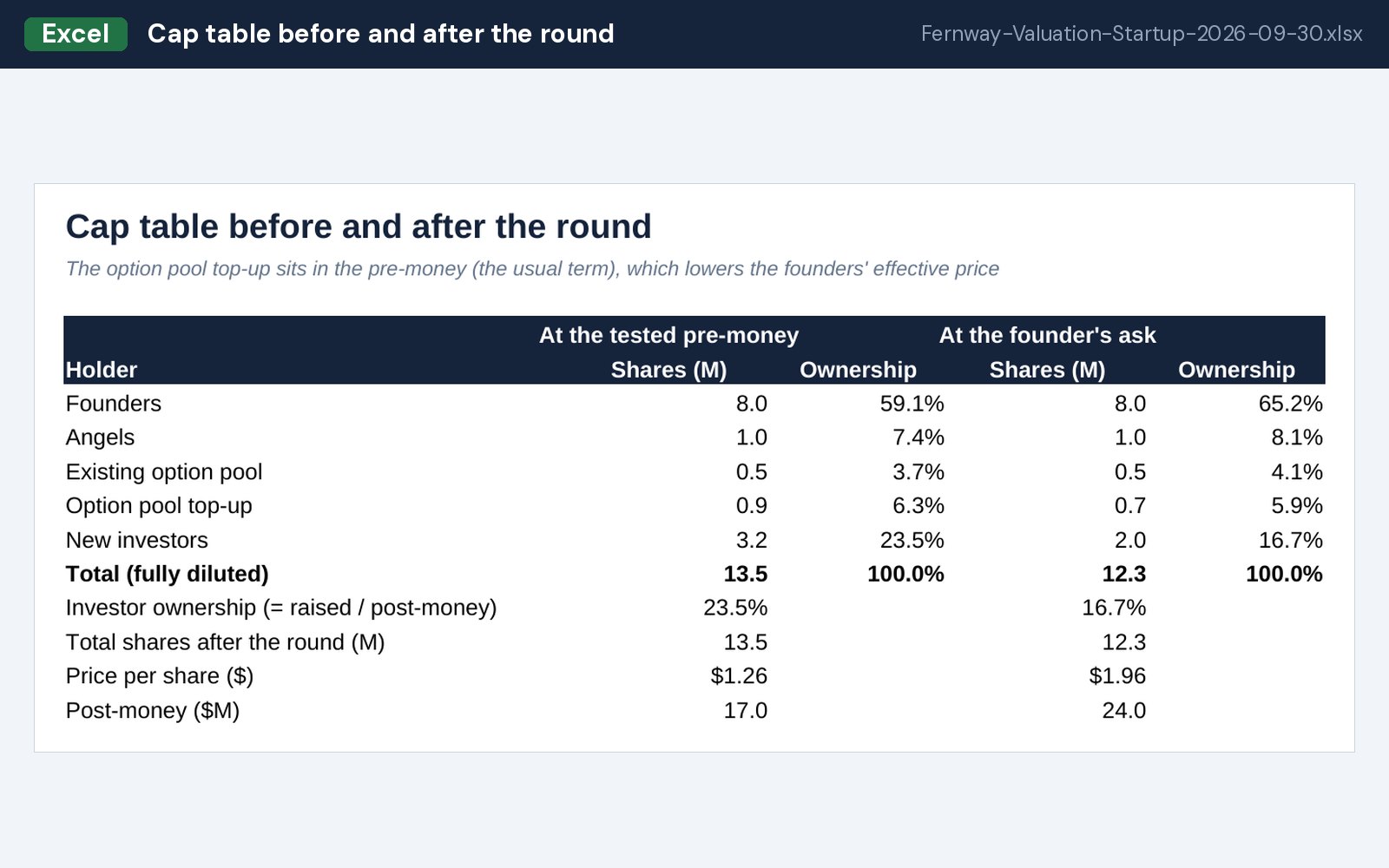
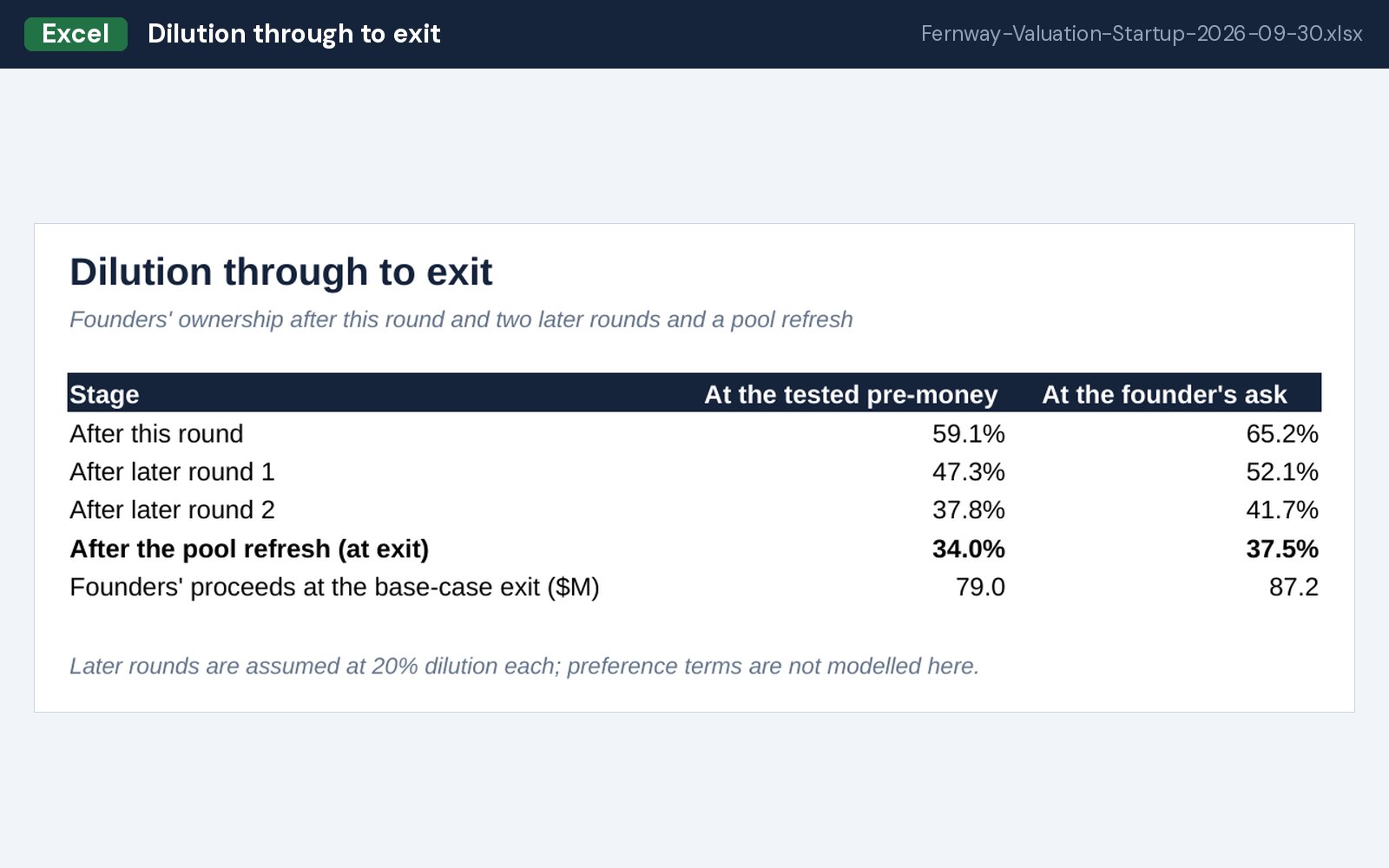
The answer: raise $4M at $13M before the money. Investors own 23.5%, founders 59.1%. At the sale, founders keep 34.0%, against 37.5% at $20M.
Why it matters: pricing at $13M costs the founders 3.5 points at the sale, against a $20M price only the high case supports.
The finished Excel model and memo
Images of the real Excel and Word files from this run. Click a title, or swipe through them.
Valuation memo, page 1
A family wants $1.2B for its company, and its advisers must tell buyers what price to expect.
What the banker typed
How the AI valuation model generator valued this deal
Step 1 of 8
Two quick answers, then a short summary for you to confirm.
AI valuation model generator
Why it matters: the board needs to know which buyers, if any, would pay $1.2B.
Step 2 of 8
Each type of deal is valued differently. The method is agreed before any number is calculated.
AI valuation model generator
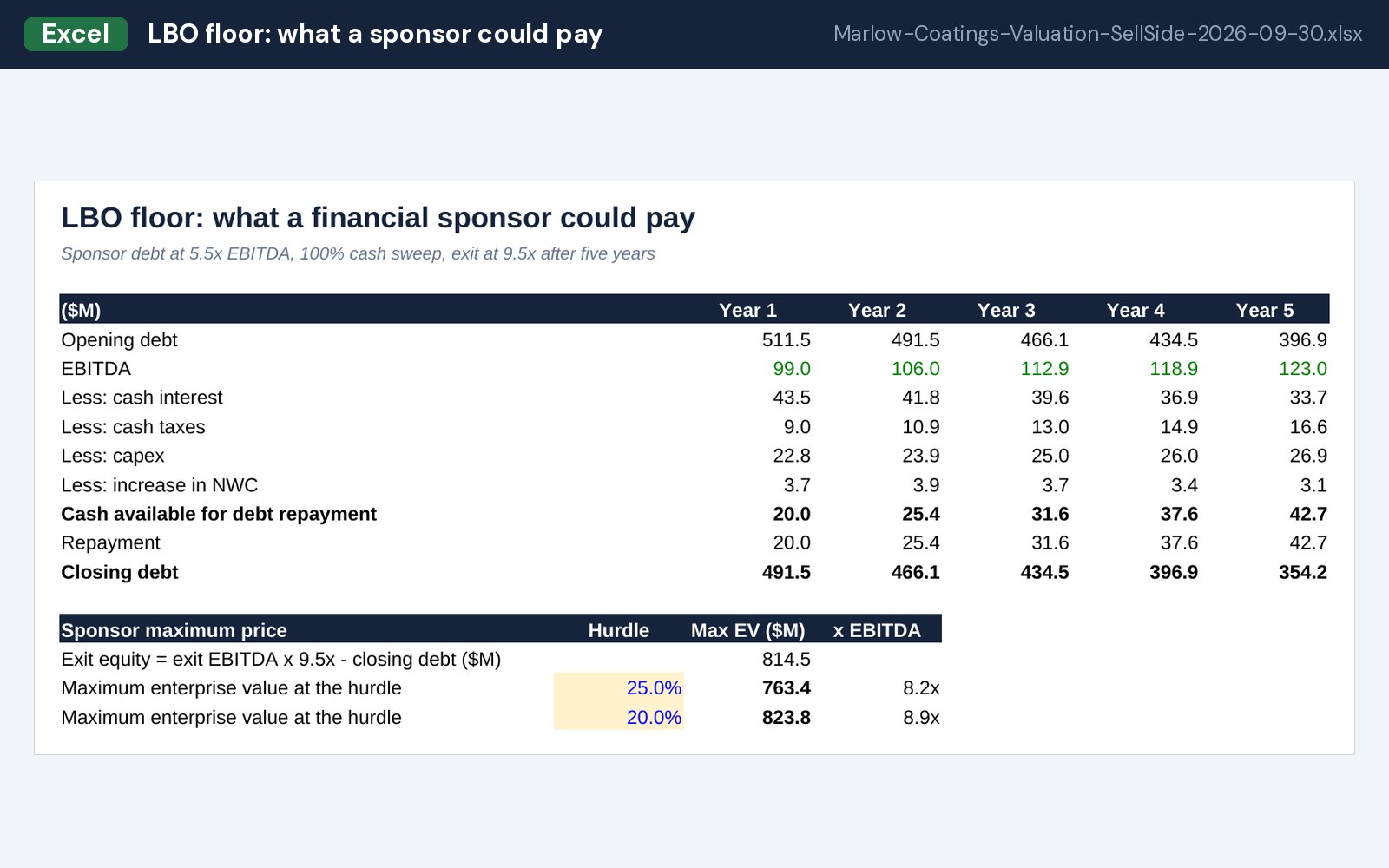
Why it matters: trade buyers price on recent deals and private equity on its target return, so the realistic range sits between them.
Step 3 of 8
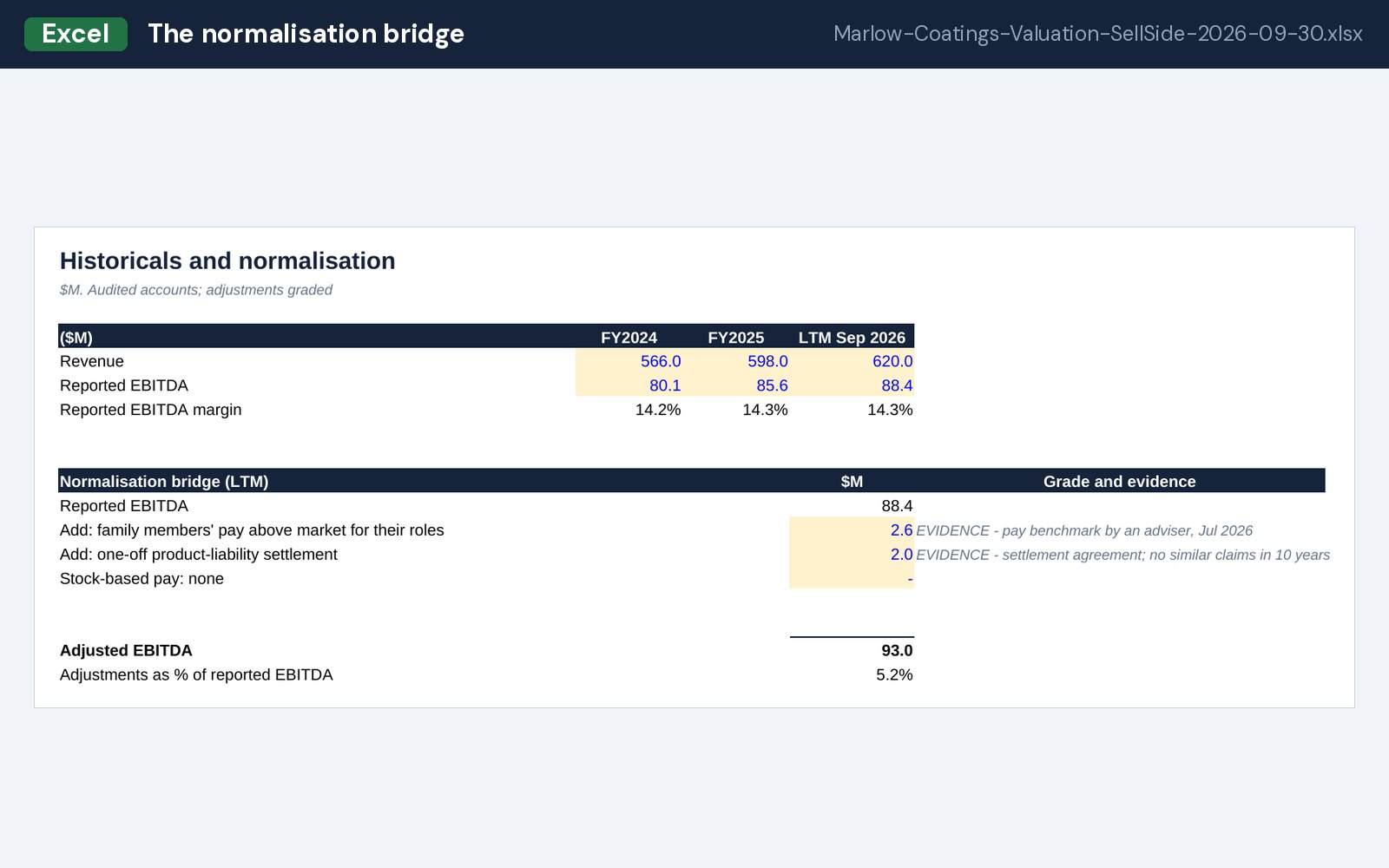
One-off costs come out; costs that come back every year stay in.
AI valuation model generator
The adjustments are 5% of reported earnings, below the 10% level that usually draws questions.
Why it matters: at 12.9 times earnings, the $4.6M of adjustments carries about $59M of the price, so each needs evidence a buyer will accept.
Step 4 of 8
A low, a middle and a high case, each built from named business drivers.
AI valuation model generator
Middle case, year 5: earnings of $123.0M. Shall I use it?
Why it matters: buyers pay for growth only where the contracts behind it are signed.
Step 5 of 8
Every calculation is shown, so you can follow it line by line.
AI valuation model generator
Recent deals include the extra a buyer pays to take control; listed share prices do not.
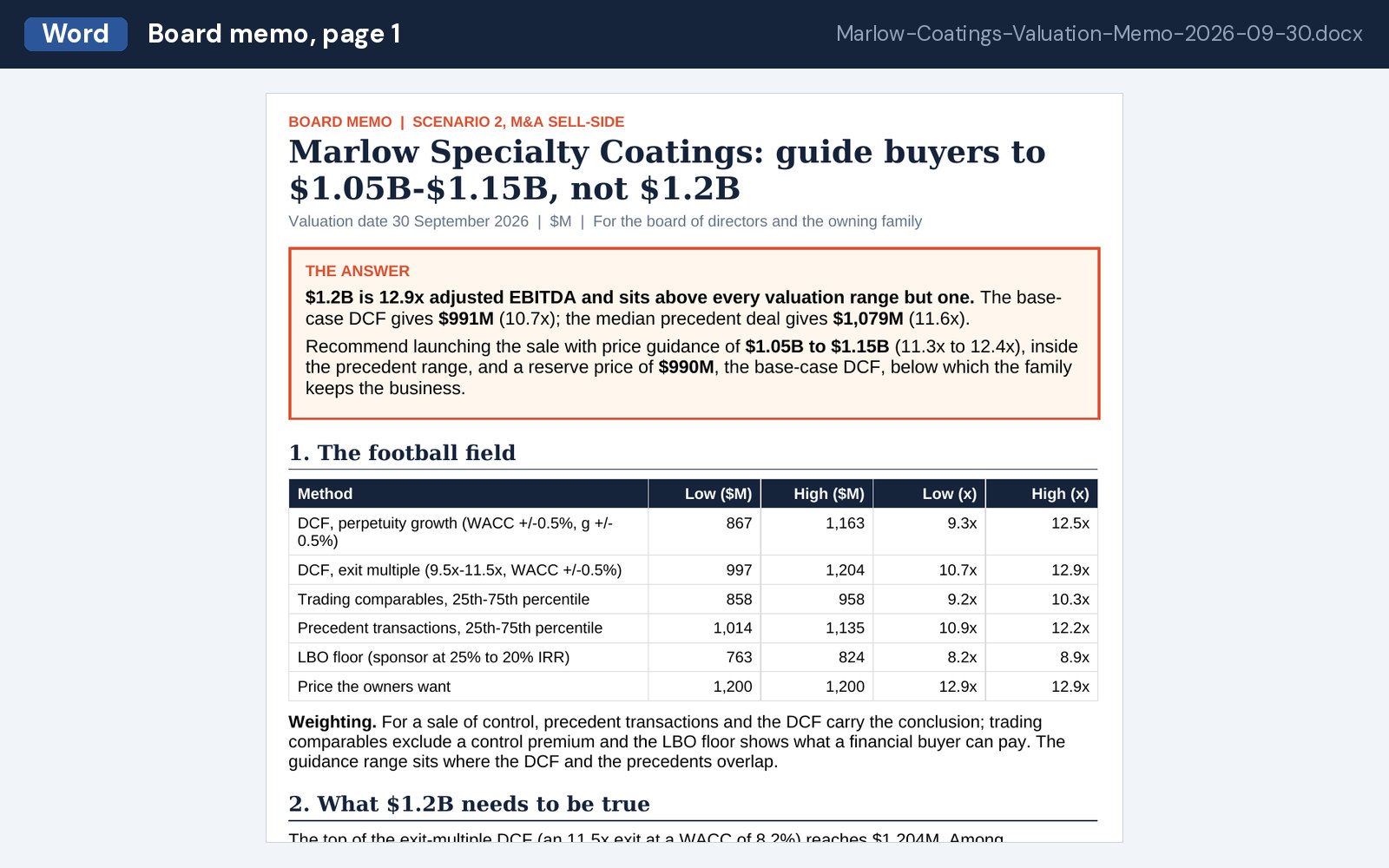
Why it matters: $1.2B is $121M above the typical recent deal.
Step 6 of 8
One chart puts every method side by side, with the price drawn across it.
AI valuation model generator
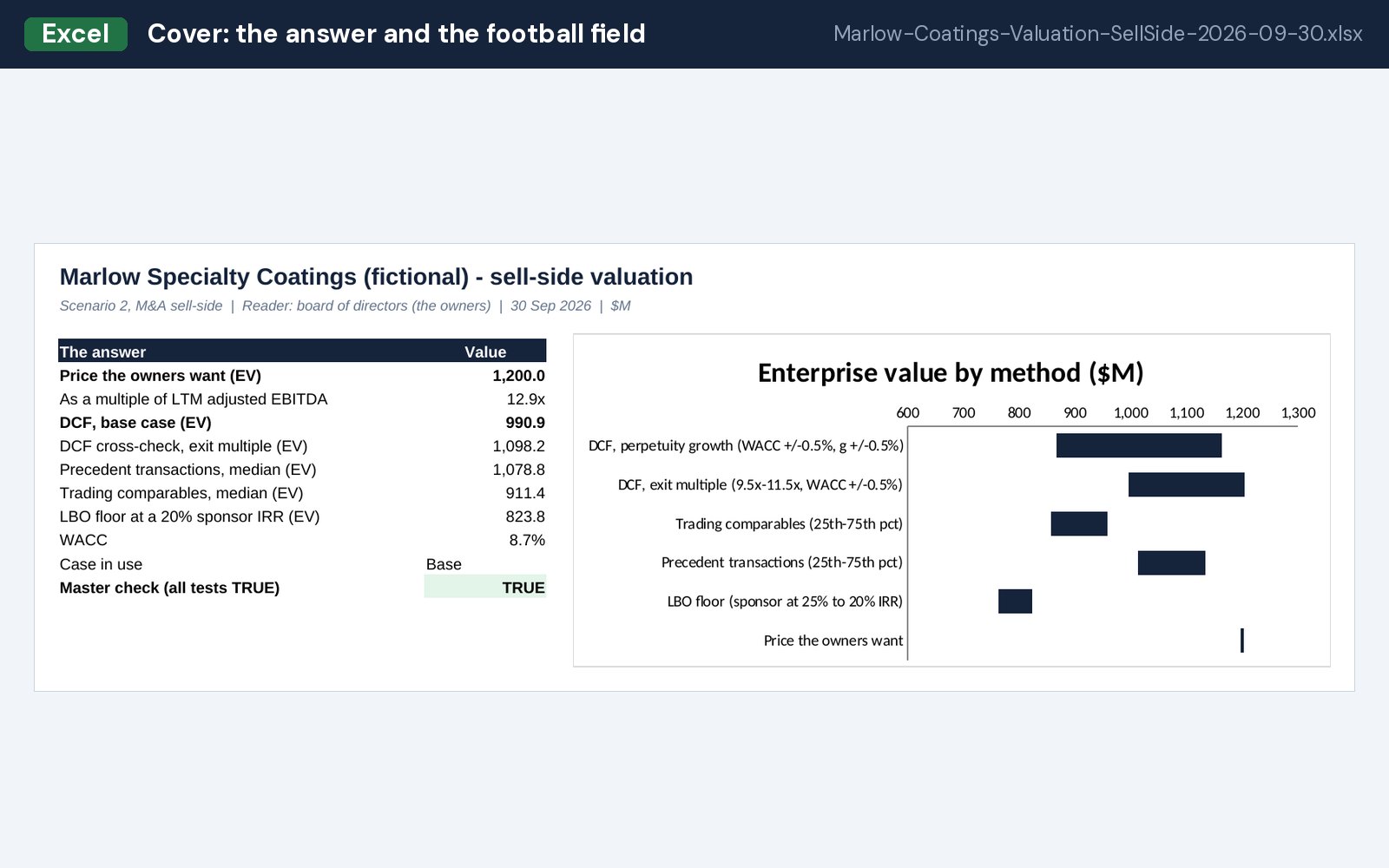
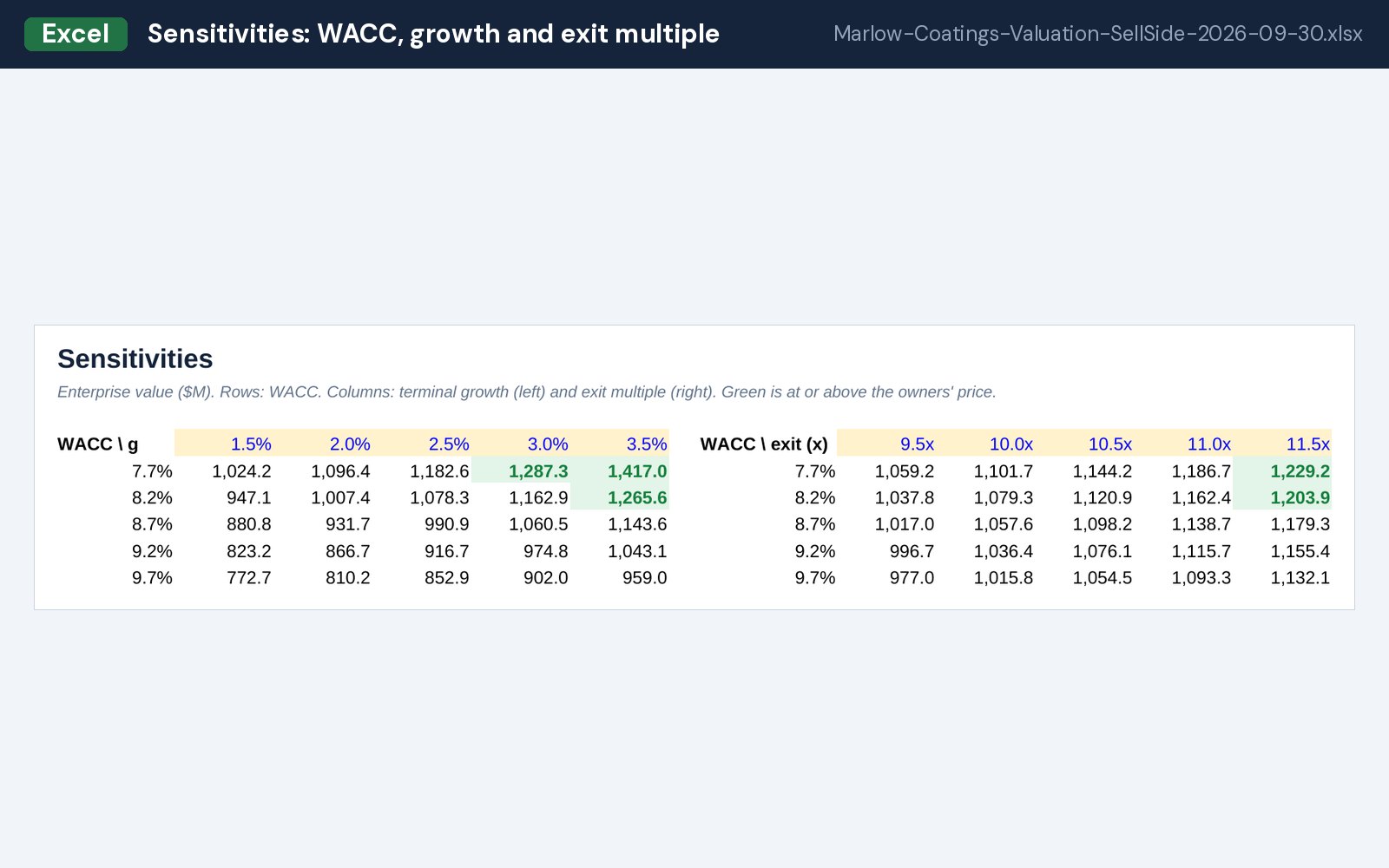
Only the top of one range reaches $1.2B. The one deal above 12.9 times was in 2021, when borrowing was unusually cheap.
Why it matters: guiding buyers to $1.2B risks a failed sale; the evidence supports $1.05B–$1.15B.
Step 7 of 8
Thirteen checks, plus a Checks sheet in the Excel model that must read TRUE.
AI valuation model generator
Master check on the cover of the Excel model: TRUE
Why it matters: the board can move the margin and watch every range update.
Step 8 of 8
A live Excel model and a 2-page Word memo with the answer on page one.
AI valuation model generator
The answer: tell buyers $1.05B–$1.15B, and hold out for at least $990M. The $990M stays private.
Next: paste the memo into the AI PowerPoint generator for the board presentation.
Why it matters: the family goes to market at up to $1.15B, a price recent deals support.
The finished Excel model and memo
Images of the real Excel and Word files from this run. Click a title, or swipe through them.
Board memo, page 1
A food company plans a $750M offer for a bakery, and the board wants to know if the deal pays off.
What the corporate development lead typed
How the AI valuation model generator valued this deal
Step 1 of 8
Two quick answers, then a short summary for you to confirm.
AI valuation model generator
Why it matters: at 15 times Pell’s $50.0M of earnings, the price works only if most of the $30M of savings arrive.
Step 2 of 8
Each type of deal is valued differently. The method is agreed before any number is calculated.
AI valuation model generator
Why it matters: every dollar above Pell’s own value pays the seller for savings Northgate has not made yet.
Step 3 of 8
One-off costs come out; costs that come back every year stay in.
AI valuation model generator
Why it matters: the $30M of savings is a management claim until checked, so it never enters the base earnings.
Step 4 of 8
A low, a middle and a high case, each built from named business drivers.
AI valuation model generator
Shall I use these figures?
Why it matters: year one carries $20M of cost against $7.5M of savings, so the deal starts behind.
Step 5 of 8
Every calculation is shown, so you can follow it line by line.
AI valuation model generator
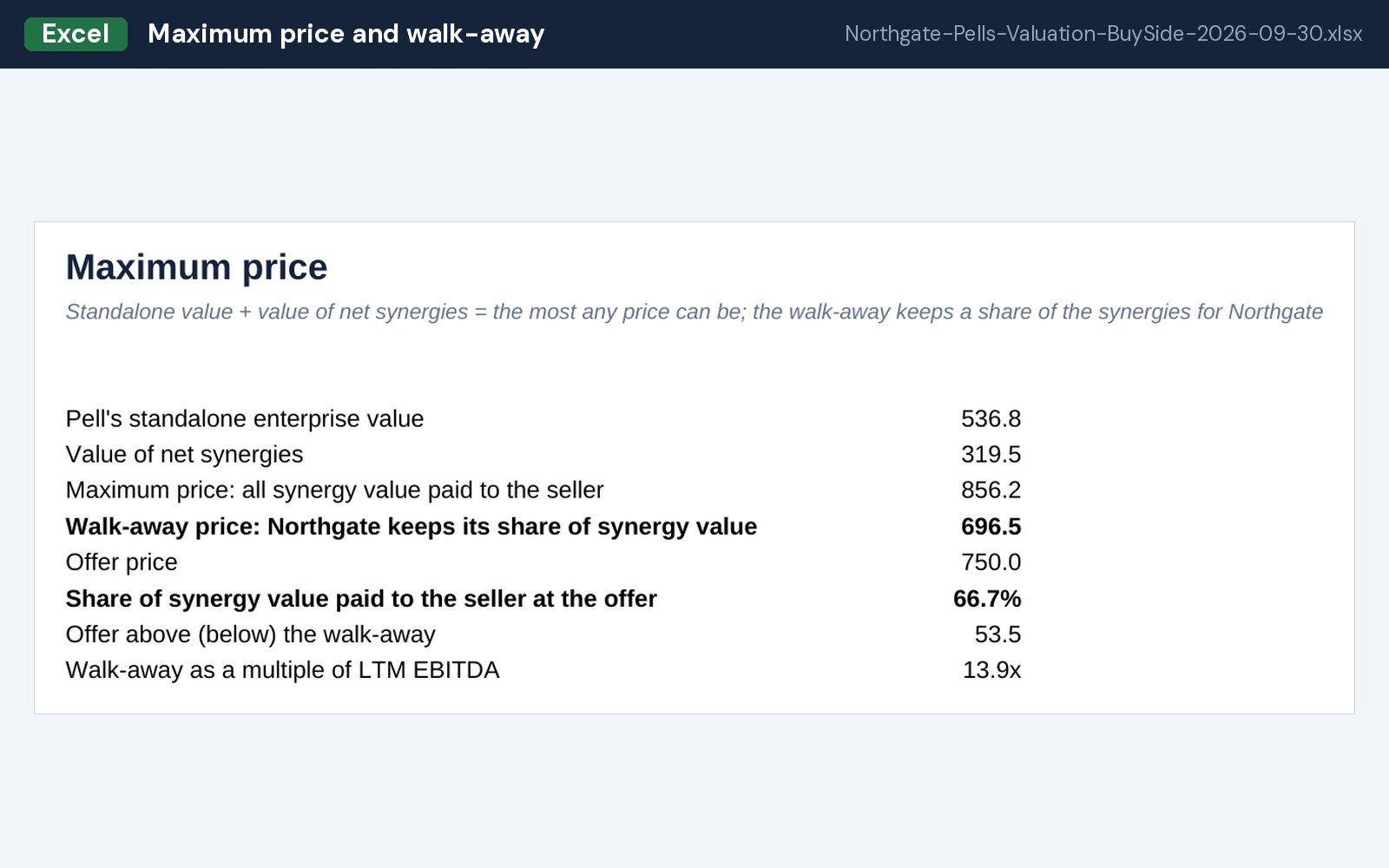
Pell’s on its own: $537M. Value of the savings: $319M. At $750M, Northgate pays $213M above Pell’s own value: 67% of the savings.
Why it matters: Northgate’s shareholders keep only a third of the savings they pay to create.
Step 6 of 8
One chart puts every method side by side, with the price drawn across it.
AI valuation model generator
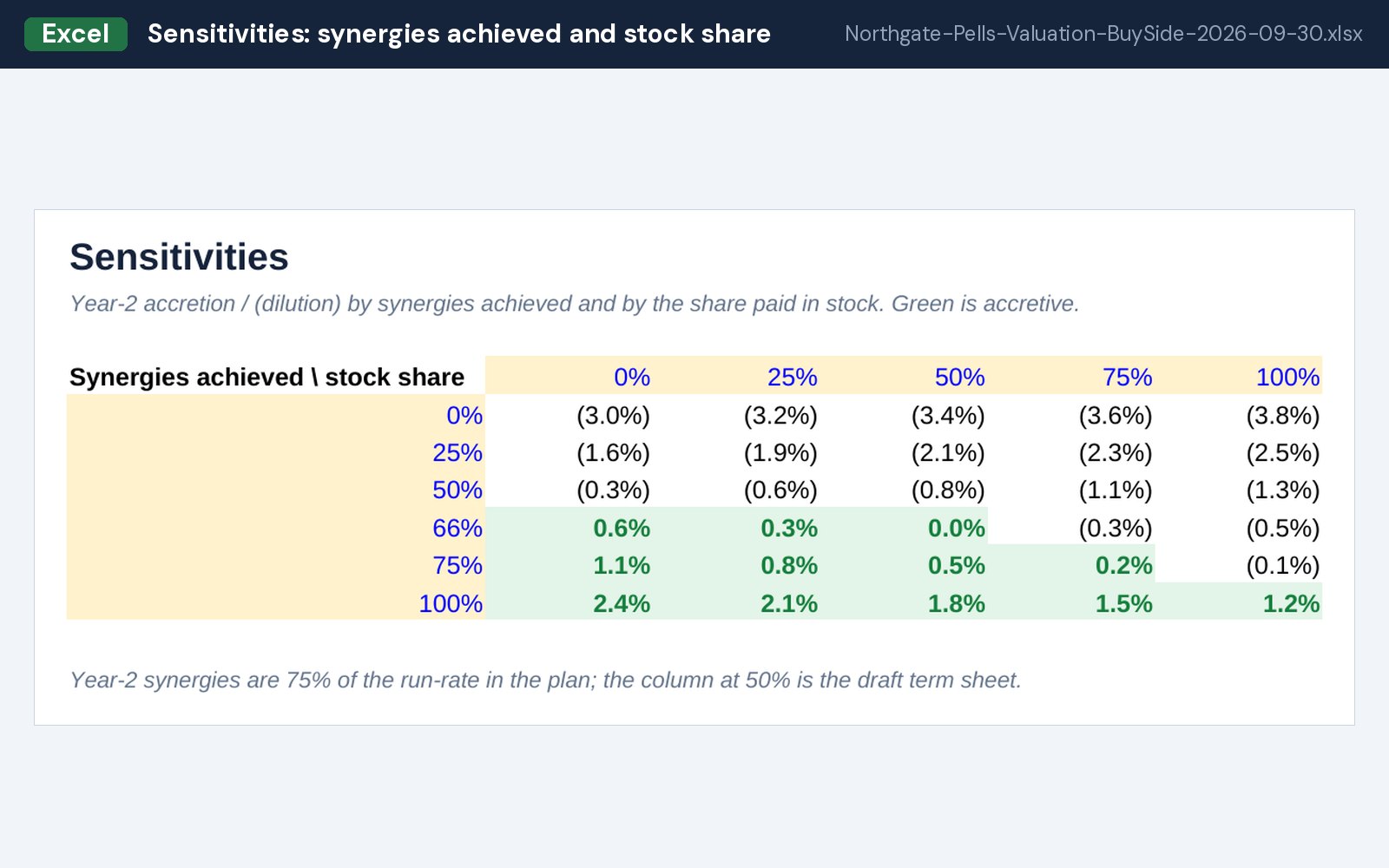
At $750M, the deal lifts earnings per share in year 2 only if at least 66% of the savings arrive. Every 10 points of savings moves year-2 earnings per share by about 0.5 points.
Why it matters: the offer is above every recent deal and depends on savings not yet confirmed.
Step 7 of 8
Thirteen checks, plus a Checks sheet in the Excel model that must read TRUE.
AI valuation model generator
Master check on the cover of the Excel model: TRUE
Why it matters: the board can change the price or the cash-and-shares mix in one cell.
Step 8 of 8
A live Excel model and a 2-page Word memo with the answer on page one.
AI valuation model generator
The answer: walk away above $696M (13.9 times earnings), keeping half the savings’ value. Confirm every saving line by line before any offer.
Why it matters: at $696M Northgate keeps about $160M of the savings’ value; at $750M, $106M.
The finished Excel model and memo
Images of the real Excel and Word files from this run. Click a title, or swipe through them.
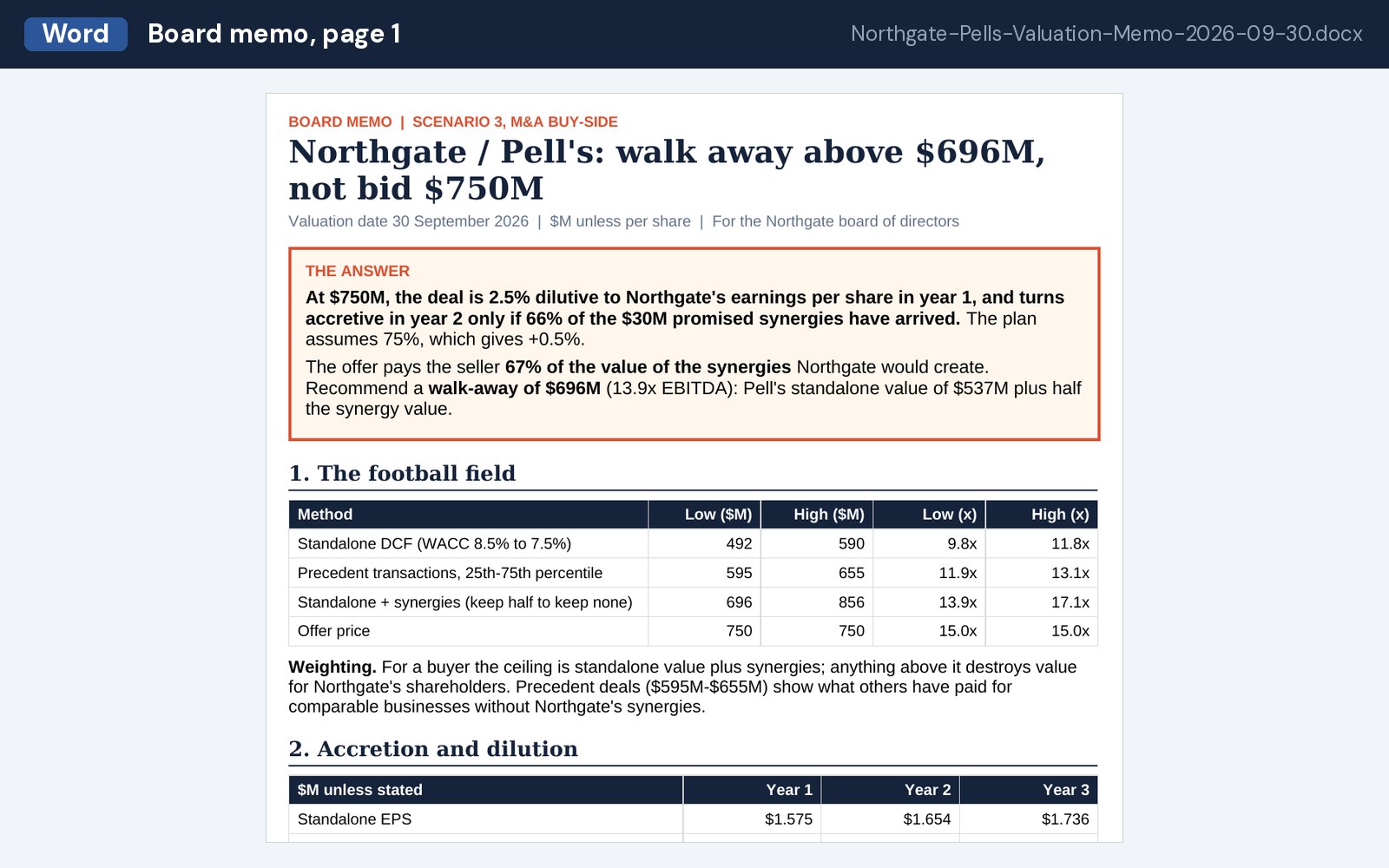
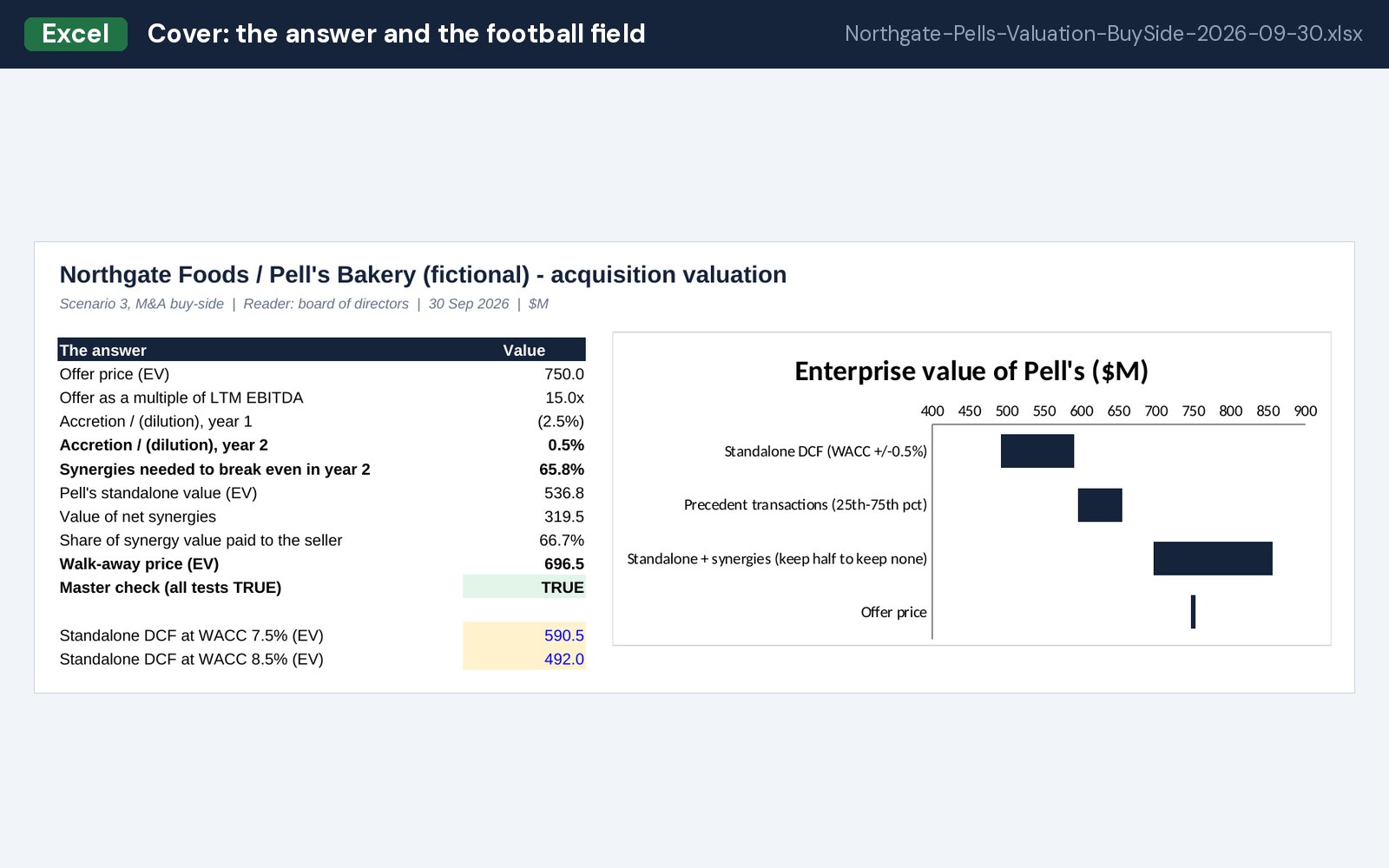
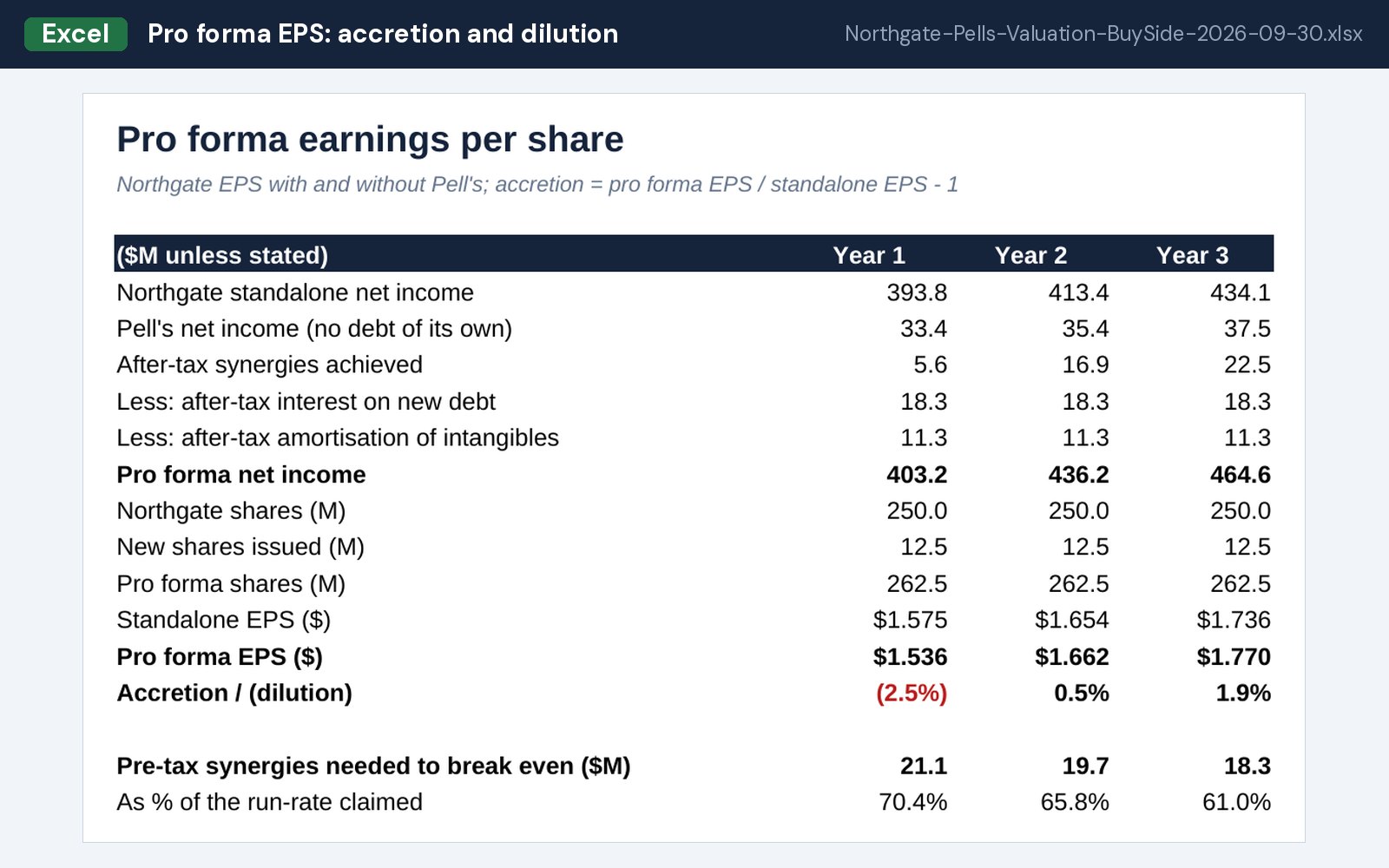
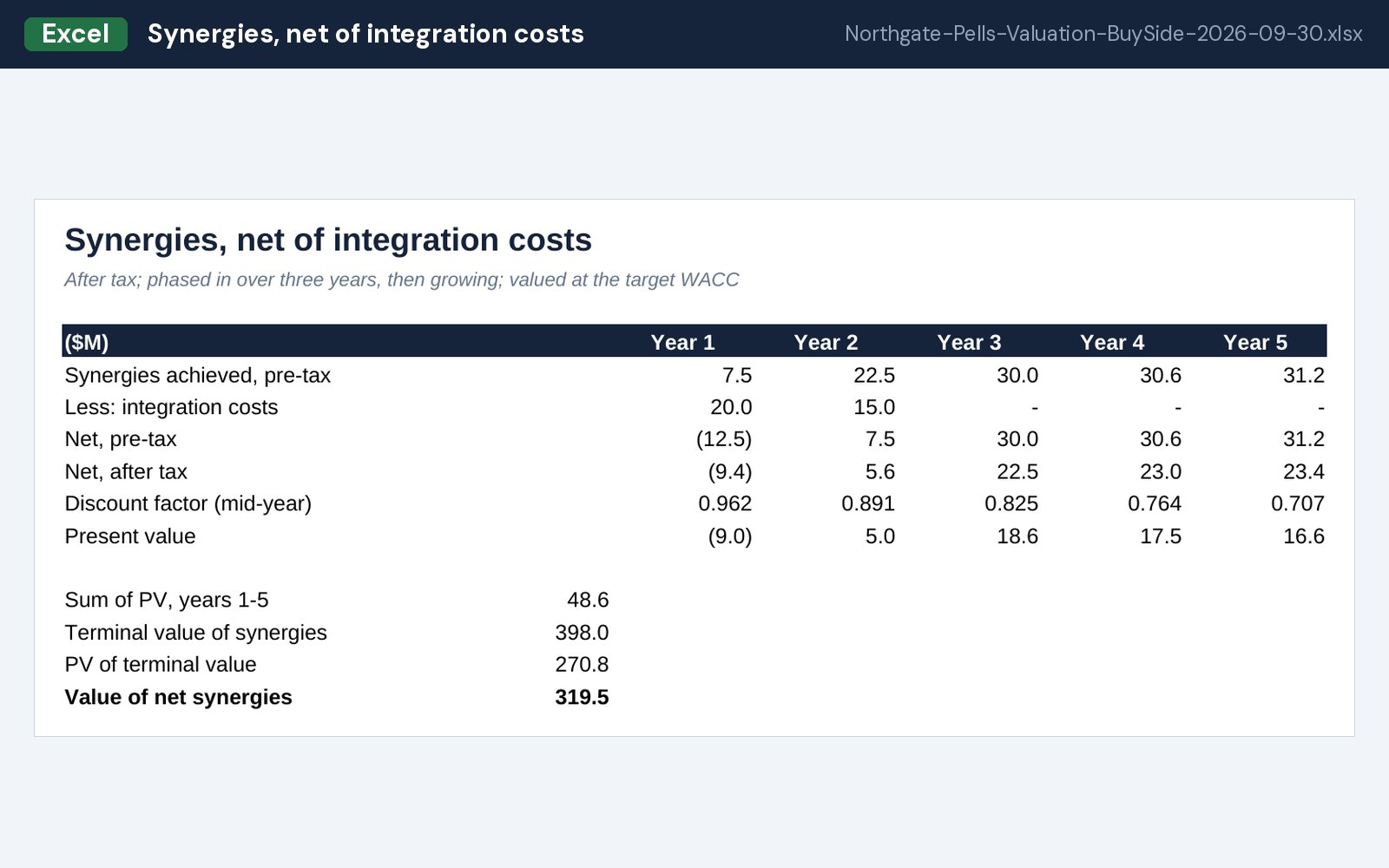
Board memo, page 1
Investors are discussing a $630M valuation for a fast-growing software company that is not yet profitable.
What the investor typed
How the AI valuation model generator valued this deal
Step 1 of 8
Two quick answers, then a short summary for you to confirm.
AI valuation model generator
Why it matters: at 15 times, the round assumes Ledgerline keeps growing close to 48% a year.
Step 2 of 8
Each type of deal is valued differently. The method is agreed before any number is calculated.
AI valuation model generator
Why it matters: the three deciding numbers are named before any modelling.
Step 3 of 8
One-off costs come out; costs that come back every year stay in.
AI valuation model generator
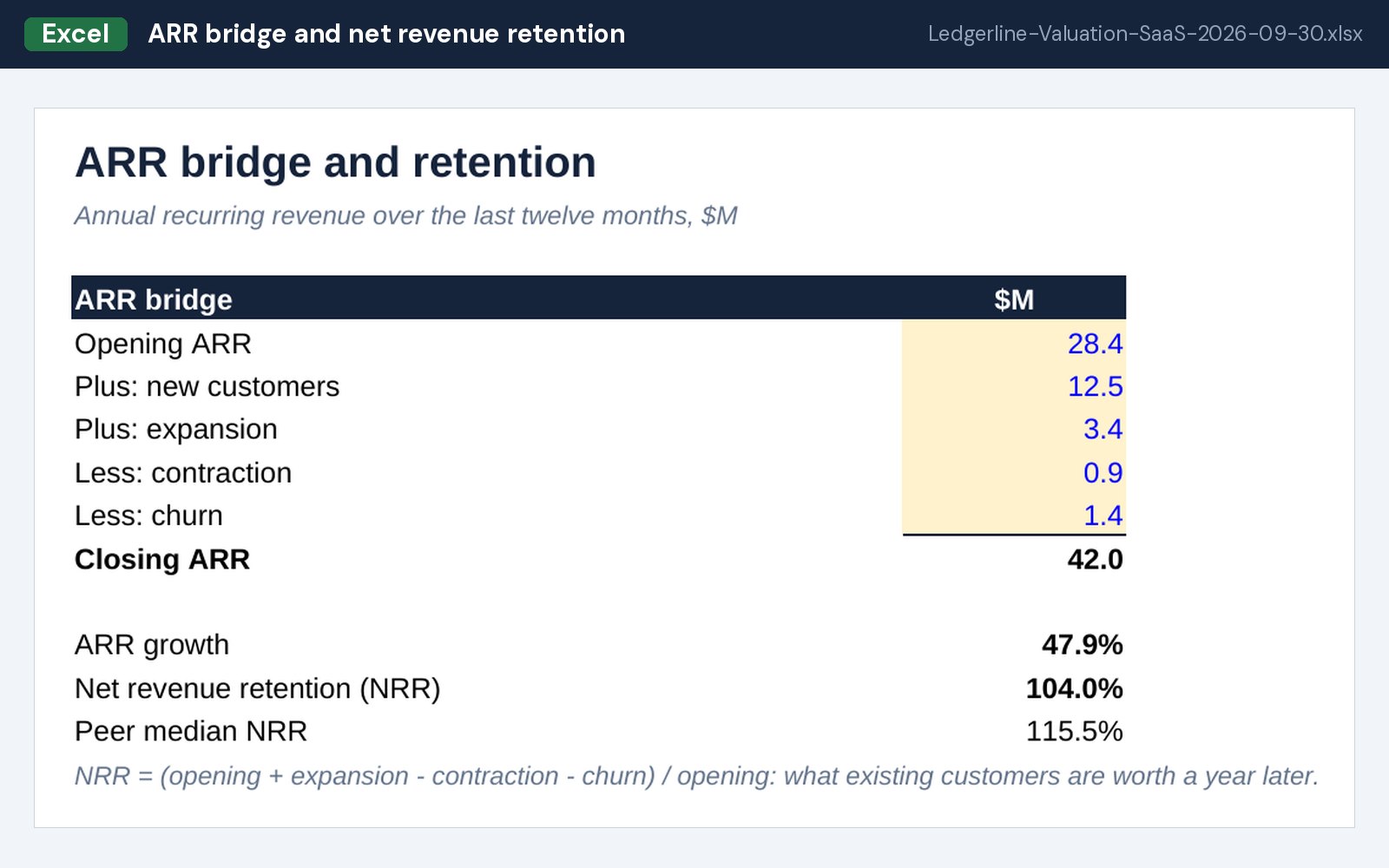
Last year’s customers now pay 104% of what they paid; at similar companies the figure is 115.5%.
Why it matters: almost all the growth comes from new customers, which costs sales spend every year.
Step 4 of 8
A low, a middle and a high case, each built from named business drivers.
AI valuation model generator
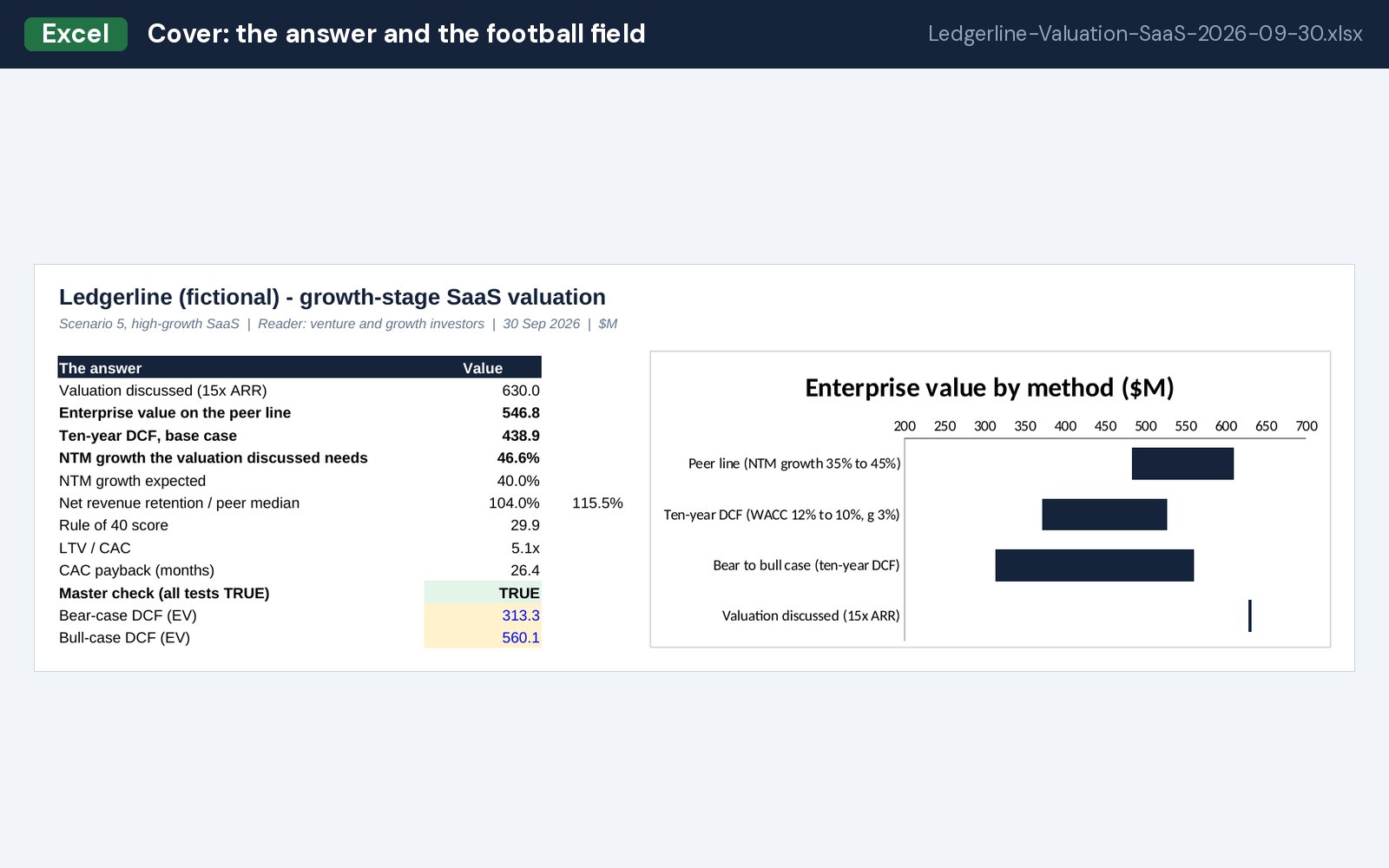
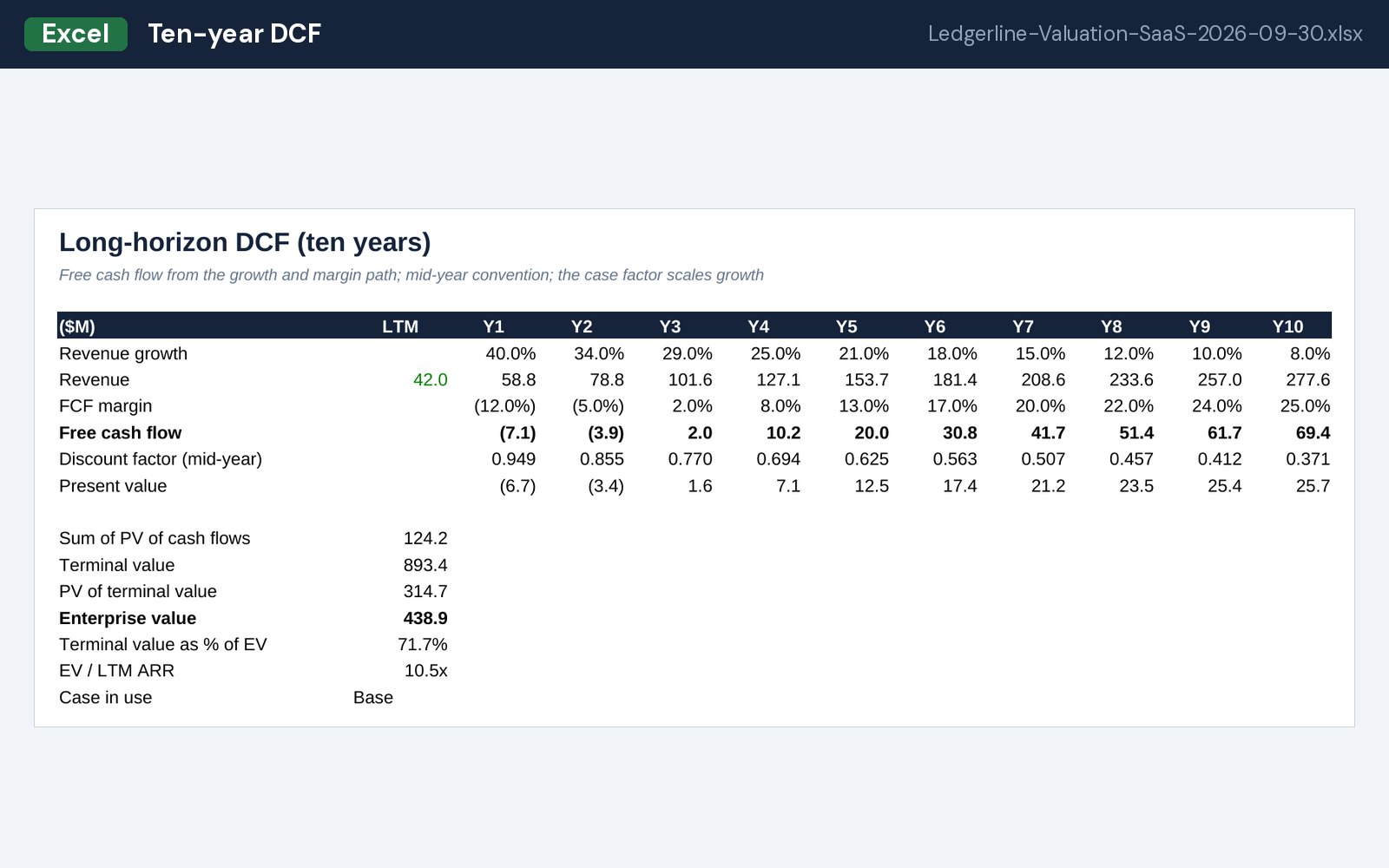
Low and high cases: $313M and $560M. Shall I use the middle case?
Why it matters: even the high case, $560M, is $70M below the $630M discussed.
Step 5 of 8
Every calculation is shown, so you can follow it line by line.
AI valuation model generator
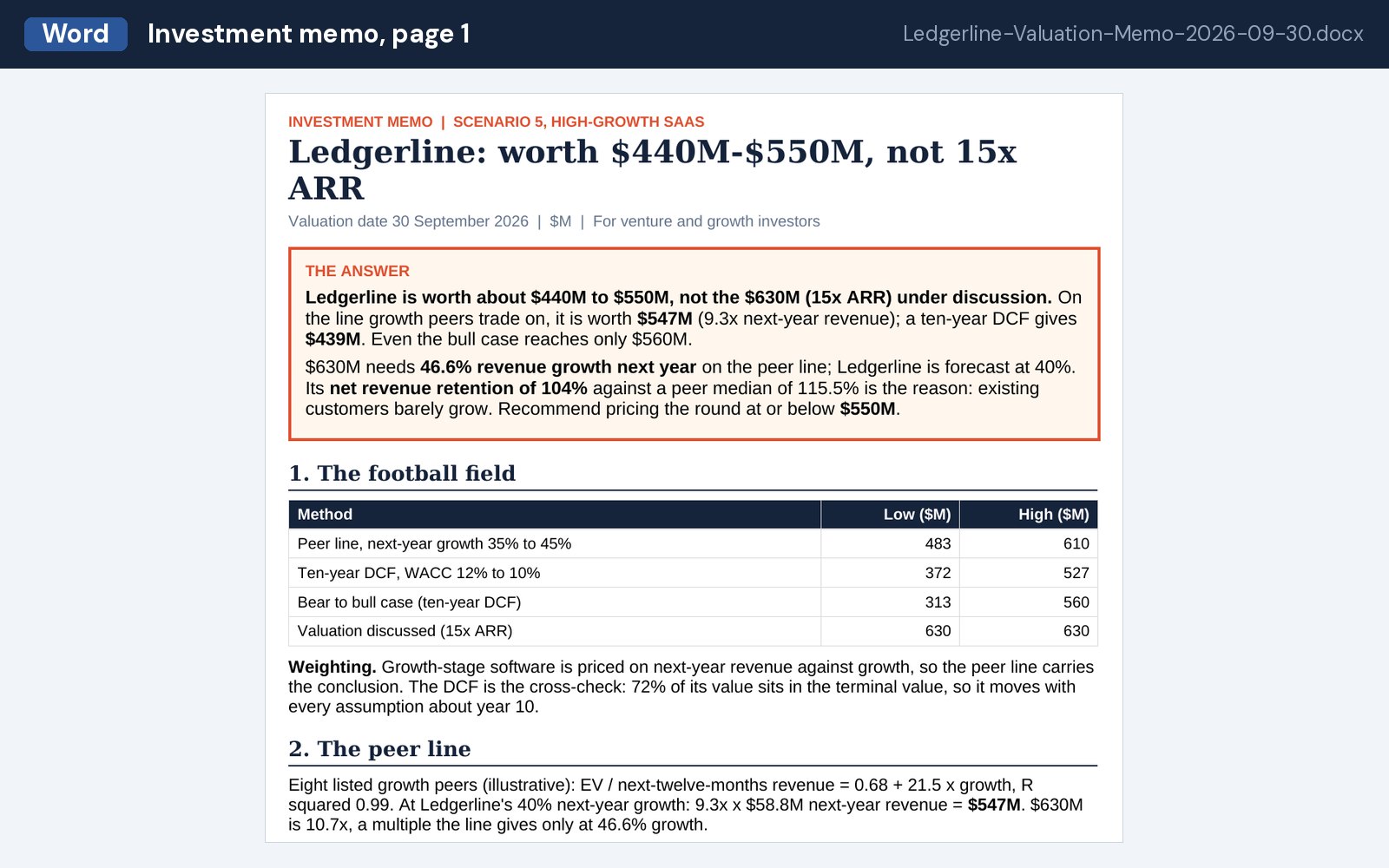
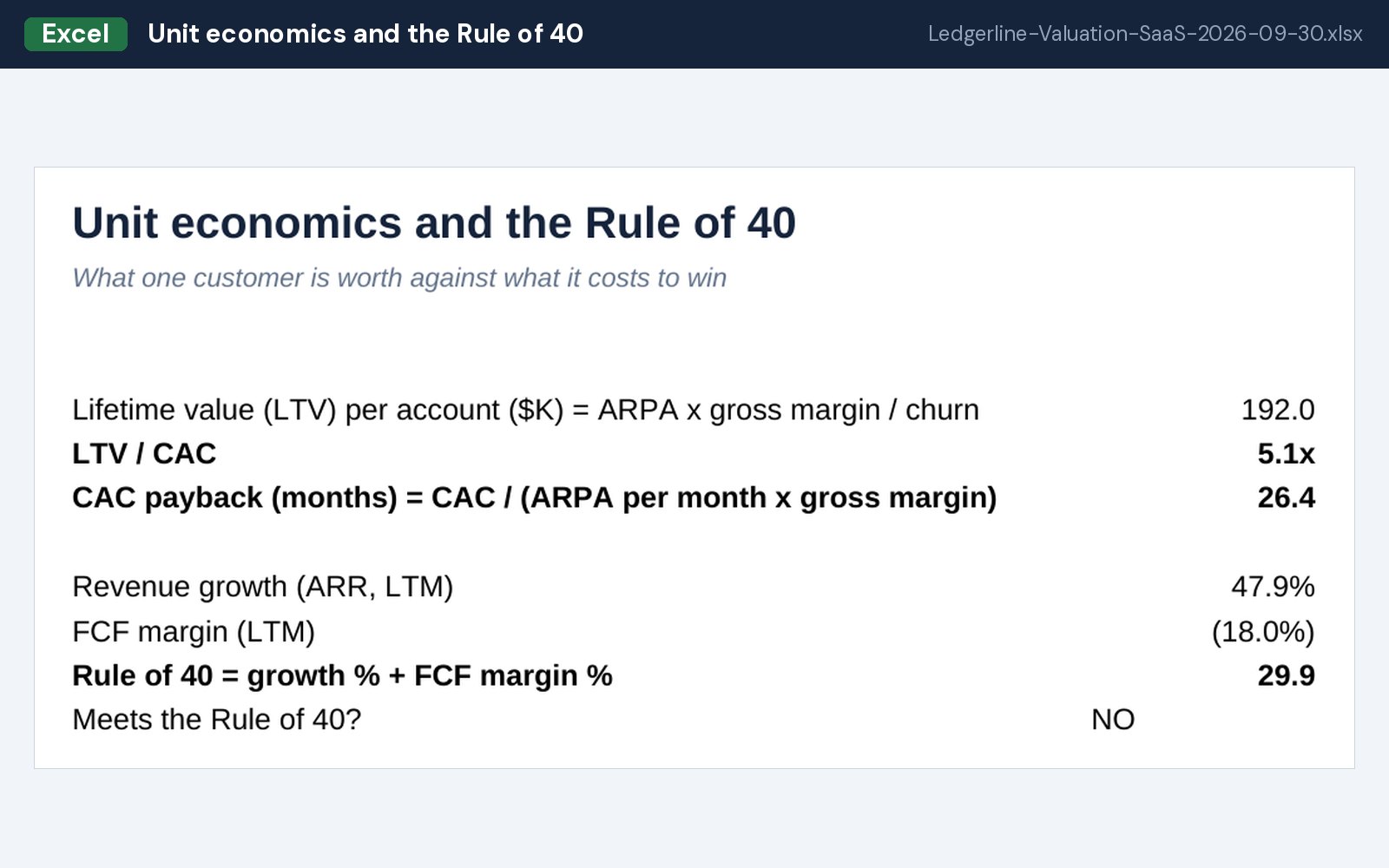
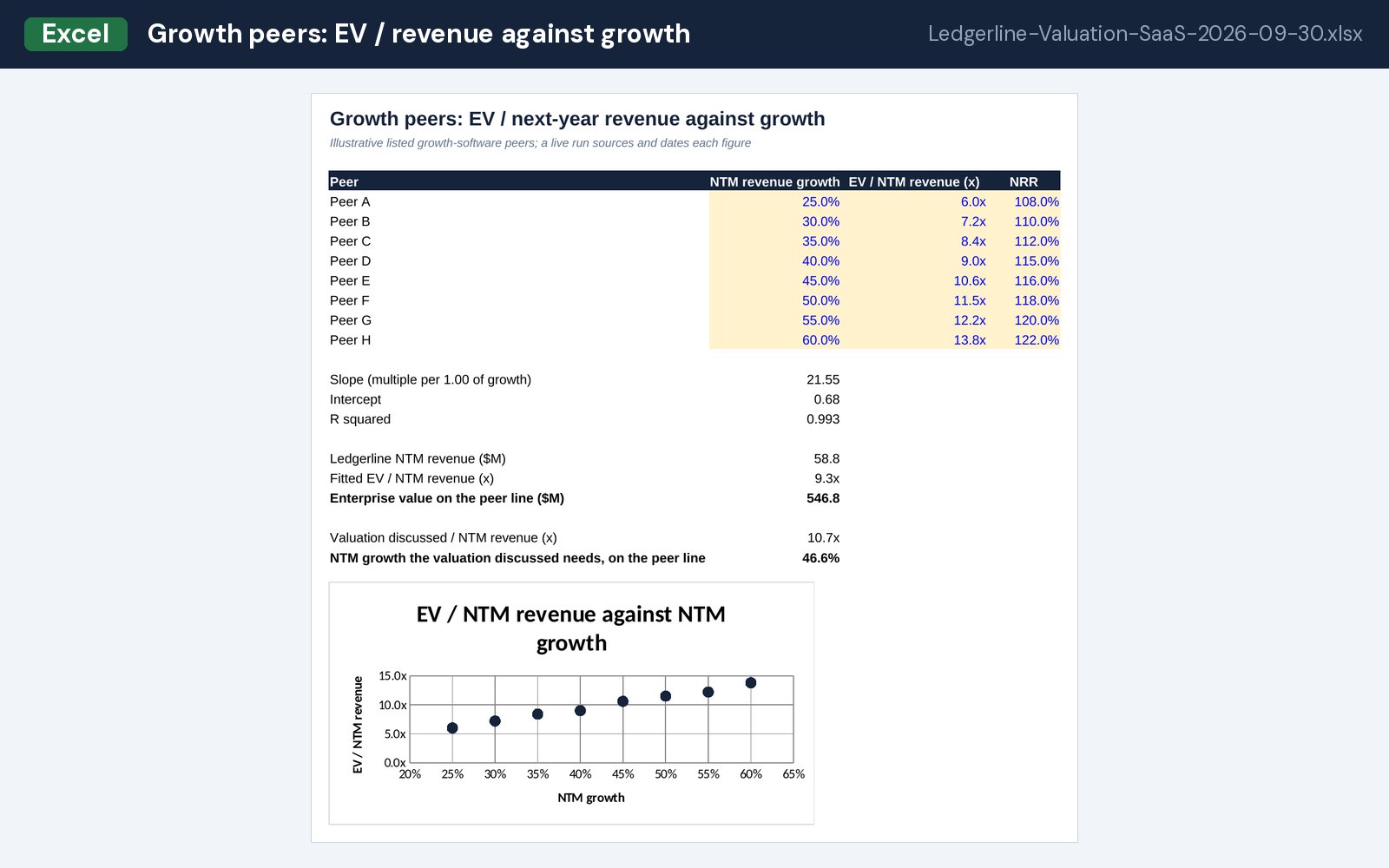
9.3 × $58.8M of next year’s revenue = $547M. Rule of 40 score: 47.9 − 18 = 29.9, below 40.
Why it matters: the comparison values Ledgerline $83M below the $630M discussed.
Step 6 of 8
One chart puts every method side by side, with the price drawn across it.
AI valuation model generator
$630M is above every range. It needs 46.6% growth next year; the forecast is 40%.
Why it matters: the round is priced on growth 6.6 points above Ledgerline’s own forecast.
Step 7 of 8
Thirteen checks, plus a Checks sheet in the Excel model that must read TRUE.
AI valuation model generator
Master check on the cover of the Excel model: TRUE
Why it matters: an investor can change next year’s growth in one cell and read the new value.
Step 8 of 8
A live Excel model and a 2-page Word memo with the answer on page one.
AI valuation model generator
The answer: worth $440M–$550M. Price the round at or below $550M, 13.1 times recurring revenue. Better customer retention is what would justify more.
Why it matters: pricing at $550M instead of $630M saves the new investors $80M on day one.
The finished Excel model and memo
Images of the real Excel and Word files from this run. Click a title, or swipe through them.
Investment memo, page 1
Deal types 7 and 8, distressed companies and sum-of-the-parts, follow the same 8 steps. Both are in the prompt, without a worked example on this page.
Claude, ChatGPT or Gemini
Run the AI valuation model generator in Claude and get a working Excel model, with inputs in one place, every calculation a live formula and a Checks sheet, plus a Word memo with the answer on page one.

Runs every step, builds both files and opens the model to check every test reads TRUE.
Runs the same steps and returns the model as tables with every formula written out. ChatGPT builds a file only where its code tools are available.
Runs the same steps and returns the tables, formulas and memo as text, ready to build in Excel.
Stay in one conversation. The generator stops after your deal details, after choosing the method and on the base-case forecast, so you can steer. Build the files at the end of the same conversation, while Claude still has every input and formula.
Yes. In Claude, the AI valuation model generator builds an Excel workbook with live formulas and a Checks sheet, plus a Word memo with the answer on page one.
The methods each deal calls for, always more than one: discounted cash flow (DCF), comparable companies, precedent transactions, LBO returns, accretion and dilution, and more, each with its formula written out.
Yes, as full tables. ChatGPT and Gemini run the same analysis and return the model and memo as tables and text. The Excel and Word files are built in Claude.
No. The model is built from the figures you supply, for your own analysis. Check every input and assumption before anyone relies on the result.
The complete prompt with step-by-step instructions and a worked example, as a PDF and a plain-text file. Lifetime updates.
Calder Packaging and Corvane Instruments are fictional, so every figure on this page is illustrative; peer and market inputs are illustrative too, where a live run sources and dates each one. Not investment, legal, tax or accounting advice. Not affiliated with or endorsed by any investment bank.