Prompts for Life · Pack 15 · 10 prompt templates

Travel Planning
AI Prompt Templates

Ten prompts that take a trip from where to go to what to claim. Every price includes what the headline leaves out, every day has one anchor, and the documents are checked before a deposit is paid.

ChatGPT, Claude & Gemini Instant download No subscription Lifetime updates Best in Claude: an Excel budget and a Word document card

Decide, book, prepare, go

Run any prompt on its own, or run all ten in order. Each output feeds the next, building one Trip Brief that holds the budget, the bookings, the days and the documents.

Four rules in every prompt

These are what stop the AI handing you a ten-stop day, a headline price and an entry rule it has invented.

Total cost, not the sticker price

Every comparison includes what the headline price leaves out: bags, seat fees, transfers, resort and city taxes, card charges and airport transfers.

Book what sells out first

Timed entries, long-distance trains and anything with a release date are booked before flexible things. Scarcity sets the order, not enthusiasm.

One anchor a day

Each day has one fixed thing, with travel counted door to door and the rest left open. Three attractions and a hope is how a trip becomes a commute.

Documents before deposits

Passport validity, visas, vaccinations and insurance are checked before any non-refundable payment - and no document numbers are ever recorded.

One family trip, all ten prompts

Kate and Dan Whitfield live in Chicago with two children, aged 7 and 11. They wanted twelve days in Japan in March 2027 with a budget of $9,800. By January the plan they had drifted to came to $12,400, two of the places they had built days around release their timed tickets 90 days ahead, their daughter’s passport expired five weeks after the return date, and nobody had checked whether a rail pass was worth buying. Here is what the ten prompts did with the budget, the bookings, the days and the cancelled outbound flight.*

$12,400

planned, against a $9,800 budget

90 days

ahead for the tickets they had built days around

5 weeks

of passport validity left after the return date

$1,420

of rail tickets nobody had compared with a pass

Step 1 · Decide

Where to Go and When

Turns what you want from the trip into a shortlist of destinations and dates that fit your time, budget and season.

Shoulder seasonFlight timeGroup fit

What the Whitfields brought · four people wanting four things

“Twelve days in March, two adults, two children, $9,800. Everyone wants something different.”

What the prompt returned

Japan in late March: blossom likely but not guaranteed, school holidays overlapping six of the twelve days, and a 13-hour flight leaving 11 full days on the ground.

The conflicttwo children under 12, two adults wanting food and trains
Seasonlate March: shoulder, with blossom pricing possible
Time math13 hours each way: 12 days becomes 11 on the ground
Agreedfood, trains, and two big days for the children

The analysis · Twelve days, four people, and no agreement on what the trip was for

A destination is chosen against four things: the time you have, the money you have, the season at that latitude, and what the group actually wants. Shoulder season, the weeks either side of the peak, usually gives the best trade-off between weather, price and crowds.

  • One purpose, written down: food, trains and two big days for the children. Every later decision is tested against that sentence.
  • 11 days, not 12: counting the flights and the first and last half-days changed the itinerary before it was written.
  • The blossom risk: late March may or may not hit the blossom, and prices rise if it does. The fallback week was chosen at the same time.

Takeaway: agree in one sentence what the trip is for, then test the destination and dates against it.
Step 2 · Decide

Your Trip Budget

Builds the full budget — flights, beds, transport, food, entry, insurance and the rest — and shows where it is over.

Per person, per dayForgotten costsExcel budget

What the Whitfields brought · a plan that had drifted

“$9,800 budget. The plan we have adds up to $12,400.”

What the prompt returned

$12,400 against a budget that also has to hold a contingency. Closed to $8,900 planned plus $890 held back, $10 inside the budget.

As plannedflights $4,720, beds $3,190, transport $1,420, food $1,560, rest $1,510
The gap$3,500 over what the budget can hold with a contingency
The cutsflights $740, accommodation $1,810, rail pass $180, smaller lines $770
The plan$8,900 planned, $890 contingency: $2,225 a person, $742 a day

The analysis · $12,400 planned against a $9,800 budget

A trip budget is built per person and per day, because that is the only way to compare options or to cut. The categories people forget sink the budget: transfers at both ends, baggage and seat fees, city taxes, tips, data, laundry, and the money spent on the days when nothing is planned.

  • The contingency is not optional: a $9,800 plan with a $9,800 budget has nothing for what changes. Ten per cent held back is what makes the plan survivable.
  • $742 a day: the per-day figure is what makes overspending visible on day three rather than on the flight home.
  • The daily target: food, entry and extras came to $174 a day on the ground, which is the number the family actually has to hold.

Takeaway: budget per person and per day, add what the headline prices leave out, and hold ten per cent back.

Step 3 · Book

What to Book Before You Go

Sets the booking order by what sells out first, with the release dates, deadlines and cancellation terms.

Scarcity orderRelease datesCancellation terms

What the Whitfields brought · two days built on assumptions

“We’d built two days around places we assumed we could just turn up to.”

What the prompt returned

Two timed entries release 90 days ahead, which is 21 December for a 21 March arrival. Trains open 30 days ahead; the ryokan needed booking immediately.

Timed entriesrelease 90 days ahead: 21 December
Long-distance trains30 days ahead
Accommodationthe ryokan, small and booked months out
Committed$180 non-refundable now; the rest refundable until dated deadlines

The analysis · Two days planned around tickets that sell out in December

Things sell out in a predictable order: timed entries and anything with a release date, then long-distance trains, then well-known restaurants, then small accommodation. Cancellation terms matter more than price when plans are months out.

  • 21 December, before the flights: the release date came before they had paid for anything else, which is why the booking calendar is built first.
  • Refundable costs more, and is cheaper: the central hotel at a refundable rate cost $85 more and kept five nights movable while the passport renewal was pending.
  • Backups named: for each must-do, the alternative that keeps the day working if the ticket cannot be had.

Takeaway: book in the order things sell out, and know what each booking commits before you pay it.

Step 4 · Book

Flights and Getting There

Compares the routes and fares on total cost and total time, including bags, seats, transfers and the hours at each end.

True priceDoor to doorConnection risk

What the Whitfields brought · two fare options

“Non-stop at $1,180 each, or one stop at $995. The stop is two hours.”

What the prompt returned

Non-stop $4,720 and 16 hours door to door; one stop $3,980 and 20 hours, with a 2h 10m connection in the same terminal on one ticket.

Non-stop$4,720, 16 hours door to door
One stop$3,980, 20 hours, single ticket
The risk checksame terminal, and a later flight that evening as the fallback
Saved$740, with bags and seats included in both

The analysis · $185 a ticket apart before bags, seats and transfers

A fare is not a price: bags, seat selection, changes and the transfer at each end change the ranking. A missed connection on separate tickets is your problem, not the airline’s, so single-ticket routings are judged differently.

  • Door to door, not gate to gate: the airport train, check-in and the connection put four hours between the two options, not two.
  • One ticket: the connection is the airline’s responsibility, which is what made a 2h 10m connection acceptable with children.
  • The arrival hour: both options land in the afternoon. A cheaper option landing at 1am would have cost a hotel night and a taxi.

Takeaway: compare the full cost and the door-to-door time, and check what happens if the connection fails.

Step 5 · Book

Where to Stay

Compares places to stay on the full nightly cost, the location against your plan, and what the group actually needs.

Full nightly costLocation testSplit stay

What the Whitfields brought · eleven nights quoted

“$290 a night in the centre for all eleven nights.”

What the prompt returned

Eleven nights all central: $3,190. Six nights in an apartment at $105 and five central at $150: $1,380, plus $96 of fares and about seven hours of travel.

All central$3,190 for 11 nights
Mixed$1,380: 6 nights out, 5 nights central
The cost of being out$96 of extra fares, about 7 hours over the stay
Saved$1,810, with the central nights on the two big days

The analysis · $3,190 of beds in a $9,800 trip

The full nightly cost includes taxes, cleaning and service fees, resort charges, parking and breakfast. A place twenty minutes cheaper by train costs an hour of the day and four fares, so location is priced against the days you have actually planned.

  • Priced against the itinerary: the apartment sits two stops from the days planned for that half of the trip, so the travel cost is small and real.
  • The split stay costs a half-day: moving between two places takes an afternoon. At $1,810 it was worth it; at $300 it would not have been.
  • The apartment has laundry: which is why the packing list in prompt 08 is two cases instead of four.

Takeaway: add the fees, price the location against your actual days, and only split the stay when the saving is worth the half-day.

Step 6 · Prepare

The Itinerary, Day by Day

Builds the days around one anchor each, with travel counted door to door and room left for the trip to breathe.

One anchor a dayDoor-to-door timesRain plan

What the Whitfields brought · a plan with three things a day

“Every day had three things on it, and half of them were an hour apart.”

What the prompt returned

Twelve days, one anchor each: two timed entries, one day trip, two slow days and two half days at the ends.

Beforethree things a day, up to an hour apart
Nowone anchor a day, with the options nearby
Half daysarrival and departure counted as halves
Left emptytwo afternoons, deliberately

The analysis · A holiday planned like a commute

A day works when it has one anchor — the thing that must happen — and everything else is optional. Travel time is counted door to door, including the walk to the station and the wait, because that is where days are lost.

  • Four things came out: with door-to-door times added, four of the planned stops did not fit any day without rushing the children.
  • Closing days checked: two museums close on different weekdays, which moved one anchor by a day.
  • A rain plan for each day: an indoor alternative that needs no booking, because March in Japan rains on about a third of days.

Takeaway: give each day one anchor, count travel door to door, and leave two afternoons empty.

Step 7 · Prepare

Documents, Visas and Health

Checks passports, visas, health requirements and insurance against the trip, and builds the document card you carry.

Entry rulesRenewal lead timeDocument card

What the Whitfields brought · four passports

“Her passport runs to May. We’re back on 1 April, so that’s fine.”

What the prompt returned

Five weeks of validity after the return, and no margin for a delay or a change. A child’s passport must be renewed in person and takes 8 to 11 weeks.

Ellie’s passportexpires 8 May 2027: five weeks after the return
The renewalin person, 8 to 11 weeks, started in January
Insurancemedical, repatriation and cancellation checked against the trip
The cardone page: what each person holds, and who to call

The analysis · Five weeks of margin on a twelve-day trip

Entry rules are set by the destination and change without notice: passport validity, visas or travel authorisations, and rules for children travelling. The prompt marks every rule to confirm with the destination’s official source, because this is where AI is most confidently wrong.

  • Margin, not just validity: the passport was technically valid. One cancelled flight or one extra night and it would not have been.
  • Renewed before deposits: the rule in this pack is documents before deposits. The renewal started in January, before the non-refundable bookings were paid.
  • No numbers on the card: the document card lists holders, expiry dates and emergency contacts. It carries no passport, visa or card numbers, so losing it costs nothing.

Takeaway: check the rule for every country on the route, count the margin after the return date, and renew before you pay deposits.

Step 8 · Prepare

What to Pack

Builds the packing list from the weather, the itinerary and the baggage allowance, and says what to leave.

Layers, not itemsWeight checkDay-one bag

What the Whitfields brought · a March forecast

“Late March in Japan. Nobody can agree whether it’s cold.”

What the prompt returned

4 to 16 degrees with rain on about a third of days: three layers each, one waterproof, two pairs of shoes, and laundry planned for day six.

Beforefour cases, packed for every possibility
The forecast4 to 16 degrees, rain on about a third of days
Laundryin the apartment on day six, which halves the clothes
Aftertwo cases, within allowance, medicines in hand luggage

The analysis · Four cases for four people and eleven nights

A list is built from what the days actually require: the forecast range, the activities, the dress codes and the laundry available. Anything replaceable at the destination is not packed, and anything irreplaceable travels in hand luggage.

  • Layers, not outfits: three layers each covers 4 to 16 degrees. Packing for each day separately is what filled four cases.
  • Laundry on day six: the apartment has a machine, so the clothes are sized to six days, not eleven.
  • The day-one bag: medicines, documents, chargers and a change of clothes for each child, reachable without opening a case.

Takeaway: pack from the forecast and the laundry, not from the list of things that might happen.

Step 9 · Prepare

Getting Around Once You’re There

Compares passes, tickets, car hire and taxis against the itinerary you have actually planned.

Break-evenSensitivityAirport transfers

What the Whitfields brought · everyone’s advice

“Everyone says buy the rail pass. Nobody has said why.”

What the prompt returned

Individual tickets for the planned route: $1,420. The 7-day pass: $1,240. Without the one long leg, tickets fall to $860 and the pass loses by $380.

Individual tickets$1,420 for the planned journeys
7-day pass$1,240: $180 cheaper
The deciderone long leg. Drop it and tickets are $860
Boughtthe pass, with the long leg confirmed as the reason

The analysis · A $1,240 pass bought on advice, not arithmetic

A pass is worth buying only when the journeys you will actually make cost more than the pass. Passes are sold on convenience and bought on hope, so the comparison is made against the itinerary, journey by journey.

  • $180, not hundreds: the pass wins, but by less than people assume, and only for this itinerary.
  • One journey decides it: the long leg is $560 of the $1,420 ticket total. If that day trip changes, the pass should not be bought.
  • Children’s fares: the 7-year-old travels free and the 11-year-old at half fare, which is exactly the detail that reverses these comparisons.

Takeaway: price the journeys you will actually make before buying any pass, and find the one that decides it.

Step 10 · Go

When Things Go Wrong

Handles the delay, cancellation, lost bag, illness or theft: what to do now, what to claim, and from whom.

The first hourEvidence packThree claim routes

What the Whitfields brought · a cancelled outbound

“Outbound cancelled at 6am. Rebooked for the next day, and we’re out of pocket.”

What the prompt returned

Rebooking confirmed in writing, then the hotel night, meals and two taxis recorded: $306 of receipts, with the cancellation reason and reference number captured at the desk.

The disruptionoutbound cancelled; rebooked for the next day
Collected at the deskreason, reference number, and the rebooking in writing
Out of pocket$306: hotel night, meals, two taxis
Claimed$306 from the airline, plus the unused hotel night refunded

The analysis · A cancelled flight and no evidence collected

Three sources may owe you something and they are separate: the airline or operator, your travel insurance, and your card issuer. What you can claim depends on the reason for the disruption and on evidence collected at the time.

  • The first hour is rebooking and receipts: the claim is written later, but it can only use what was captured at the desk.
  • The reason matters: what an airline owes usually turns on why the flight was cancelled, which is why it is asked for in writing at the time.
  • The trip repaired: the first hotel night was refundable under its own terms, and the day-one anchor moved to the empty afternoon on day four.

Takeaway: rebook first, collect the evidence before you leave the desk, and claim in order: operator, insurer, card.

The finale · what prompts 02, 06 and 07 produce

What the Whitfields took with them

Three things from the Trip Brief: the budget from prompt 02, the day plan from prompt 06, and the document card from prompt 07.

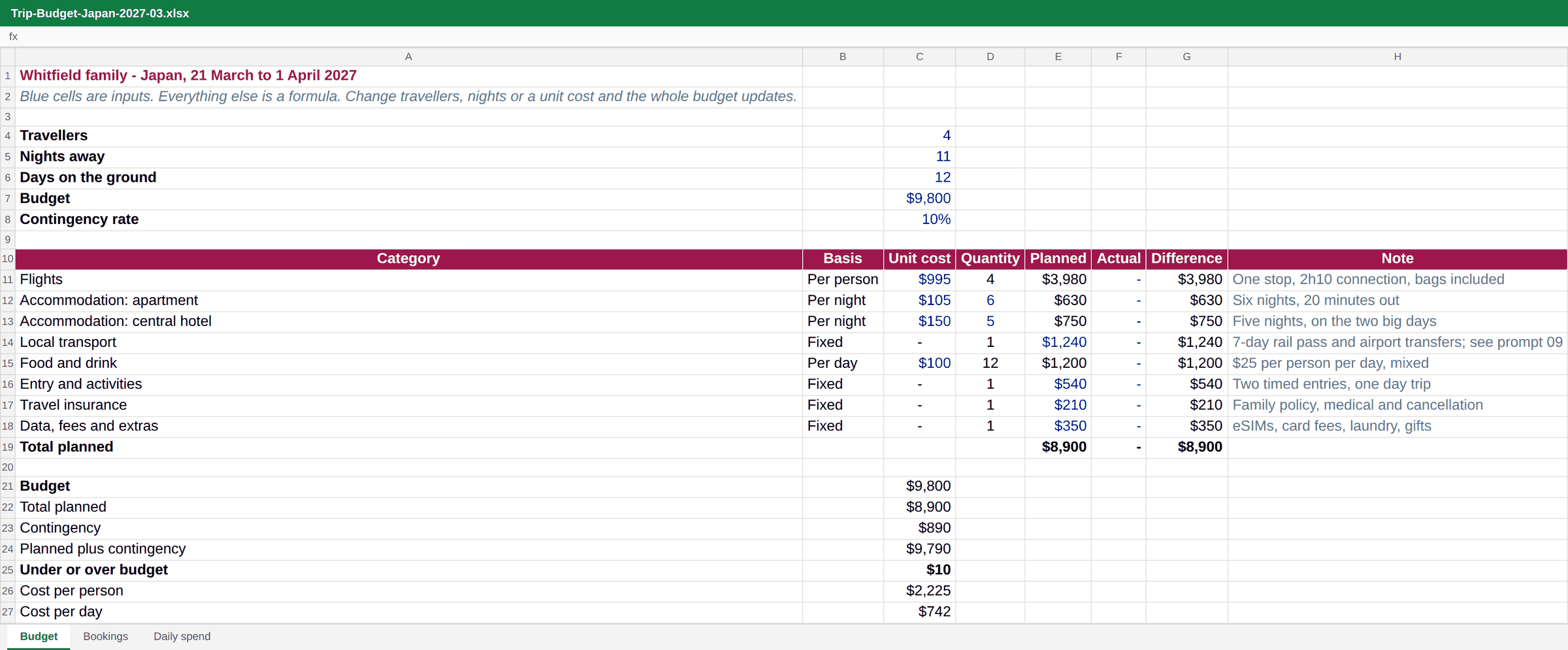
Trip budget — Japan, March 2027

As planned against what fits, with the contingency held back

Trip-Budget-Japan-2027-03.xlsx
$2,225 a person · $742 a day

CategoryAs plannedWhat fitsWhat changed
Flights$4,720$3,980One stop, same terminal, one ticket
Accommodation$3,190$1,380Six nights out at $105, five central at $150
Local transport$1,420$1,2407-day rail pass, and airport transfers
Food and drink$1,560$1,200$25 per person per day
Entry and activities$620$540Two timed entries, one day trip
Travel insurance$210$210Unchanged
Data, fees and extras$680$350eSIMs, card fees, laundry, gifts
Total$12,400$8,900Contingency $890 · budget $9,800
Trip budget in Excel: categories by basis, unit cost and quantity, with cost per person, cost per day and the contingency against the budget
The Excel budget built in Claude to prompt 02’s specification. It also tracks bookings against their cancellation deadlines and the daily spend on the ground.

Twelve days, one anchor each

Travel counted door to door; two afternoons left empty

11 days on the ground
2 timed entries · 1 day trip

DayAnchorTravel, door to doorIf it rains
1 · Sun 21 MarArrive, check in, eat nearby95 min airport to apartmentSame
2 · Mon 22 MarTimed entry, 10:00 (booked 21 Dec)35 min each wayIndoors anyway
3 · Tue 23 MarMarket morning, then nothing20 minCovered arcade
4 · Wed 24 MarEmpty afternoon, kept free
5 · Thu 25 MarDay trip by train, the long leg2h 10m each wayMove to day 9
6 · Fri 26 MarPark and playground, laundry15 minScience museum
7 · Sat 27 MarMove to central hotel, then nothing50 min with bagsSame
8 · Sun 28 MarTimed entry, 13:30 (booked 21 Dec)25 min each wayIndoors anyway
9 · Mon 29 MarEmpty afternoon, kept free
10 · Tue 30 MarNeighbourhood walk and dinner booked30 minAquarium
11 · Wed 31 MarLast things, packing, early nightSame
12 · Thu 1 AprFly home110 min to the airportSame

Four stops came out of the plan once door-to-door times were counted, and two afternoons were left deliberately empty.

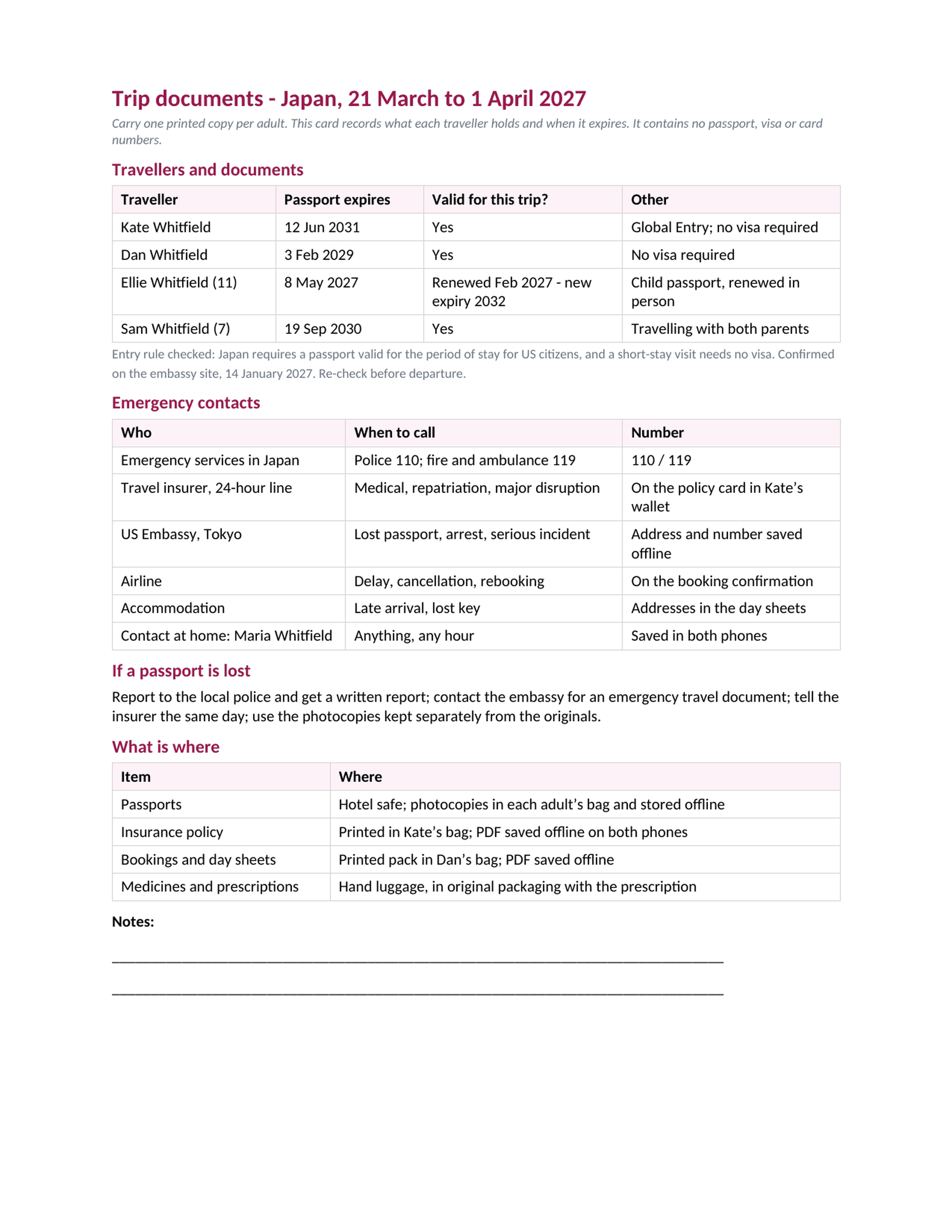
Trip documents — one page, carried

What each traveller holds, when it expires, and who to call

Trip-Documents-Japan.docx
No document numbers

One-page travel document card listing travellers and passport expiry dates, emergency contacts, what to do if a passport is lost, and where everything is kept
The Word card built in Claude to prompt 07’s specification. It records expiry dates and contacts, never passport, visa or card numbers.

Prompt output, formatted for this page. In other AI tools the prompts return the same content as tables and text; the figures come from whatever you paste in. The Whitfields are fictional, so every number here is ours to show you.

Pack 15 · Travel Planning

Ten prompt templates, one running brief

  • Where to go and when, and a trip budget per person and per day, built in Excel in Claude
  • What to book first, flights on true cost and true time, and where to stay
  • The day-by-day itinerary, and documents, visas and health with a printable Word card
  • Packing, local passes priced against your route, and what to claim when things go wrong
  • Text file and formatted PDF · ChatGPT, Claude and Gemini · best in Claude

$15

One-time purchase · instant download

Get the pack

* The Whitfields, the prices and all figures on this page are fictional and used for illustration only. Output depends on the information you supply and the AI tool you use. Entry rules, visa and health requirements, fares and passenger rights change and differ by country and nationality: confirm every requirement with the official source before travelling. The prompts record what you hold and when it expires, never document or card numbers.

More Prompts for Life

Nine packs for everyday life, from career and money to travel and health, each written to the same standard with its own worked example.

See all Prompts for Life
Back to The Prompt Library