Ten prompts that follow the full sequence of a strategy engagement, from framing the problem to the board recommendation. Below, one company is worked through all ten, ending in the board memo and the $2M ask.
What’s inside
Every prompt runs on its own: it asks for what it needs and returns a finished Word or Excel file. Run the one you need, or run all ten in order.
Frame
01Problem Framing & Issue TreeReframes the board’s question into one the data can actually answer.Analyze
03Competitor Analysis (Five Forces)Analyses the competitor and estimates when its threat will reach Northwind’s customers.04Market Sizing & Profit Pool AnalysisSizes the market bottom-up and locates where the profit sits.05Market-Entry AssessmentA conditional go on the adjacent segment, with spending released only after a pilot.06Strategic Framework Analysis (Five Forces, SWOT, Three Horizons)Splits the plan across three horizons and forces one divestment.Diagnose
07Root-Cause Analysis of GrowthTests five possible causes and isolates the binding constraint.The scenario
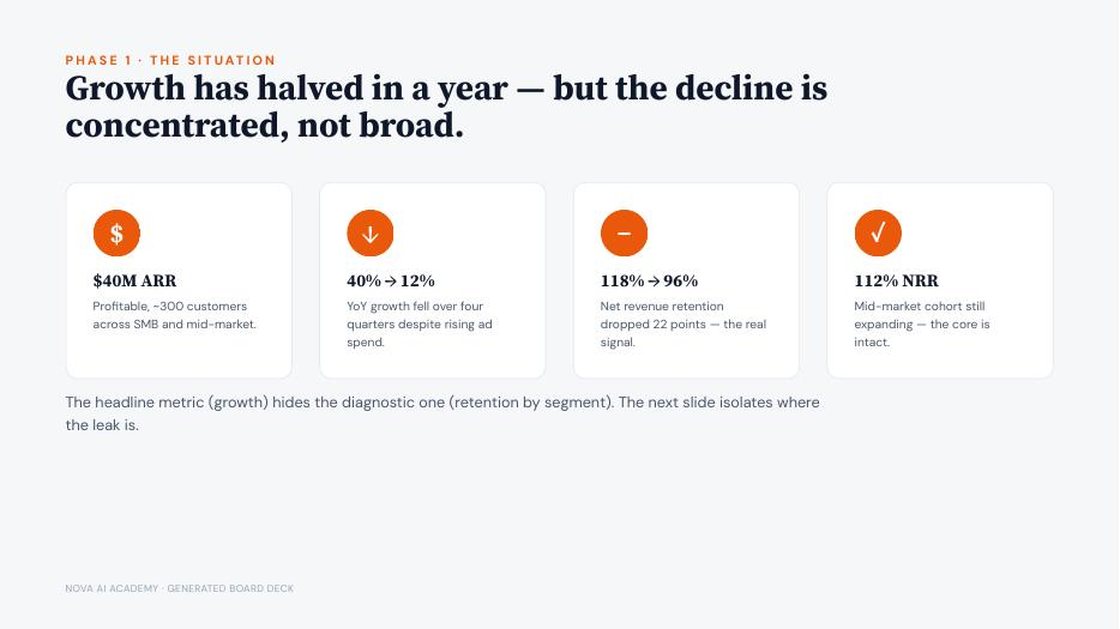
A $40M B2B SaaS company. Growth has stalled from 40% to 12% in a year, net revenue retention slid from 118% to 96%, and the board wants a plan. Here is how the ten prompts take Northwind from that starting point to an approved board recommendation, one step at a time.
Annual recurring revenue — the predictable subscription income arriving every year.
A year ago the company was growing fast. It has now almost stalled.
Net revenue retention: what last year’s customers spend this year. Above 100% they grow revenue on their own; below 100% they shrink it.
This is a condensed view of how a McKinsey-style consultant works a case.
Each step below shows the reasoning behind the output, so you can follow the case from the first question through to the board ask. The prompt itself returns considerably more — pages of structured analysis, full tables, evidence grading and source reasoning.
Step by step · 10 prompts
Each step names the consulting framework it runs — the same tools a McKinsey team would reach for. The outputs here are distilled highlights; the real prompt returns each in full.
Reframes the board’s question into one the data can actually answer.
“Growth fell 40% → 12%. The board wants to know why.”
“Which customers are cancelling, and what do they have in common?”
An issue tree breaks a broad question into smaller questions that are MECE (mutually exclusive, collectively exhaustive): no overlaps, and nothing left out. Applied to Northwind, it separates the symptom, slower growth, from its root cause in net revenue retention (NRR): the percentage of last year’s revenue that existing customers still pay this year, after upgrades, downgrades and cancellations.
Takeaway: investigate which customers are cancelling and why, before changing the sales team or spending more on acquisition.
Grades five parts of the business on evidence, not internal opinion.
Raw metrics, customer notes, the competitor list.
A five-dimension diagnostic rates People, Process, Positioning, Performance and Pipeline separately, and evidence grading requires each rating to rest on data rather than internal opinion. Northwind’s leadership blames the sales team and praises the culture; the data says otherwise.
Takeaway: fix which buyers Northwind acquires. Replacing the Chief Revenue Officer would not change the type of customers coming in.
Analyses the competitor and estimates when its threat will reach Northwind’s customers.
Rival “Vertex” — strong brand, slow product.
Porter’s Five Forces assesses the competitive pressure in an industry through rivalry, new entrants, supplier power, buyer power and substitutes; the competitor analysis then examines one rival on four vectors: product, sales model, positioning and hiring. Vertex leads on brand but lags on product, because it ships updates slowly.
Takeaway: treat Vertex as a risk to next year’s renewals, and build a retention plan for mid-market customers now.
Sizes the market bottom-up and locates where the profit sits.
Buyer counts × seats × average contract value.
Bottom-up market sizing multiplies the number of buyers by seats and average contract value, and produces three figures: total addressable market (TAM), serviceable addressable market (SAM) and serviceable obtainable market (SOM).
Takeaway: the market is large enough for Northwind to grow. The priority is winning more firms that bill by the hour: the most profitable segment and Northwind’s ideal customer profile (ICP).
A conditional go on the adjacent segment, with spending released only after a pilot.
Enter the RevOps-adjacent segment?
A market-entry assessment scores strategic fit, compares entry modes (build, partner or acquire) and ends in a go/no-go decision. The adjacent RevOps segment, the revenue operations teams that run sales and marketing systems, scores 6 out of 10 on fit.
Takeaway: enter the RevOps segment through partners, and release the budget only after the 60-day pilot succeeds.
Splits the plan across three horizons and forces one divestment.
Apply Three-Horizons to the growth plan.
The Three Horizons model divides a portfolio into Horizon 1, the core business that earns today’s revenue; Horizon 2, emerging opportunities; and Horizon 3, longer-term bets. At Northwind, Horizon 1 funds RevOps (H2) and the platform bet (H3), yet receives the least investment.
Takeaway: close the SMB tier and cut the ad channel at the same time, then move that money into the core business.
Tests five possible causes and isolates the binding constraint.
Funnel, retention, acquisition cost, capacity data.
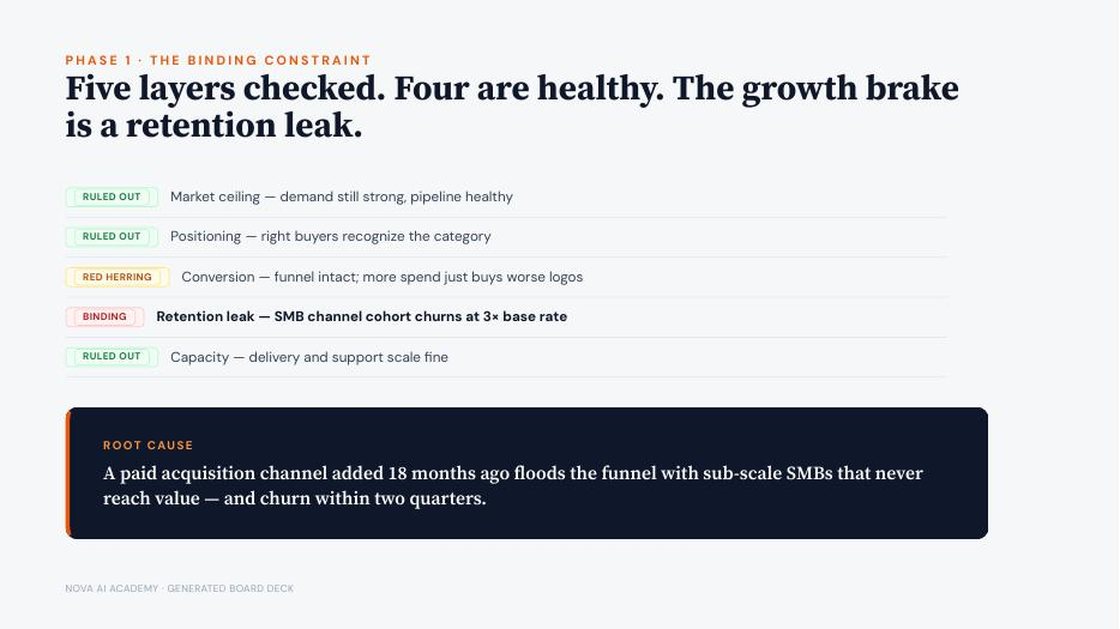
A root-cause diagnostic tests possible causes in order, market, positioning, conversion, retention and capacity, to find the binding constraint: the single factor that limits growth. At Northwind it is one paid ad channel whose customers churn at three times the base rate.
Takeaway: stop the paid ad channel now, improve onboarding for high-value accounts, and do not increase ad spend to replace the lost revenue.
Scores four genuinely different options and picks one.
How should Northwind grow?
| Option | Impact | Effort | Confidence | Fit |
|---|---|---|---|---|
| ★ Refocus on ICP | 5 | 2 | 4 | 5 |
| Move upmarket | 4 | 4 | 3 | 3 |
| Acquire a rival | 5 | 5 | 2 | 3 |
| Do nothing | 1 | 1 | 5 | 1 |
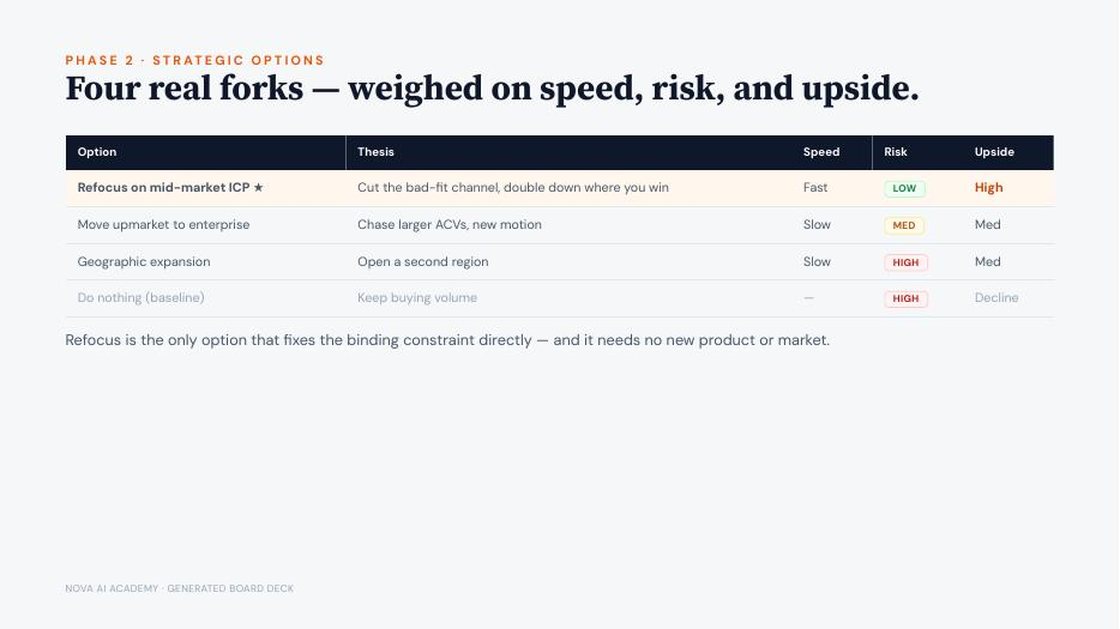
Each option is scored 1 to 5 on four criteria, impact, effort, confidence and fit, and plotted on an impact-effort 2×2 matrix to show which delivers the most for the least. Refocus on the ICP scores 5 on impact and 2 on effort.
Takeaway: refocus on the ICP: it needs no new capital, avoids competing with Vertex for enterprise customers, and moves budget to accounts that already grow.
Finds the assumption the plan cannot survive without, and prices the test.
The Refocus recommendation, ready to commit.
The assumption the plan depends on: that refocusing on the core won’t disturb the core. Never tested.
An assumption audit sorts every assumption as validated, unvalidated or contradicted, and flags the load-bearing ones: those the plan fails without. Northwind’s is that it can refocus on the core without disrupting it.
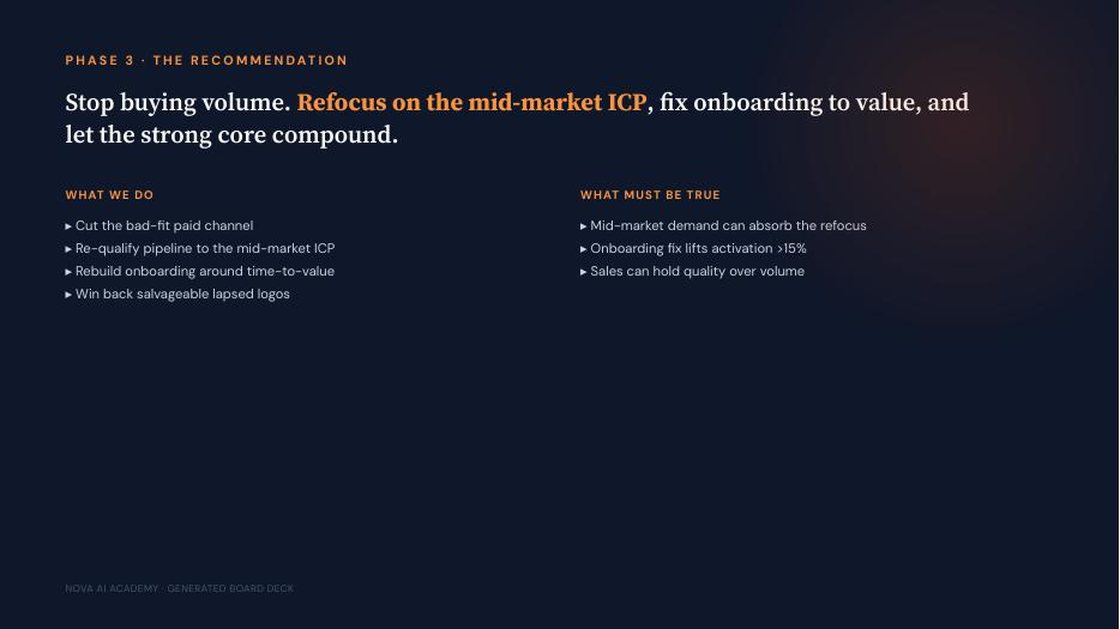
Takeaway: run the refocus as a 30-day pilot with stop criteria agreed in advance, before committing the full $2M.
Compresses nine steps into a board narrative and a specific ask.
The outputs of prompts 1–9.
“The slowdown is a retention problem, not a market problem — refocus and get back to 25%.”
The Pyramid Principle puts the answer first and the supporting arguments beneath it; the SCRAP structure orders the memo as Situation, Complication, Resolution, Action and Proof. Northwind’s answer: the slowdown is a contained retention problem driven by one acquired cohort, and refocusing returns growth to 25%.
Takeaway: open the board memo with the recommendation and the $2M request, and prepare the answer to the ad-spend question in advance.
What the ten steps add up to
The blended 96% NRR is a dangerous illusion hiding two opposite truths. The mid-market core remains highly lucrative and is actively expanding at 112%. The entirety of the 22-point retention collapse sits inside a single cohort — acquired through one bad ad channel, housed in the legacy SMB tier, and churning at over 35%. Because that cohort has swelled to roughly a third of the total customer base, its mathematical weight drags the healthy core down to 96%.
Reacting to the blended number leads to three expensive errors: cutting prices for customers who are already willing to pay more, chasing new segments while the core sits undefended against Vertex, and firing a CRO whose team is performing at historic levels. The mandate is simpler than any of them — stop paying to acquire the problem.
Three documents from Northwind’s ten prompts: the issue tree that reframed the board’s question, the evaluation of four growth options, and the board memo with its $2M ask.
Reframed as a question the data can answer: which customers are cancelling, and what do they have in common?
| Branch | What it tests | Priority |
|---|---|---|
| Acquisition | Channel mix · lead quality | Later |
| Activation | Speed to first value · onboarding | Later |
| Expansion | Upgrades · how much customers use it | Later |
| Churn | Which segment cancels · why customers downgrade | Investigate first |
Four options, each scored 1 to 5 on four criteria. Lower effort is better.
| Option | Impact | Effort | Confidence | Fit | Why |
|---|---|---|---|---|---|
| Refocus on the ideal customer profile | 5 | 2 | 4 | 5 | Recommended: no new capital, moves budget to accounts that already grow |
| Move upmarket | 4 | 4 | 3 | 3 | Competes directly with Vertex’s enterprise strength |
| Acquire a rival | 5 | 5 | 2 | 3 | Needs capital Northwind does not have |
| Do nothing | 1 | 1 | 5 | 1 | Scored honestly, as the baseline the board is entitled to see |
Board memo · answer first, in Situation, Complication, Resolution, Action and Proof order
Situation
$40M in annual recurring revenue. Growth has fallen from 40% to 12% in a year, and net revenue retention from 118% to 96%.
Complication
One paid ad channel brings in customers who churn at over 35% a year, against about 12% for healthy accounts. Split by cohort, the mid-market core is still expanding at 112%.
Resolution
Refocus on the ideal customer profile. Stop the ad channel and close the small-business tier at the same time. Growth returns to 25%.
Action
Reallocate $2M, 5% of revenue, from the eliminated channel and the closed tier. No net-new funding. Run it first as a 30-day pilot with stop criteria agreed in advance.
Prompt output, formatted for this page. In Claude each prompt returns it as a finished Word or Excel file; other tools return the same content as text and tables. The figures come from whatever you paste in. Northwind is fictional, so every number here is ours to show you.
All 10 prompts with full copy-paste templates and worked examples — a downloadable PDF plus a plain-text copy file. In Claude, every prompt ends in a finished Word or Excel file. Lifetime updates.
Instant download · lifetime updates
The pack ends with the documents above. The McKinsey-Grade PowerPoint Generator is a separate product, $19: paste the pack’s documents into it and it builds a board deck in Claude, as a real .pptx with native, editable charts.
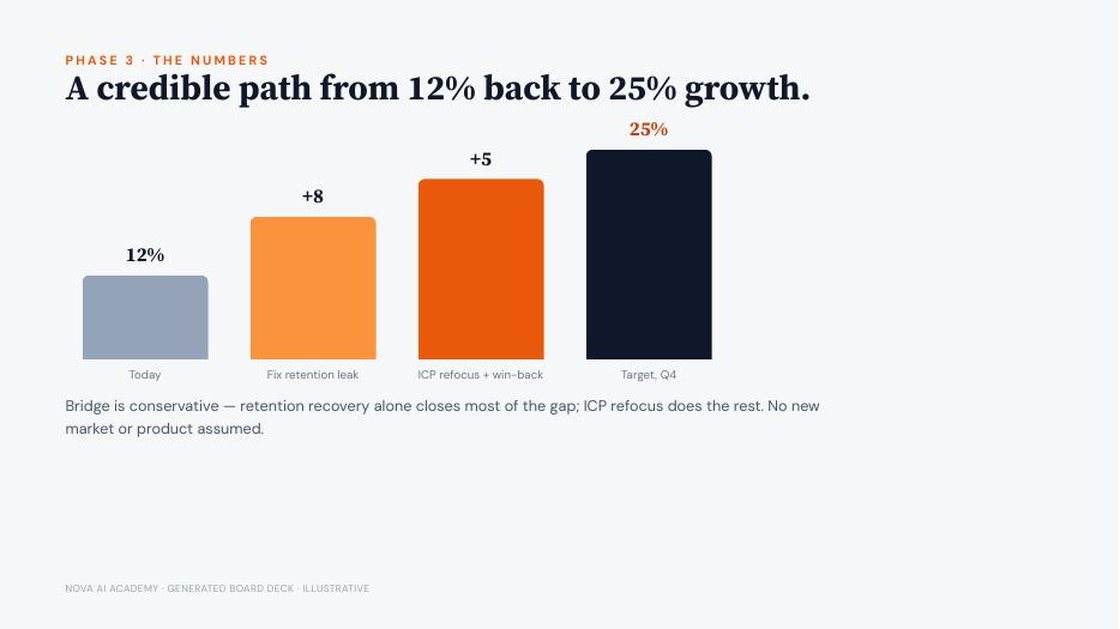
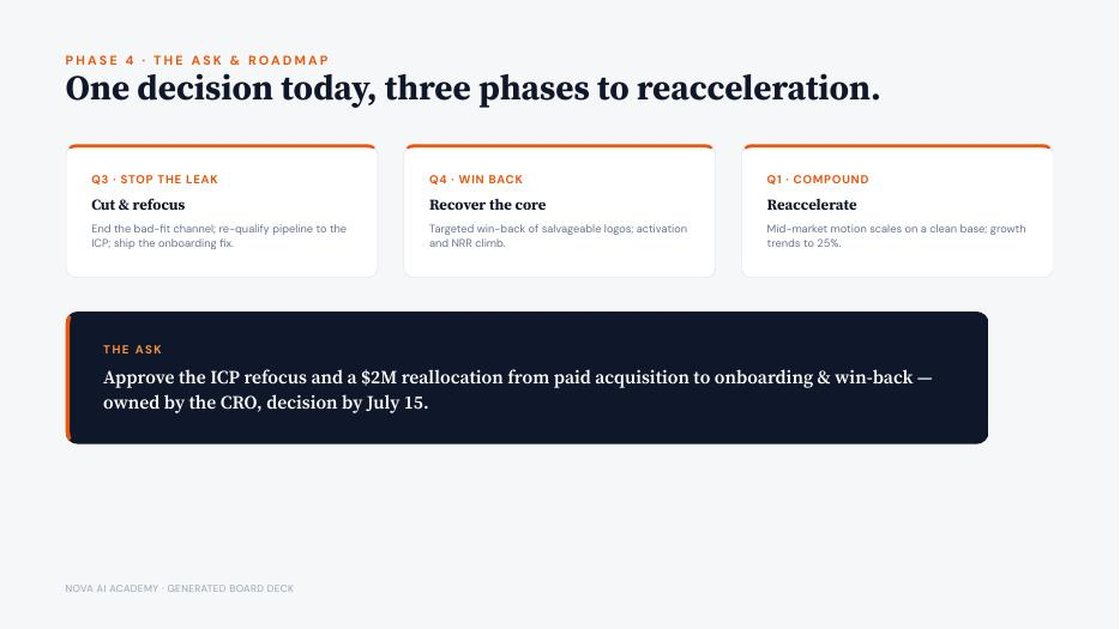
Below is Northwind’s, eight slides, unedited.
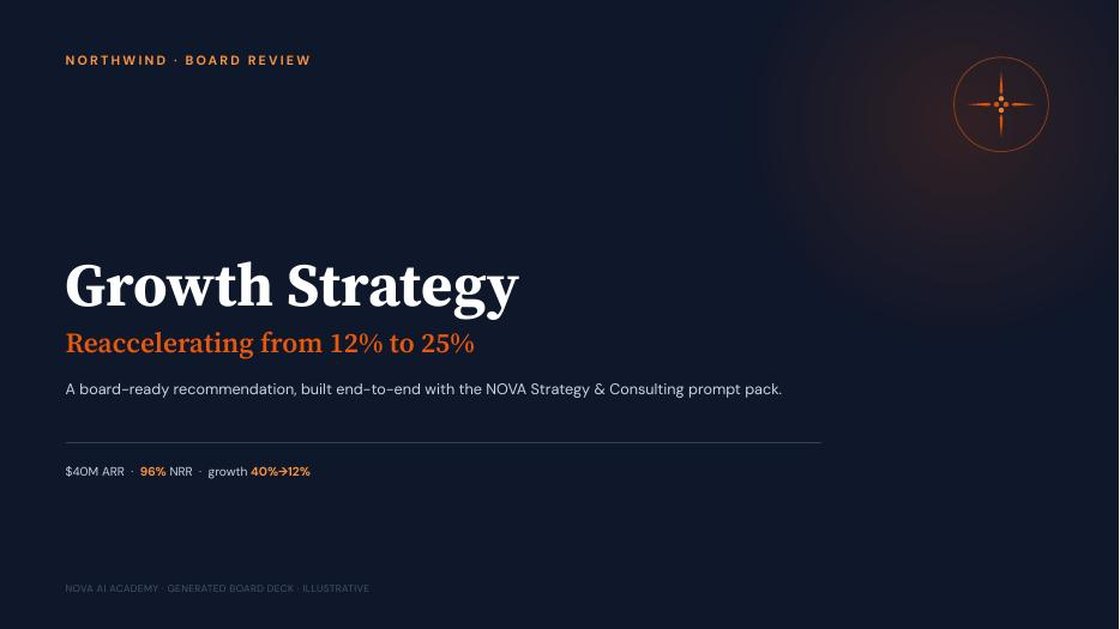
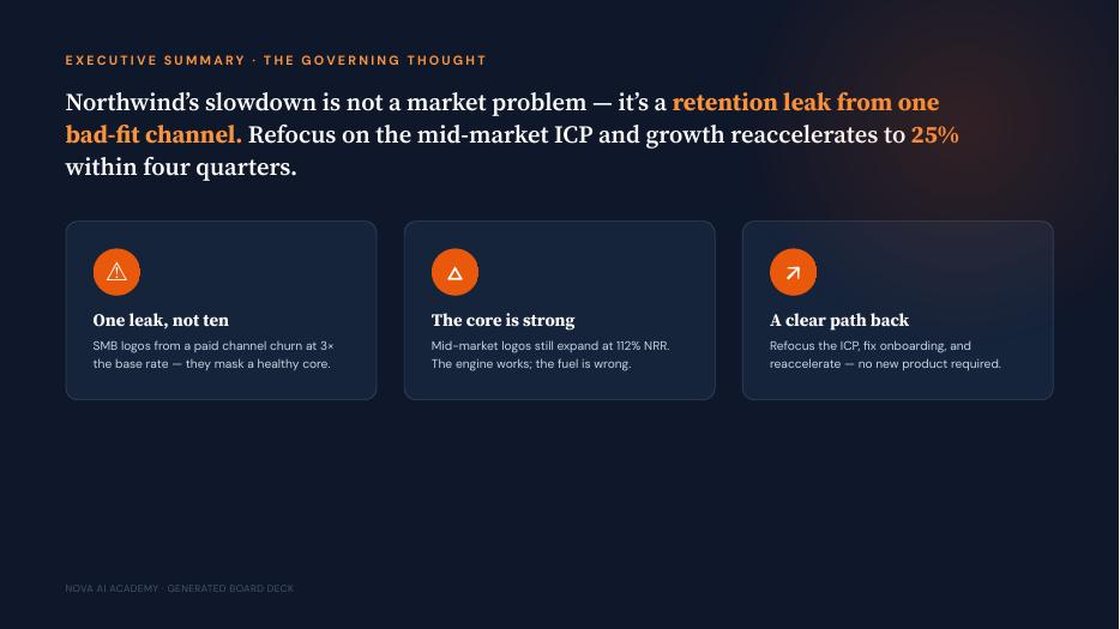
Northwind is a fictional company, so every number here is ours to show you. Generated in the NOVA house style.
Built in
as a real .pptx with native, editable charts. Or take both generators together in the bundle, $25.