01Frame
Problem Framing: Ask the Right Question (Issue Tree)
Reframes the board’s question into one the data can actually answer.
See it in Northwind’s examplePrompts for Work · Pack 1 · 10 prompt templates
12 of 12 quality checks passed
The Strategy & Consulting pack: 10 AI prompt templates for ChatGPT, Claude and Gemini
Turn a big business question into a clear recommendation. Describe the question the board is asking, and the strategy prompts frame the problem, size the market, analyse competitors with Porter’s Five Forces, find the real cause of slowing growth, compare your options and write the board memo with the ask.
Free guide: TAM, SAM and SOM: how to size a market
Real exampleIssue tree · Prompt 01
“Growth fell 40% → 12%. The board wants to know why.”
Why did growth fall from 40% to 12%?
Benefits of the strategy prompts
Four things the strategy prompts do, from the first question to the board decision.
The problem framing prompt turns the board’s question into one the data can actually answer, broken down in an issue tree.
The market sizing prompt builds the market from customers and prices, not a headline figure, and shows where the profit sits.
The root cause prompt tests each possible reason for a problem, such as slowing growth, and isolates the one that matters most.
The options prompt scores genuinely different choices and picks one, and the board memo prompt turns the work into a short story with a specific ask.
What is in the pack
Each strategy prompt works on its own. The prompt asks for what is needed and, in Claude, returns a finished Word or Excel file. Run the one you need, or run all ten in order.
Reframes the board’s question into one the data can actually answer.
See it in Northwind’s exampleGrades five parts of the business on evidence, not internal opinion.
See it in Northwind’s exampleAnalyses the competitor and estimates when its threat will reach Northwind’s customers.
See it in Northwind’s exampleSizes the market bottom-up and locates where the profit sits.
See it in Northwind’s exampleA conditional go on the adjacent segment, with spending released only after a pilot.
See it in Northwind’s exampleSplits the plan across three horizons and forces one divestment.
See it in Northwind’s exampleTests five possible causes and isolates the binding constraint.
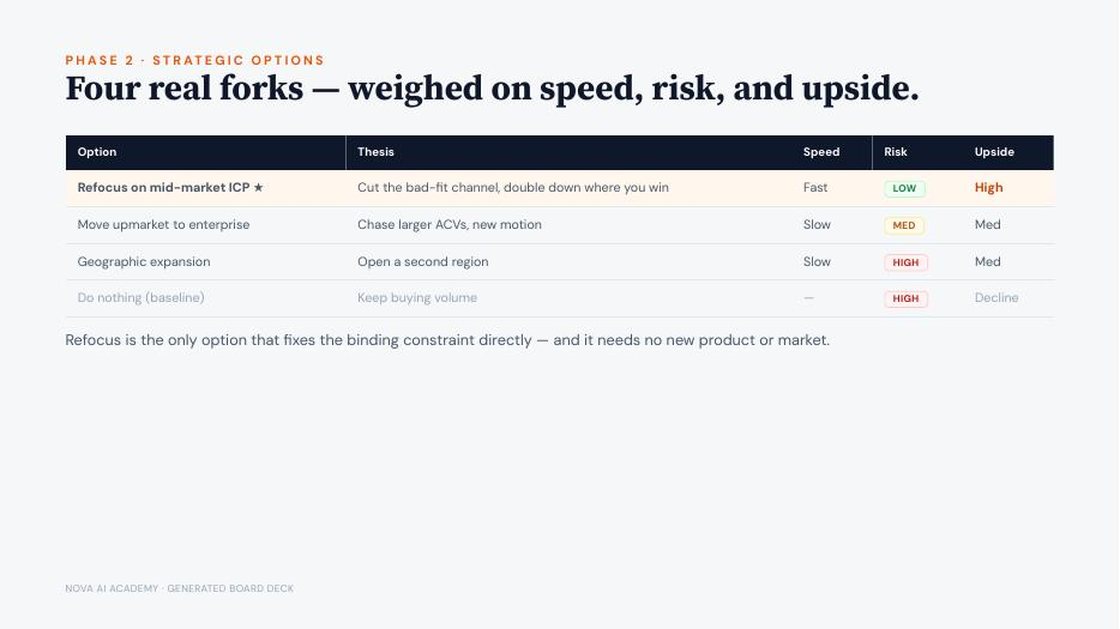
See it in Northwind’s exampleScores four genuinely different options and picks one.
See it in Northwind’s exampleFinds the assumption the plan cannot survive without, and prices the test.
See it in Northwind’s exampleCompresses nine steps into a board narrative and a specific ask.
See it in Northwind’s exampleWorked example
A $40M B2B SaaS company. Growth has stalled from 40% to 12% in a year, net revenue retention slid from 118% to 96%, and the board wants a plan. Here is how the ten prompts take Northwind from that starting point to an approved board recommendation, one step at a time.
This is a condensed view of how a top strategy consultant works a case. Each step below shows the reasoning behind the output, so you can follow the case from the first question through to the board ask. The prompt itself returns considerably more — pages of structured analysis, full tables, evidence grading and source reasoning.
Prompt 01 · Frame
What Northwind brought · CEO
“Growth fell 40% → 12%. The board wants to know why.”
What the prompt returned
“Which customers are cancelling, and what do they have in common?”
Takeaway: investigate which customers are cancelling and why, before changing the sales team or spending more on acquisition.
An issue tree breaks a broad question into smaller questions that are MECE (mutually exclusive, collectively exhaustive): no overlaps, and nothing left out. Applied to Northwind, it separates the symptom, slower growth, from its root cause in net revenue retention (NRR): the percentage of last year’s revenue that existing customers still pay this year, after upgrades, downgrades and cancellations.
Prompt 02 · Diagnose
What Northwind brought · Strategy lead
Raw metrics, customer notes, the competitor list.
What the prompt returned
Takeaway: fix which buyers Northwind acquires. Replacing the Chief Revenue Officer would not change the type of customers coming in.
A five-dimension diagnostic rates People, Process, Positioning, Performance and Pipeline separately, and evidence grading requires each rating to rest on data rather than internal opinion. Northwind’s leadership blames the sales team and praises the culture; the data says otherwise.
Prompt 03 · Analyze
What Northwind brought · Chief Revenue Officer
Rival “Vertex” — strong brand, slow product.
What the prompt returned
Takeaway: treat Vertex as a risk to next year’s renewals, and build a retention plan for mid-market customers now.
Porter’s Five Forces assesses the competitive pressure in an industry through rivalry, new entrants, supplier power, buyer power and substitutes; the competitor analysis then examines one rival on four vectors: product, sales model, positioning and hiring. Vertex leads on brand but lags on product, because it ships updates slowly.
Prompt 04 · Analyze
What Northwind brought · Strategy lead
Buyer counts × seats × average contract value.
What the prompt returned
Takeaway: the market is large enough for Northwind to grow. The priority is winning more firms that bill by the hour: the most profitable segment and Northwind’s ideal customer profile (ICP).
Bottom-up market sizing multiplies the number of buyers by seats and average contract value, and produces three figures: total addressable market (TAM), serviceable addressable market (SAM) and serviceable obtainable market (SOM).
Prompt 05 · Analyze
What Northwind brought · Head of Partnerships
Enter the RevOps-adjacent segment?
What the prompt returned
Takeaway: enter the RevOps segment through partners, and release the budget only after the 60-day pilot succeeds.
A market-entry assessment scores strategic fit, compares entry modes (build, partner or acquire) and ends in a go/no-go decision. The adjacent RevOps segment, the revenue operations teams that run sales and marketing systems, scores 6 out of 10 on fit.
Prompt 06 · Analyze
What Northwind brought · CFO
Apply Three-Horizons to the growth plan.
What the prompt returned
Takeaway: close the SMB tier and cut the ad channel at the same time, then move that money into the core business.
The Three Horizons model divides a portfolio into Horizon 1, the core business that earns today’s revenue; Horizon 2, emerging opportunities; and Horizon 3, longer-term bets. At Northwind, Horizon 1 funds RevOps (H2) and the platform bet (H3), yet receives the least investment.
Prompt 07 · Diagnose
What Northwind brought · Strategy lead
Funnel, retention, acquisition cost, capacity data.
What the prompt returned
Takeaway: stop the paid ad channel now, improve onboarding for high-value accounts, and do not increase ad spend to replace the lost revenue.
A root-cause diagnostic tests possible causes in order, market, positioning, conversion, retention and capacity, to find the binding constraint: the single factor that limits growth. At Northwind it is one paid ad channel whose customers churn at three times the base rate.
Prompt 08 · Decide
What Northwind brought · CEO
How should Northwind grow?
What the prompt returned
| Option | Impact | Effort | Confidence | Fit |
|---|---|---|---|---|
| ★ Refocus on ICP | 5 | 2 | 4 | 5 |
| Move upmarket | 4 | 4 | 3 | 3 |
| Acquire a rival | 5 | 5 | 2 | 3 |
| Do nothing | 1 | 1 | 5 | 1 |
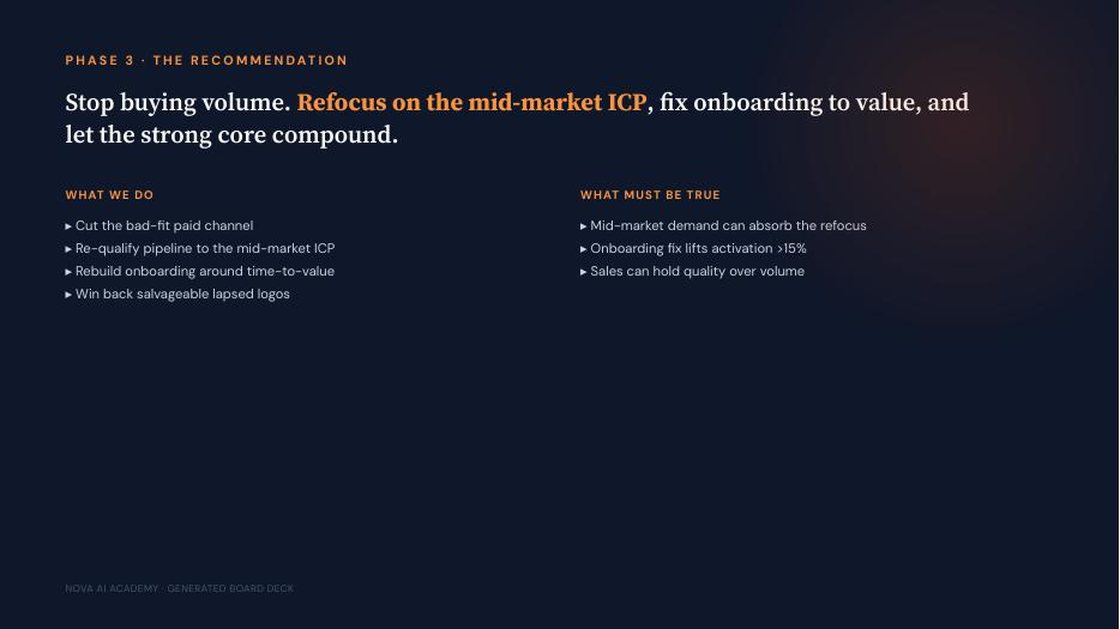
Takeaway: refocus on the ICP: it needs no new capital, avoids competing with Vertex for enterprise customers, and moves budget to accounts that already grow.
Each option is scored 1 to 5 on four criteria, impact, effort, confidence and fit, and plotted on an impact-effort 2×2 matrix to show which delivers the most for the least. Refocus on the ICP scores 5 on impact and 2 on effort.
Prompt 09 · Decide
What Northwind brought · CEO
The Refocus recommendation, ready to commit.
What the prompt returned
The assumption the plan depends on: that refocusing on the core won’t disturb the core. Never tested.
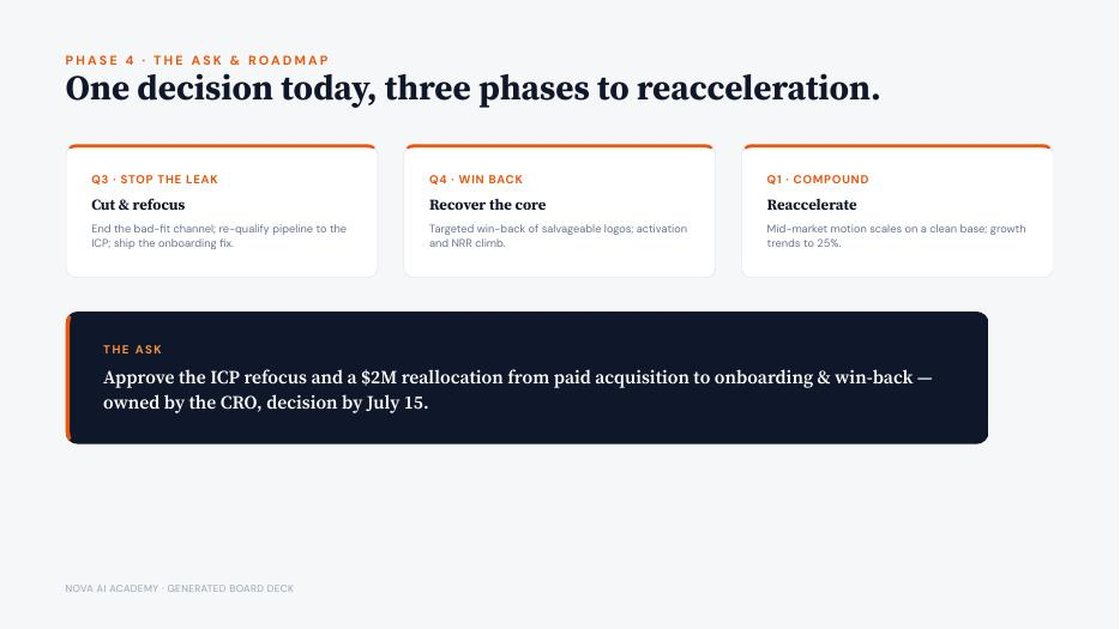
Takeaway: run the refocus as a 30-day pilot with stop criteria agreed in advance, before committing the full $2M.
An assumption audit sorts every assumption as validated, unvalidated or contradicted, and flags the load-bearing ones: those the plan fails without. Northwind’s is that it can refocus on the core without disrupting it.
Prompt 10 · Communicate
What Northwind brought · CEO
The outputs of prompts 1–9.
What the prompt returned
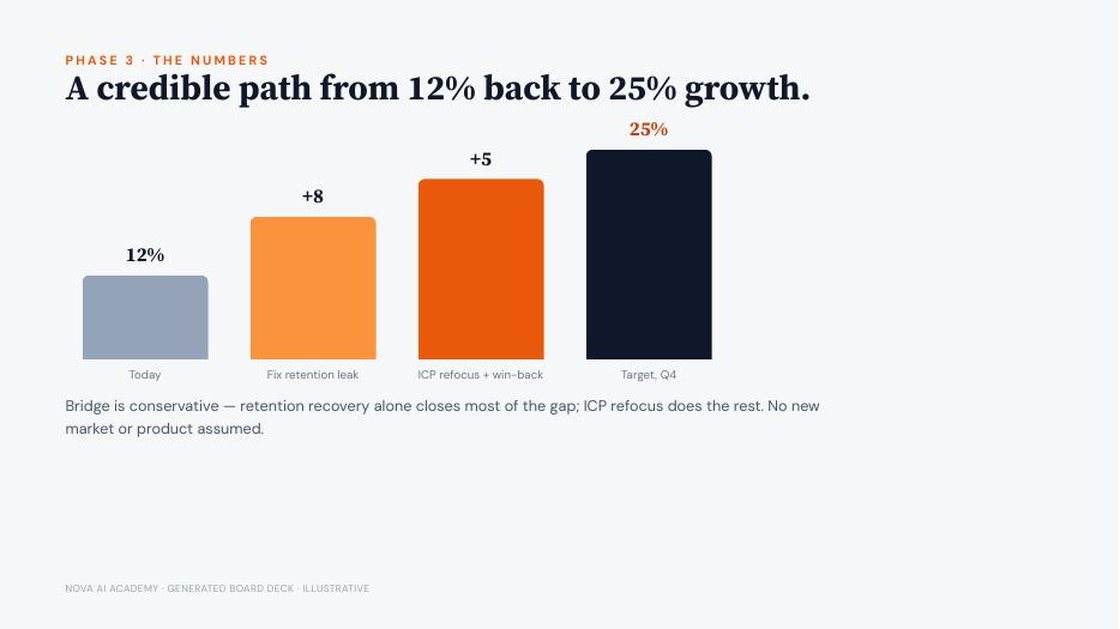
“The slowdown is a retention problem, not a market problem — refocus and get back to 25%.”
Takeaway: open the board memo with the recommendation and the $2M request, and prepare the answer to the ad-spend question in advance.
The Pyramid Principle puts the answer first and the supporting arguments beneath it; the SCRAP structure orders the memo as Situation, Complication, Resolution, Action and Proof. Northwind’s answer: the slowdown is a contained retention problem driven by one acquired cohort, and refocusing returns growth to 25%.
What the ten steps add up to
The blended 96% NRR is a dangerous illusion hiding two opposite truths. The mid-market core remains highly lucrative and is actively expanding at 112%. The entirety of the 22-point retention collapse sits inside a single cohort — acquired through one bad ad channel, housed in the legacy SMB tier, and churning at over 35%. Because that cohort has swelled to roughly a third of the total customer base, its mathematical weight drags the healthy core down to 96%.
Reacting to the blended number leads to three expensive errors: cutting prices for customers who are already willing to pay more, chasing new segments while the core sits undefended against Vertex, and firing a CRO whose team is performing at historic levels. The mandate is simpler than any of them — stop paying to acquire the problem.
Three documents from Northwind’s ten prompts: the issue tree that reframed the board’s question, the evaluation of four growth options, and the board memo with its $2M ask.
Why did growth fall from 40% to 12%?
Reframed as a question the data can answer: which customers are cancelling, and what do they have in common?
| Branch | What it tests | Priority |
|---|---|---|
| Acquisition | Channel mix · lead quality | Later |
| Activation | Speed to first value · onboarding | Later |
| Expansion | Upgrades · how much customers use it | Later |
| Churn | Which segment cancels · why customers downgrade | Investigate first |
How should Northwind grow?
Four options, each scored 1 to 5 on four criteria. Lower effort is better.
| Option | Impact | Effort | Confidence | Fit | Why |
|---|---|---|---|---|---|
| Refocus on the ideal customer profile | 5 | 2 | 4 | 5 | Recommended: no new capital, moves budget to accounts that already grow |
| Move upmarket | 4 | 4 | 3 | 3 | Competes directly with Vertex’s enterprise strength |
| Acquire a rival | 5 | 5 | 2 | 3 | Needs capital Northwind does not have |
| Do nothing | 1 | 1 | 5 | 1 | Scored honestly, as the baseline the board is entitled to see |
The slowdown is a retention problem, not a market problem
Board memo · answer first, in Situation, Complication, Resolution, Action and Proof order
Situation
$40M in annual recurring revenue. Growth has fallen from 40% to 12% in a year, and net revenue retention from 118% to 96%.
Complication
One paid ad channel brings in customers who churn at over 35% a year, against about 12% for healthy accounts. Split by cohort, the mid-market core is still expanding at 112%.
Resolution
Refocus on the ideal customer profile. Stop the ad channel and close the small-business tier at the same time. Growth returns to 25%.
Action
Reallocate $2M, 5% of revenue, from the eliminated channel and the closed tier. No net-new funding. Run it first as a 30-day pilot with stop criteria agreed in advance.
Prompt output, formatted for this page. In Claude each prompt returns it as a finished Word or Excel file; other tools return the same content as text and tables. The figures come from whatever you paste in. Northwind is fictional, so every number here is ours to show you.
Yes. The market sizing prompt sizes the market from the bottom up, from customers, usage and prices, and shows where the profit sits. In Claude, every prompt ends with a finished Word or Excel file.
Yes. The competitor analysis and strategy framework prompts apply Five Forces, SWOT and Three Horizons to your own business, and say what each one means for the decision.
Yes. The board memo prompt turns the analysis into a short board narrative with a specific ask, and prepares answers to the questions the board is most likely to ask.
ChatGPT, Claude and Gemini. In Claude, every prompt ends with a finished Word or Excel file. ChatGPT and Gemini return the same content as text and tables.
Pack 1 · Strategy & Consulting
Paste the pack’s documents into the AI PowerPoint generator, a separate product at $19, and Claude builds the board presentation as a real .pptx file with editable PowerPoint charts.
Below is Northwind’s, eight slides, unedited.
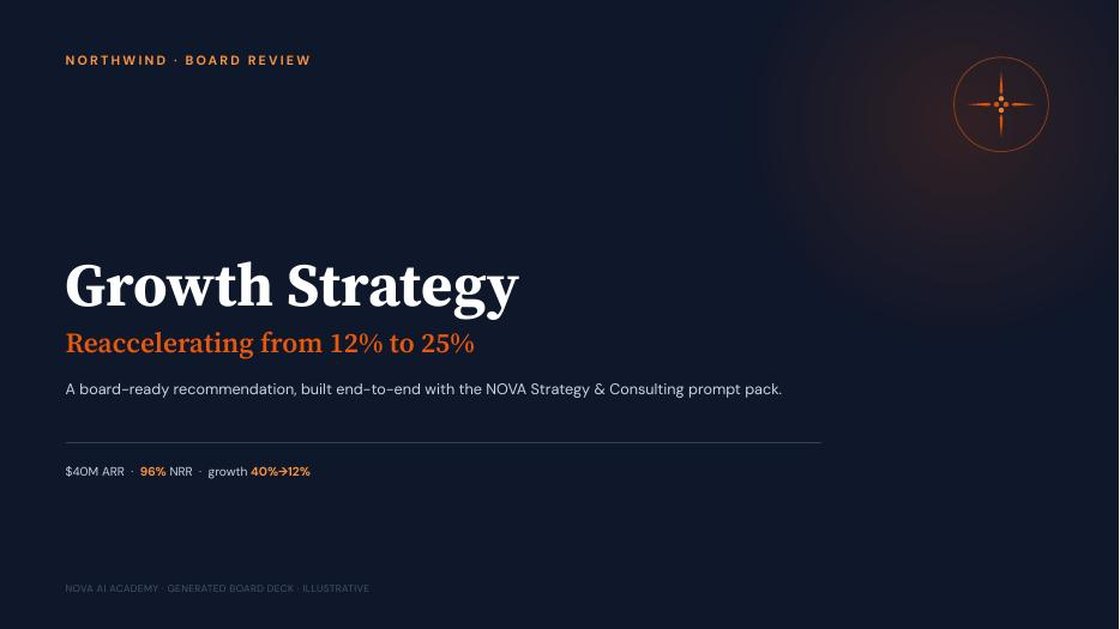
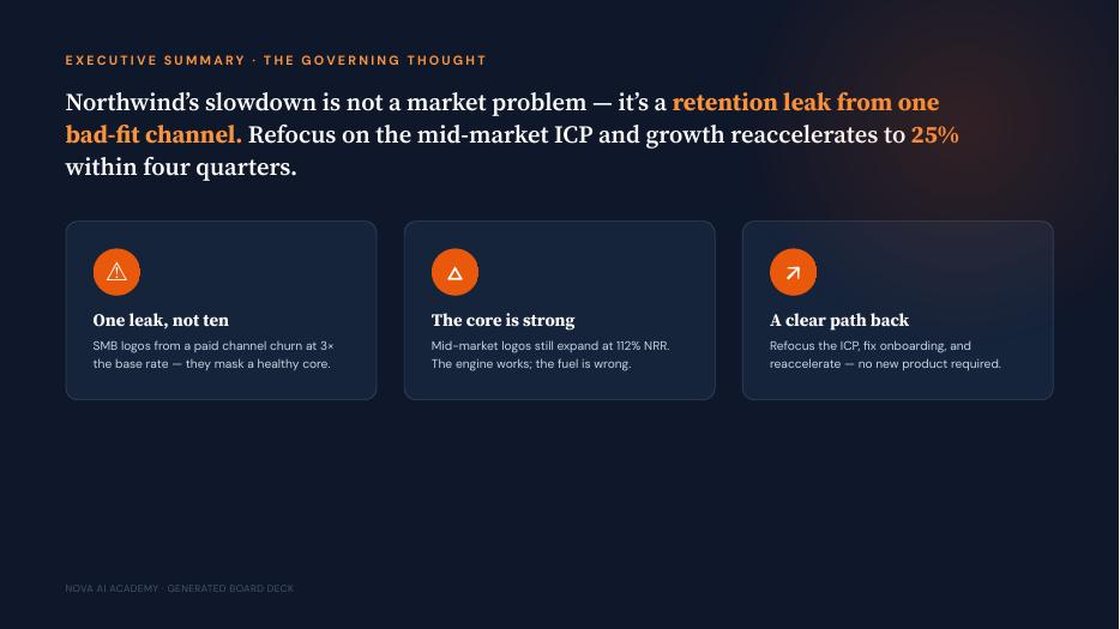
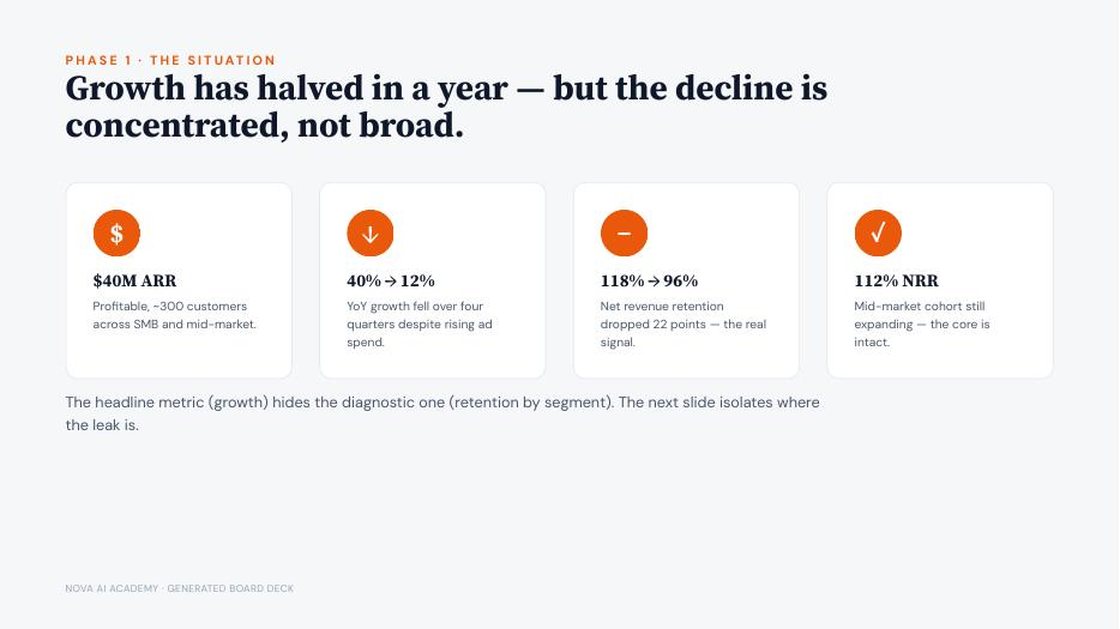
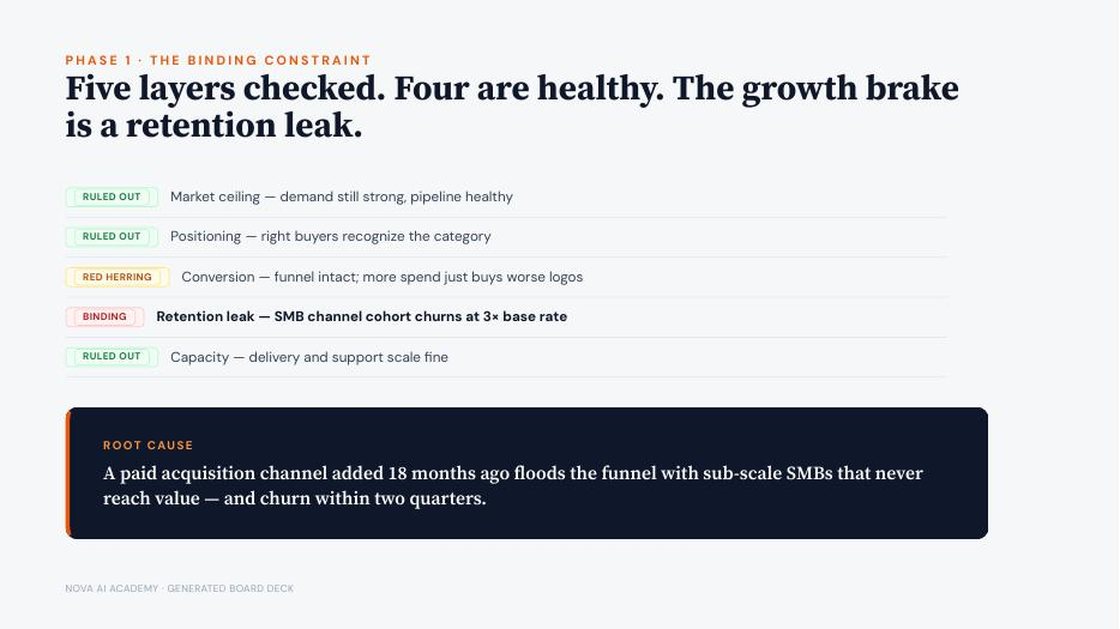
Northwind is a fictional company, so every number here is ours to show you. Generated in the NOVA house style.
 Want the presentation built for you?
The AI PowerPoint Generator — $19
Built in  as a real .pptx file with editable charts. Or take both generators together in the bundle, $25.
Nine packs for work, from strategy and finance to sales, HR and operations, each written to the same standard with its own worked example.