Prompts for Life · Pack 12 · 10 prompt templates

Side Business & Freelancing
AI Prompt Templates

Ten prompts that take a side business from the first offer to the quarterly review. Every hour is counted, every project has a written scope before it starts, and tax is set aside from every payment.

ChatGPT, Claude & Gemini Instant download No subscription Lifetime updates Best in Claude: an Excel model and a Word proposal

Define, price, win, deliver, run

Run any prompt on its own, or run all ten in order. Each output feeds the next, building one Business Brief that every price, proposal and review draws on.

Four rules in every prompt

These are what stop the AI giving generic freelancing tips instead of a business built on your own numbers.

Effective hourly rate, not the quoted rate

Every hour is counted, billed or not. The effective hourly rate is revenue divided by all hours, and every pricing decision is tested against it.

Scope in writing before work starts

No work starts without a statement of work fixing deliverables, revisions, timeline and price. Anything more is a change order, quoted first.

Cash flow, not revenue

An invoice is not income until it is paid. Deposits and payment terms are set before the work, and tax is set aside from every payment.

Protect the day job

The employment contract is checked for outside-work, IP and non-compete clauses first. Business work uses its own hours, equipment and accounts.

One side business, all ten prompts

Grace Lin is a 36-year-old marketing manager in Chicago who writes website copy for small businesses in the evenings and at weekends. In 2025 she quoted $45 an hour and billed 410 hours across nine clients: $18,450. She also worked 200 hours of revisions she never billed, one client paid a $3,600 invoice 94 days late, and in April 2026 she owed $6,134 of tax with nothing set aside. Here is how the ten prompts took her from $30 an hour to $87, one step at a time.*

$30

an hour effective, against $45 quoted

200

hours of revisions never billed

94 days

to collect a $3,600 invoice

$6,134

of tax, with nothing set aside

Step 1 · Define

Business Idea Validation & Value Proposition

Tests whether people will pay for what you offer, defines the value proposition, and checks the employment contract.

Customer discoveryValue propositionContract check

What Grace brought · her 2025 client list

“I’ll write copy for anyone who asks. Last year I had nine clients.”

What the prompt returned

Three of the nine were independent physical therapy and chiropractic clinics: 54% of her revenue and the fewest revisions. Her contract allows outside work that she discloses, outside her employer’s industry.

2025 clients9, in 7 industries, at $45 an hour
Clinics3 clients, $9,900 of $18,450 (54%), fewest revisions
Value propositionwebsite copy that turns clinic website visitors into booked patients
Contract checkdisclose outside work; no clients in her employer’s industry; done

The analysis · Nine clients in seven industries earned her $30 an hour

A value proposition is the specific result a client pays for, and the reason to buy it from you rather than someone else. Customer discovery, Steve Blank’s method, tests an idea with real buyers before building it: only payments and commitments count as evidence.

  • $9,900 from 3 clinics: a third of her clients produced more than half her revenue, because clinics bought whole websites and asked for fewer changes.
  • A clause she had never read: her employment contract requires written disclosure of outside work and bars clients in her employer’s industry. She disclosed in May; clinics are outside it.
  • One client type: every later prompt is built for independent clinics, not for anyone who asks.

Takeaway: choose the client type your record shows pays best, and check the employment contract before the first client.
Step 2 · Define

Target Market & Ideal Client Profile

Sizes the market for your offer and defines the one type of client to pursue first.

TAM, SAM, SOMIdeal client profileBuying triggers

What Grace brought · clinic directories

“Chicago has a lot of clinics. I just don’t know how many.”

What the prompt returned

TAM: about 2,400 independent clinics in Illinois. SAM: 1,140 in the Chicago area. SOM: 12 clients a year, which is what her hours can serve.

TAMabout 2,400 independent clinics in Illinois, about $5.8M at $2,400 each
SAM1,140 in the Chicago area, about $2.7M
SOM12 clients a year, $28,800
Buying triggera new location, a new service, or a website older than five years

The analysis · 12 clients from a list of 1,140, in place of anyone who asks

TAM is all potential revenue for the offer; SAM is the part you can reach and serve; SOM is the share you can realistically win in a year. An ideal client profile describes the client who gains most and is easiest to win.

  • 1,140 reachable clinics: state licensing lists and two clinic associations give names, locations and owners.
  • 12 a year: at 24 hours a package and 8 hours a week, capacity, not demand, sets the limit.
  • Buying triggers: a second location, like Lakeview’s, is the moment a clinic rewrites its website.

Takeaway: size the market in clients you can actually reach, and set the target from your available hours.

Step 3 · Price

Pricing Strategy (Cost-Plus, Market Rate, Value-Based)

Sets the price from three angles — your costs, the market, and the value to the client — and packages the offer.

Cost-plusMarket rateValue-based pricing

What Grace brought · competitors’ prices

“I charged $45 an hour. Other writers seem to charge anything from $60 to $120.”

What the prompt returned

Floor $1,800. Market $1,500 to $3,000. One new patient is worth about $1,500 to a clinic. Price: $2,400 for five pages and two revision rounds.

2025 price$45 an hour, open-ended revisions
Cost-plus floor24 hours at $75 = $1,800
Market rate$1,500 to $3,000 for a five-page site
Package$2,400: five pages, two revision rounds; extra page $400, extra round $300

The analysis · An hourly rate charged the client for her revisions and paid her for none

Cost-plus pricing starts from hours and costs plus a margin, and sets the floor. Market-rate pricing reads what comparable providers charge. Value-based pricing starts from what the result is worth to the client.

  • $1,500 a patient: Lakeview’s own figure for the revenue from one new patient. The package pays for itself with two.
  • $2,400, fixed: in the middle of the market range, $600 above the floor, and a fixed price the client can compare with two patients.
  • Extras priced in advance: $400 a page and $300 a revision round, so change orders are never negotiated from scratch.

Takeaway: price between the cost floor and the value to the client, and sell a defined package rather than hours.

Step 4 · Price

Break-Even Analysis & Effective Hourly Rate

Models revenue, costs and every hour worked, finds the break-even point, and builds the pricing model spreadsheet.

Contribution marginBreak-even pointExcel model

What Grace brought · her 2025 figures

“Last year: $18,450 for 410 billed hours. I didn’t count the revisions.”

What the prompt returned

2025: $18,450 over 610 hours, $30 an hour. Plan: 12 packages, $28,800, 348 hours, $83 an hour. Built in Claude as a working Excel model.

2025 effective rate$18,450 ÷ 610 hours = $30
Contribution margin$2,400 − $60 = $2,340 a package
Break-even point1 package covers $1,140 of fixed costs
2026 plan12 packages, $26,940 profit before tax, 348 hours, $83 an hour

The analysis · 200 unbilled hours cut her $45 rate to $30

The contribution margin is the price minus the costs that vary with each sale. The break-even point is the number of sales at which contribution covers fixed costs. The effective hourly rate is revenue divided by every hour worked, billed or not.

  • 610 hours, not 410: the 200 hours of revisions were never billed, so her real rate was a third below the quoted one.
  • 8 packages, 192 hours: eight packages match all of 2025’s revenue in 192 hours, against 610.
  • ±20% sensitivity: a 20% lower price still leaves $21,180 of profit; 20% more hours per package cuts the effective rate to $71.

Takeaway: count every hour, and test each price against the effective hourly rate it produces.

Step 5 · Win

Client Outreach & Sales Pipeline

Builds the list of prospects, writes the outreach, and tracks each prospect through the stages of the sales pipeline.

Sales pipelineConversion rateDiscovery call

What Grace brought · the clinic list

“My clients have all found me by word of mouth. I’ve never sold anything.”

What the prompt returned

60 clinics contacted over eight weeks: 14 replies, 8 calls, 5 proposals, 3 signed.

Contacted60 clinics, each named for a trigger
Replied14 (23%)
Calls and proposals8 calls, 5 proposals
Signed3 of 5 proposals (60%), including Lakeview

The analysis · Word of mouth gave her clients she did not choose

A sales pipeline is the set of prospects at each stage of buying: contacted, replied, call held, proposal sent, won or lost. The conversion rate is the share that moves from one stage to the next, and shows where sales are lost.

  • 23% replied: each message named the clinic’s situation, such as a new location or an outdated site, and asked for a 15-minute call.
  • 5 proposals, 3 signed: the discovery call confirmed budget, decision-maker and deadline before any proposal was written.
  • A visible loss point: most losses came before the call, so the next quarter’s work is on the first message.

Takeaway: track every prospect through each stage, so you can see where sales are lost.

Step 6 · Win

Proposal & Statement of Work

Writes the proposal and the statement of work that fixes deliverables, revisions, timeline and price, as a Word document.

ProposalStatement of workWord document

What Grace brought · her discovery call notes

“Lakeview Physical Therapy wants its site rewritten before its second location opens in September.”

What the prompt returned

Five pages, two revision rounds, four weeks, $2,400: 50% deposit, balance due 14 days after delivery. Built in Claude as a two-page Word proposal.

Deliverablescopy for five named pages, with page titles and descriptions
Revisionstwo rounds, each one set of consolidated comments
Not includeddesign, building, photography, extra pages
Terms$1,200 deposit, $1,200 due 14 days after delivery; extras priced

The analysis · Her 2025 projects had no written scope at all

A statement of work (SOW) fixes the scope: deliverables, number of revision rounds, timeline, what the client provides, price and payment terms. Scope that is not written down becomes unpaid work.

  • A defined revision: one set of consolidated comments on all pages, returned within five business days. In 2025, every message was a new revision.
  • What Lakeview provides: site access and therapist biographies by the kick-off call, and one person to consolidate comments.
  • Signed with a deposit: work began on 22 June 2026, after signature and a $1,200 deposit.

Takeaway: put deliverables, revisions, exclusions and payment terms in writing before any work starts.

Step 7 · Deliver

Contract Terms & Scope Control

Sets the contract terms that protect you, and handles requests outside the agreed scope with change orders.

Scope creepChange orderPayment terms

What Grace brought · Lakeview’s request

“Lakeview approved the pages, then asked for three more.”

What the prompt returned

A change order for three extra pages at $400 each, $1,200, with the new delivery date. Approved by email before the work started.

Requestthree pages not in the statement of work
Change order3 × $400 = $1,200; delivery moved by one week
Approvedby email, before any work on the new pages
Contract termsownership passes on full payment; revisions capped

The analysis · Requests like this became 200 unbilled hours in 2025

Scope creep is work added after the price was agreed. A change order is a written amendment that adds the work and its price before it is done.

  • $1,200 billed: the same kind of request, from 2025 clients, was absorbed into her 200 unbilled hours.
  • Ownership on payment: the copy becomes the client’s when the final invoice is paid, which gives the payment terms force.
  • No refusal needed: the reply thanked Lakeview, confirmed the pages were outside the SOW, and attached the change order.

Takeaway: quote every out-of-scope request as a change order, and wait for written approval before doing it.

Step 8 · Deliver

Invoicing, Payment Terms & Collections

Sets the invoicing routine, payment terms and reminders, and tracks unpaid invoices until they are paid.

Accounts receivableDays sales outstandingPayment terms

What Grace brought · a year of invoices

“One client paid $3,600 ninety-four days late. I didn’t want to nag.”

What the prompt returned

A 50% deposit before work, the balance due 14 days after delivery, a late fee stated in the SOW, and four reminders set up in advance.

2025 DSO38 days on average; one invoice at 94 days
Deposit50% on signature
Reminders3 days before due, on the due date, 7 and 14 days late
Q3 2026 DSO9 days

The analysis · A $3,600 invoice took 94 days to collect

Accounts receivable is money invoiced but not yet paid. Days sales outstanding (DSO) is the average number of days it takes to be paid. Payment terms such as net 14 set the due date.

  • No terms in 2025: invoices said "thank you" and nothing about when payment was due.
  • Half paid before work: the deposit means no project can leave her with nothing.
  • From 38 days to 9: deposits and scheduled reminders cut the average wait by four weeks.

Takeaway: set the deposit, terms and reminders before the work starts, not after the invoice is late.

Step 9 · Run

Business Finances & Tax Set-Aside

Separates the business finances, sets the tax set-aside rate, and plans the estimated tax payments.

Self-employment taxEstimated paymentsSet-aside rate

What Grace brought · her tax bill

“I owed $6,134 in April and had nothing put aside.”

What the prompt returned

2025 tax: self-employment tax $2,446, federal income tax $2,831, Illinois $857: 35% of profit. Plan: set aside 35% of every payment; $2,357 a quarter.

2025 tax on side income$6,134, from $17,310 of profit
Set-aside rate35% of profit, moved on the day each payment arrives
Accountsseparate business checking and a tax savings account
2026 payments$2,357 a quarter, or higher withholding at the day job

The analysis · $6,134 of tax arrived with nothing set aside

In the US, side-business profit carries self-employment tax (Social Security and Medicare) as well as income tax. It is usually paid during the year through quarterly estimated payments, or by raising withholding at the day job.

  • 35%, not a guess: the rate comes from her own 2025 bill divided by her profit, not a rule of thumb.
  • One account for business: separate accounts make the expense record, the set-aside and the tax return simpler.
  • A question for her adviser: whether higher withholding at her day job is simpler than quarterly payments.

Takeaway: set aside tax from every payment as it arrives, at a rate calculated from your own figures.

Step 10 · Run

Quarterly Business Review

Reviews the quarter’s revenue, profit, hours and pipeline against the plan, and decides prices and priorities for the next quarter.

KPIsWin ratePrice review

What Grace brought · her third quarter

“First full quarter on the new system. Is it working?”

What the prompt returned

July to September 2026: $10,800 revenue, 124 hours, $87 an hour, 9.5 hours a week. $3,596 set aside for tax.

Revenue$10,800: four packages and one $1,200 change order
Effective rate$87 an hour, against $30 in 2025
Hours124, 9.5 a week, against a plan of 8
Win rate3 of 5 proposals (60%): the price is low

The analysis · $87 an hour, almost three times 2025

A quarterly business review compares results with the plan using a few key performance indicators (KPIs). For a side business, it also checks the hours against the day job.

  • $10,800 in one quarter: 59% of all 2025 revenue, in a fifth of the hours.
  • A 60% win rate: winning most proposals usually means the price is below what clients would pay.
  • $2,800 from January: the package price rises by $400, and the effective rate is re-checked next quarter.

Takeaway: review a few numbers every quarter, and raise the price when you win most proposals.

The finale · what prompts 04, 06 and 10 produce

What Grace built

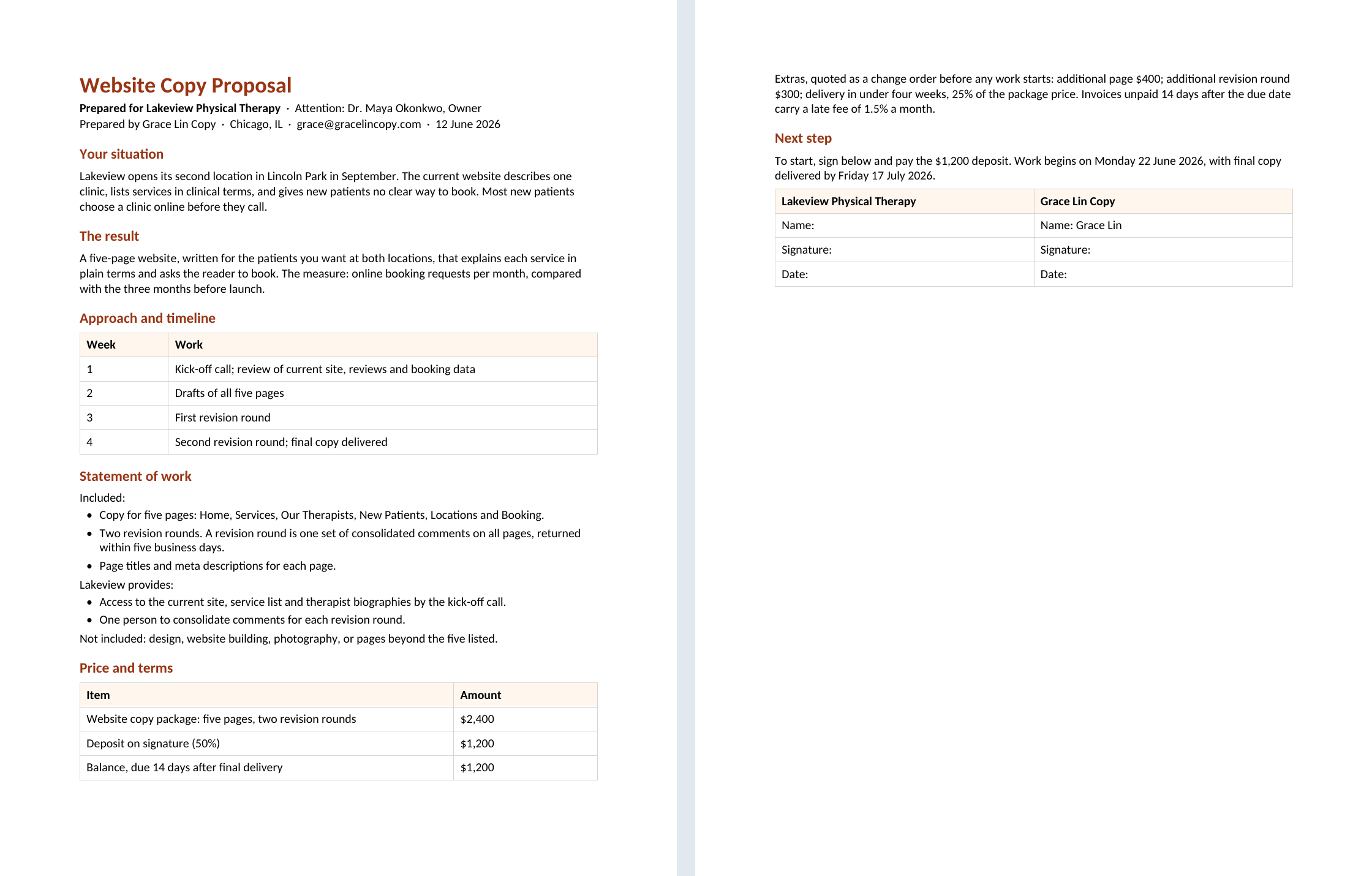
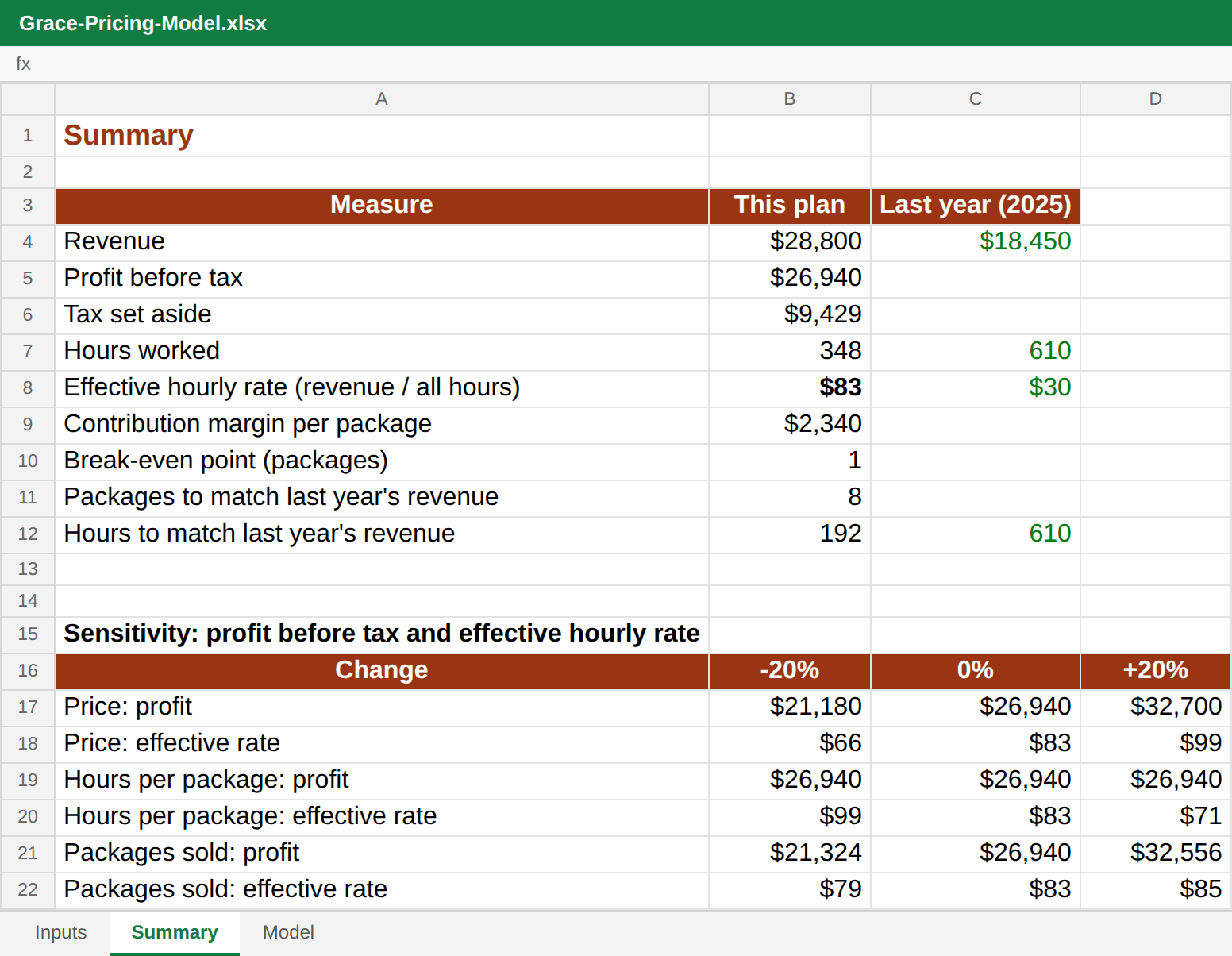
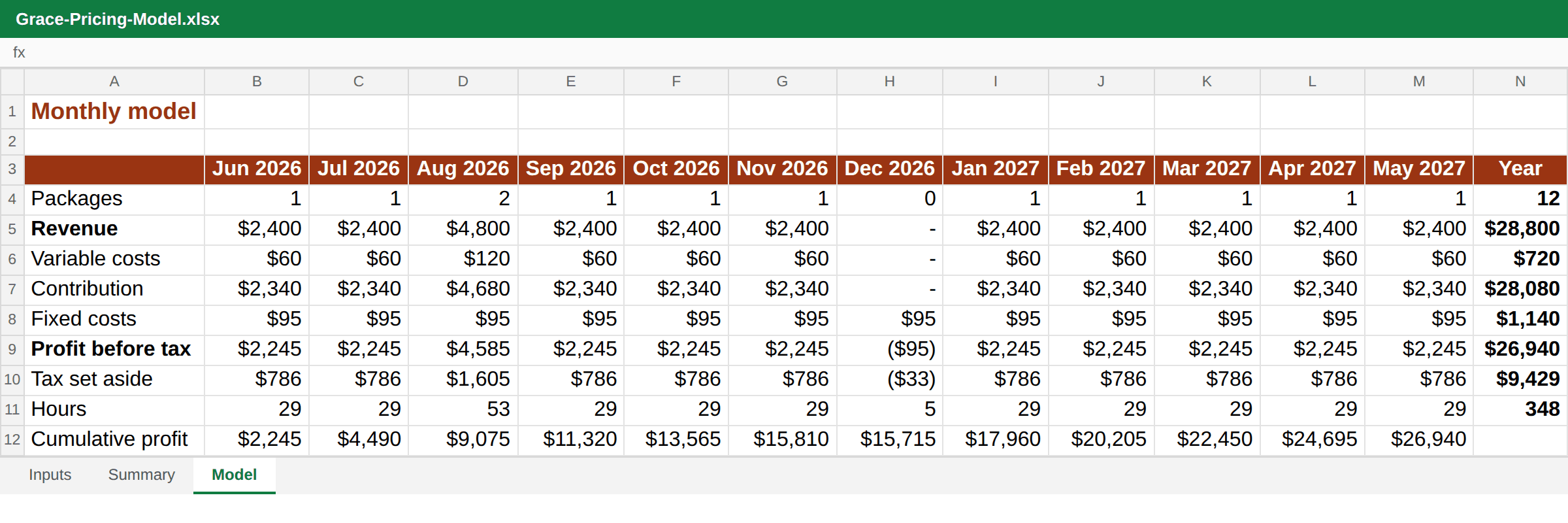
Three documents from Grace’s Business Brief: the pricing model from prompt 04, the Lakeview proposal from prompt 06, and the third-quarter review from prompt 10.

Pricing model — June 2026 to May 2027

Summary sheet and the monthly model

Grace-Pricing-Model.xlsx
Effective rate: $83 an hour

Pricing model summary: $28,800 revenue, $26,940 profit, 348 hours, $83 an hour against $30 in 2025, with a sensitivity tableMonthly model from June 2026 to May 2027: packages, revenue, contribution, profit, tax set aside and hours
The Excel model built in Claude to prompt 04’s specification.

Website Copy Proposal — Lakeview Physical Therapy

Proposal and statement of work, two pages

Business-Proposal-Lakeview.docx
$2,400 · signed 19 June 2026

Two-page Word proposal for Lakeview Physical Therapy with situation, result, timeline, statement of work, price and terms, and signature block
The Word proposal built in Claude to prompt 06’s specification.

Quarterly business review — July to September 2026

KPIs against the plan in the pricing model

Hours: 9.5 a week
Tax set aside: $3,596

KPIPlanActualCause
Revenue$9,600$10,800+$1,200: the Lakeview change order
Profit before tax$9,075$10,275Includes the change order
Hours111124+13: change order and extra outreach
Effective hourly rate$86$87On plan
Proposals won3 of 5 (60%)High: price below what clients will pay
Days to payment149Deposits and reminders
Tax set aside$3,176$3,59635% of profit

Client review. All four clinics are repeat prospects for new locations. No client to drop.

Hours check. 9.5 hours a week against a plan of 8, with no overlap with the day job. The extra hours were paid by the change order.

Next quarter. Raise the package to $2,800 from January 2027; hold four packages a quarter; cut outreach time with a second referral request.

Decision. Hold the volume and raise the price. A 60% win rate shows clients would pay more.

Prompt output, formatted for this page. In other AI tools the prompts return the same content as tables and text; the figures come from whatever you paste in. Grace Lin and her clients are fictional, so every number here is ours to show you.

Pack 12 · Side Business & Freelancing

Ten prompt templates, one running brief

  • Idea validation, value proposition, target market and employment contract check
  • Pricing strategy and break-even model, built as a working Excel model in Claude
  • Sales pipeline, and the proposal and statement of work as a Word document in Claude
  • Contract and scope control, invoicing and collections, tax set-aside, quarterly review
  • Text file and formatted PDF · ChatGPT, Claude and Gemini · best in Claude

$15

One-time purchase · instant download

Get the pack

* Grace Lin, Lakeview Physical Therapy, the people named and all figures on this page are fictional and used for illustration only. Output depends on the information you supply and the AI tool you use. Contract and tax outputs are general information, not legal or tax advice; tax, contract and employment rules differ by country and state.

More Prompts for Life

Nine packs for everyday life, from career and money to travel and health, each written to the same standard with its own worked example.

See all Prompts for Life
Back to The Prompt Library