Prompts for Life · Pack 17 · 10 prompt templates

School, University & MBA
Application AI Prompt Templates

Ten prompts that take an application from a long list to a signed offer, at any level: school entry, high school, undergraduate, postgraduate or MBA. Every prompt asks the level first, so each one works on its own.

ChatGPT, Claude & Gemini Instant download No subscription Lifetime updates Best in Claude: a deadline tracker and a Word essay

Choose, plan, write, test and interview, decide

Every prompt asks for the application level first, so any one of them runs on its own. Run them in order and each output feeds the next, building one Application Brief.

Four rules in every prompt

These are what stop the AI inventing a deadline, a course, an admission statistic or an achievement you never had.

Deadlines rule everything

Every date is worked backwards with its lead time: test registration and results, references, aid forms, portfolios. A missed date cannot be appealed.

Their voice, their material

Essays are drafted only from what the applicant supplies, in their own register. No activity, achievement or result is ever invented.

Evidence over adjectives

"Led the team" is not a claim until it says what, for how long, with how many people and what changed. Every claim carries its specifics.

Verify at the source

Requirements, deadlines, test policies and fees change yearly and differ by country. Everything about a school is marked to confirm at the source.

One application, all ten prompts

Dev Sharma is 17, in his final year at a public high school in New Jersey, applying to US universities with his mother keeping track. In August he had twelve schools chosen from rankings, no idea which were realistic, a 1380 SAT against target medians he had not looked up, 38 dated items he had not written down, and one essay draft that could have been written by anyone. Here is what the ten prompts did with the list, the calendar, the essays, the test and four offers.* The same ten work for school entry, postgraduate study or an MBA: each asks the level first.

12

schools chosen from rankings, none checked

38

dated items, none of them on a calendar

1380

SAT, against a 1480 median at his top choices

14

supplementary essays he had not started

Step 1 · Choose

Shortlist & Compare Schools

Turns a long list into a scored shortlist of reach, match and safe schools, against what actually matters to you.

Weighted criteriaReach, match, safeCost after aid

What Dev brought · a list off a ranking site

“Twelve universities off a ranking list. I don’t know which are realistic.”

What the prompt returned

Twelve scored against his weighted criteria: nine kept, three dropped. Three reach, four match, two near-certain, with his 1380 SAT against each school’s published middle 50%.

Before12 schools, chosen by reputation, none checked
The criteriaengineering teaching, cost after aid, distance, size
The balance3 reach, 4 match, 2 near-certain
Dropped3, including two with no engineering major

The analysis · Twelve schools chosen by rank, none checked against his record

A shortlist is built on fit rather than rankings: what is taught and how, the cost after aid, the entry standard against the applicant’s record, and what the applicant actually wants. A balanced list holds reaches, matches and near-certainties, because nine reaches is nine rejections.

  • Weighted before scored: the family ranked what mattered before any school was scored, so the table could not be argued backwards from a favourite.
  • Two had no major: two of the twelve did not offer mechanical engineering at all, which a ranking table does not tell you.
  • Everything marked to confirm: every requirement, fee and score range is tagged [CONFIRM] against the school’s own admissions page, because these change yearly.

Takeaway: weight what matters first, then score every school against it, and keep the list balanced.
Step 2 · Choose

Entry Requirements & Your Chances

Reads each school’s requirements against the applicant’s record, and says plainly where the gaps are.

Requirements tableThe honest oddsOne action

What Dev brought · a 1380 SAT

“My SAT is 1380. Is that enough for my top three?”

What the prompt returned

Below the median at his three reaches, at or above it at four, comfortably above at two. A retake before the registration deadline was the one action that could still change it.

Top three1380 against a 1480 median
Four schoolsat or above the middle 50%
What cannot changehis junior-year chemistry grade
What canone test retake, if registered by 5 September

The analysis · A target score he had never looked up

An honest assessment compares the record with what the school publishes about its admitted students, names the gaps, and separates what can still change before the deadline from what cannot.

  • Likely, possible, unlikely: each school labelled, with the reasoning. No false comfort, and no school ruled out that the figures do not rule out.
  • The gap that closes: one retake, with a registration deadline eleven days away, was the only action that could still move three schools.
  • The gap that does not: a weak semester in junior year cannot be changed, so it goes to the additional-information box in prompt 04 as a fact, not a plea.

Takeaway: compare your record with what each school publishes, then act only on the gaps that can still close.

Step 3 · Plan

Deadlines & Application Timeline

Puts every date on one calendar, worked backwards with the lead time each item needs.

Start-by datesCritical pathExcel tracker

What Dev brought · nine schools and no calendar

“Nine schools, three early action, six regular. It’s all in my head.”

What the prompt returned

38 items with owners and start-by dates: references asked eight weeks before the November deadline, the October SAT registered by 5 September, aid forms opened on 1 October.

Before38 dated items, none written down
The critical pathregister, sit, results, submit: decided by 5 September
OwnersDev, his mother, two referees and the school office
Sorted bystart-by date, not due date

The analysis · Thirty-eight dates held in someone’s head

Applications are lost to dates, not to ability. Every item is dated by working backwards from the deadline with its true lead time — references six to eight weeks, test results two to four — and the calendar holds the start-by date rather than the due date.

  • The chain that cannot compress: test registration, sitting, results, submission. Miss the 5 September registration and the November deadline decides itself.
  • Other people’s lead times: two referees and a school office have their own queues, so the asks were dated eight weeks out with reminder dates attached.
  • Sorted by start, not due: the tracker sorts by when work must begin, which is the only view that prevents a January cluster.

Takeaway: work every date backwards with its lead time, and sort your list by when to start.

Step 4 · Plan

The Application Form, Section by Section

Works through the form itself: what each section wants, and how to write the entries that carry marks.

Character limitsRankingConsistency check

What Dev brought · his activity list

“My activity list says ‘debate club’ and ‘volunteering’.”

What the prompt returned

Ten entries rewritten to the 150-character limit: role, scale, hours a week, weeks a year and the result — the debate entry naming the state quarter-final and the 14 juniors he coached.

Beforeactivity names, no role, no scale, no result
Each entryrole, scale, hours a week, weeks a year, what changed
Rankedstrongest first: readers skim the last entries
Consistencyform against transcript and essay: two dates corrected

The analysis · Ten activities described as ten nouns

Most applicants underuse the form: entries that name a club without saying what was done, blank optional sections, and claims that contradict the transcript. Every entry has a character limit, so each states role, scale, time given and what changed.

  • 150 characters: "Debate: coached 14 juniors, 3 hrs/wk, 30 wks; team reached state quarter-final" fits, and says more than a paragraph of enthusiasm.
  • The optional box, used once: one factual paragraph on the semester his family moved, with no pleading and no excuse.
  • Two dates corrected: the form said he had started the robotics club a year before the transcript did. A reader who spots that doubts everything else.

Takeaway: write every entry with role, scale, time and result, rank them, and check them against the transcript.

Step 5 · Write

Personal Statement or Main Essay

Finds the angle, builds the structure, and drafts the main essay in the applicant’s own voice.

Three anglesVoice checkWord document

What Dev brought · a draft that could be anyone’s

“My draft could have been written by anyone. 650 words, Common App.”

What the prompt returned

Three angles from his own notes; the chosen one opening on the Tuesday evenings he spent rebuilding a neighbour’s scooter, and never repeating the activity list.

Before650 words of general claims about hard work
The angles3, each with what it could show and what it left out
The draft625 words, from his material only
The voice check3 sentences rewritten because they were not his

The analysis · An essay that any of 40,000 applicants could have sent

The main essay differs completely by level: a parent’s supporting statement, a student’s personal statement, a postgraduate statement of purpose, or an MBA goals essay. All fail the same way: general claims, a list already on the form, and a voice that belongs to nobody.

  • Specific, then structural: the essay opens on a bedsheet of scooter parts on a garage floor, not on a statement about perseverance.
  • Nothing invented: every detail in the draft came from his notes. Where the material was thin, the prompt said so rather than filling it in.
  • The voice check: three sentences were rewritten because they did not match the paragraph of his own writing he had pasted in.

Takeaway: choose an angle your own material can carry, then write it in your own register.

Step 6 · Write

Supplementary Essays & Short Answers

Writes the per-school essays — why this school, why this subject, the short answers — without recycling one text.

Reuse mapSchool specificsWorkload plan

What Dev brought · fourteen supplements

“Fourteen supplements across nine schools, all due within six weeks.”

What the prompt returned

Six built from one core paragraph about the scooter and the repair shop, tailored per school; eight written fresh, each naming a specific course or lab from the pages he had read.

The workload14 essays, 6 weeks, 3 due on 1 November
Reused6, from one core paragraph, tailored
Fresh8, each naming a course, lab or professor
Checkedno sentence that fits another school

The analysis · Fourteen essays and a temptation to write one

A supplementary essay is a test of specificity: readers want evidence that you know what this school teaches and what you would do there. Generic praise reads as a form letter, and short answers reward one concrete thing rather than a summary.

  • The reuse map is honest: six prompts shared a core idea and could be built from one paragraph. The other eight could not, and the prompt says so.
  • Only his research: the specifics came from pages he had read. The prompt will not invent a course, a professor or a lab, and marks anything unverified [CONFIRM].
  • Ordered by deadline and freshness: the eight fresh essays were scheduled first, because those are the ones that cannot be written in an evening.

Takeaway: reuse an idea where it genuinely fits, and make every school’s answer impossible to paste elsewhere.

Step 7 · Write

References & Recommendation Requests

Chooses the referees, asks them properly, and gives them the brief that makes a strong letter easy to write.

Who has seen the workThe briefReminder schedule

What Dev brought · a plan to ask the principal

“I was going to ask the principal. He’s met me twice.”

What the prompt returned

Two referees who had taught him: the physics teacher who supervised the scooter project and the English teacher who had read two years of his writing, each with a one-page brief and an eight-week lead.

The planthe most senior person available
Insteadtwo teachers who had watched him work
The briefone page: what he is applying for, the angle, two moments
Resultboth letters submitted a week early

The analysis · A reference from someone who had met him twice

A strong letter comes from someone who has seen the applicant work, not from the most senior person available. Referees are asked early and given a brief: the deadline, how to submit, what the application argues, and the specific moments they might mention.

  • Eight weeks: asked in early September for a 1 November deadline, with a reminder date set rather than a hopeful silence.
  • Material, not words: the prompt will not draft the letter or write in the referee’s voice. It gives them the moments and the deadline.
  • An easy decline: the ask includes a way to say no, which is what makes a lukewarm referee say no rather than write a lukewarm letter.

Takeaway: ask someone who has watched you work, eight weeks out, and hand them a one-page brief.

Step 8 · Test and interview

Entrance Test Preparation

Builds the preparation plan for the entrance or admissions test, with practice, timing and a retake decision.

Format tacticsTimed practiceRetake decision

What Dev brought · one test score

“1380. My top three have a median of 1480.”

What the prompt returned

Marks lost mostly in one section and mostly to timing; six weeks of practice to the October sitting, registered by 5 September, with results due before the 1 November deadline.

The gap1380 against a 1480 median
The causetiming, not knowledge, in one section
The plan6 weeks, one timed section a week
The result1470, before the early-action deadline

The analysis · A 100-point gap with eleven days to register

Every test rewards familiarity with its own format as much as knowledge: the question types, the timing per question and whether wrong answers cost you. Preparation is planned backwards from the registration and result dates, because a result that arrives late is worth nothing.

  • Diagnosed before planned: the marks lost were traced by section, question type and cause. Most were timing in one section, so most of the practice was timed.
  • Registered first, prepared second: the 5 September registration deadline came before any studying, and it was the single date the whole plan depended on.
  • The retake decision has a date: whether to sit again, by when it must be booked, and what improvement is realistic in the weeks available.

Takeaway: find where the marks are actually lost, then plan backwards from the registration date.

Step 9 · Test and interview

Interview Preparation & Mock Interview

Prepares for the interview at this level, then runs a mock and scores the answers.

Answers from the fileMock and scoringTheir questions

What Dev brought · three interviews in two weeks

“Three interviews in two weeks, and one is with an alumnus.”

What the prompt returned

Twelve questions per school, answers traced back to his essays, and a mock where his first “why this school” answer scored 2 of 5 for evidence and named nothing specific.

First mock2 of 5 on evidence; nothing specific named
The fixanswers rebuilt from his own research and essays
Second run4 of 5 on the same question
His questions5, none answered on the website

The analysis · An interview answer that contradicted his own essay

What an interview is for differs by level: a taster day looks at how a child gets on with others, a subject interview tests motivation and thinking, and an MBA interview is behavioural. Answers are built from the application, because an interview that contradicts the file is worse than no interview.

  • Scored, not praised: each answer is marked on motivation, evidence, thinking and fit, with the words that earned or lost the score.
  • Questions from his own file: an interviewer who has read the scooter essay will ask about the scooter. Twelve of the questions came from his own application.
  • Five questions to ask: drawn from his research and not answerable on the website, which is the difference between interest and politeness.

Takeaway: build every answer from your own file, then be scored on it rather than reassured.

Step 10 · Decide

Offers, Costs & the Final Decision

Compares the offers on what they really cost and what they really offer, with the deadlines and the appeal.

Net costLoans are not aidThe appeal

What Dev brought · four offers

“Four offers. The one with the biggest scholarship looked like the cheapest.”

What the prompt returned

Net cost after grants: $18,200, $24,500, $31,400 and $35,000 a year. The largest award came from the most expensive school and finished third.

The biggest award$32,000, from a school costing $63,400
Net cost$18,200 · $24,500 · $31,400 · $35,000
Over four yearsthe gap widens where awards do not renew
The appealsent to the second choice with the competing letter

The analysis · $16,800 a year between the cheapest and the dearest offer

Offers are compared on net cost — total cost of attendance less grants and scholarships that do not have to be repaid — not on the headline fee or the size of the award. Loans are not aid.

  • The award that looked biggest: $32,000 off a $63,400 cost leaves $31,400 to find. A $13,600 award off a $31,800 cost leaves $18,200.
  • Renewal matters: one award required a grade average to renew, which changes the four-year total and not the first-year letter.
  • An appeal, not a negotiation: a short factual letter with the competing offer attached, sent before the reply deadline.

Takeaway: compare offers on net cost over the whole course, and never count a loan as aid.

The finale · what prompts 03, 05 and 10 produce

What Dev submitted

Three things from Dev’s Application Brief: the deadline tracker from prompt 03, the personal essay from prompt 05, and the offer comparison from prompt 10.

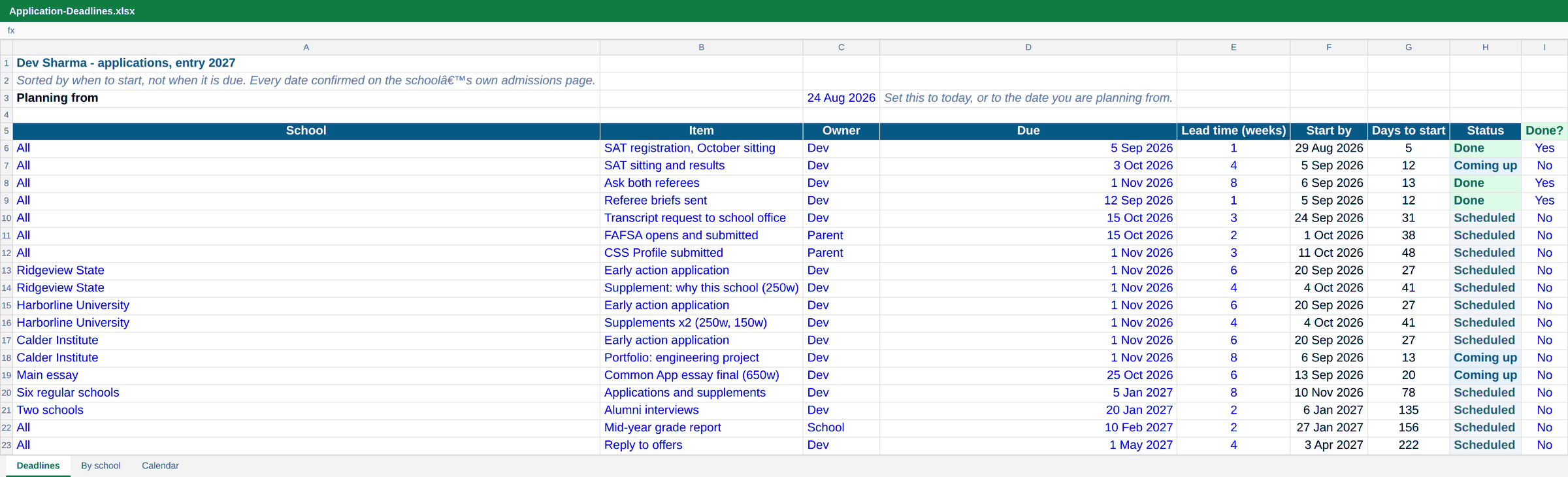
38 items, sorted by when to start

Owners, lead times, start-by dates and status

Application-Deadlines.xlsx
Planning from 24 August

Deadline tracker in Excel: school, item, owner, due date, lead time, start-by date and a status column reading Done, Coming up or Scheduled
The Excel tracker built in Claude to prompt 03’s specification, with a by-school sheet and a month-by-month calendar.

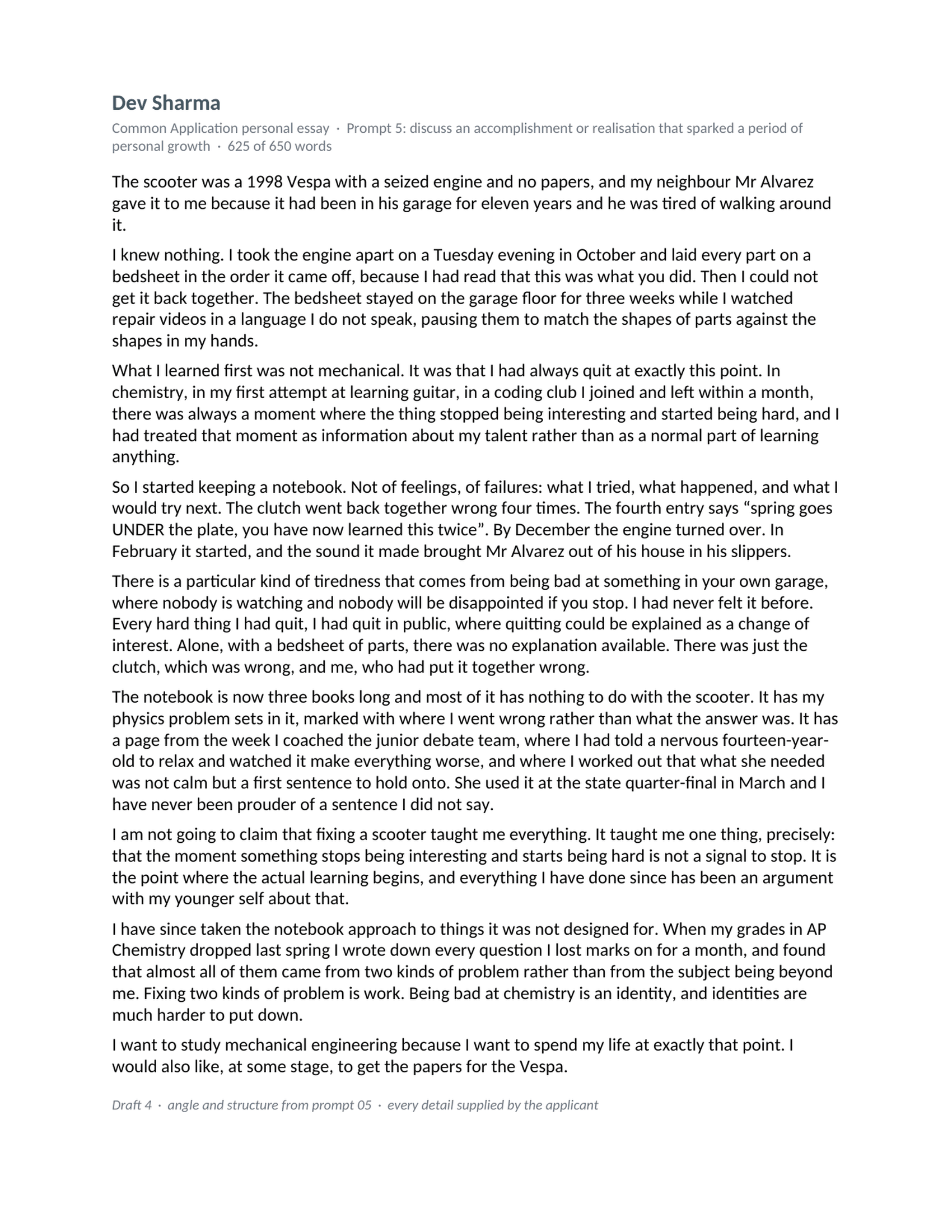
Common Application personal essay

Angle and structure from prompt 05; every detail his own

Essay-CommonApp-Dev-Sharma.docx
625 of 650 words

One-page personal essay in Word, opening on a scooter engine taken apart on a garage floor
The Word draft built in Claude to prompt 05’s specification, written only from the material Dev supplied.

Four offers, compared on net cost

Cost of attendance less grants and scholarships. Loans are not aid.

Gap: $16,800 a year
Reply by 1 May

SchoolCost of attendanceGrants and scholarshipsNet cost a yearRenewal
Ridgeview State$31,800$13,600$18,200Renews automatically
Harborline University$42,700$18,200$24,500Renews automatically
Calder Institute$63,400$32,000$31,400Needs a 3.3 average to renew
Eastbrook College$58,900$23,900$35,000First year only

The biggest award was not the cheapest offer. Calder’s $32,000 came off a $63,400 cost and left $31,400 to find, against $18,200 at Ridgeview.

Renewal changes the four-year total. One award needs a 3.3 average to renew and one covers the first year only, which the award letters state and the headline figure does not.

An appeal, not a negotiation. A short factual letter went to Harborline with the competing award attached, before the 1 May reply deadline.

Prompt output, formatted for this page. In other AI tools the prompts return the same content as tables and text; the figures come from whatever you paste in. Dev Sharma and the schools named are fictional, so every number here is ours to show you.

Pack 17 · School, University & MBA Applications

Ten prompt templates, one running brief

  • Works at any level: school entry, high school, undergraduate, postgraduate, MBA
  • Shortlist and compare schools, read your real chances, and build the deadline calendar in Excel
  • The form section by section, the main essay as a Word file, the supplements and the references
  • Entrance test preparation, mock interviews, and offers compared on net cost
  • Text file and formatted PDF · ChatGPT, Claude and Gemini · best in Claude

$15

One-time purchase · instant download

Get the pack

* Dev Sharma, the schools named and all figures on this page are fictional and used for illustration only. Output depends on the information you supply and the AI tool you use. Admissions requirements, deadlines, test policies, aid rules and fees change every year and differ by country and by school: confirm everything on the school’s own admissions page before you rely on it.

More Prompts for Life

Nine packs for everyday life, from career and money to travel and health, each written to the same standard with its own worked example.

See all Prompts for Life
Back to The Prompt Library