Prompt LibrarySales & Business Development
Prompts for Work · Pack 4

Sales & Business Development
AI Prompt Templates

Ten AI prompt templates that run a complete sales cycle: who you reliably win, what is happening at the account, the outreach sequence that earns a reply, the discovery questions that quantify the cost of inaction, and the plan that closes the deal. Below, one deal is worked through all ten.

$15 · 10 prompt templates · lifetime updates
Get the pack — $15 Jump to the deal package ↓

What’s inside

The 10 prompts in this pack

Run any prompt on its own, or run all ten in order. Each output feeds the next, building one Deal Brief.

The scenario

Meridian: a full pipeline that keeps ending in no decision

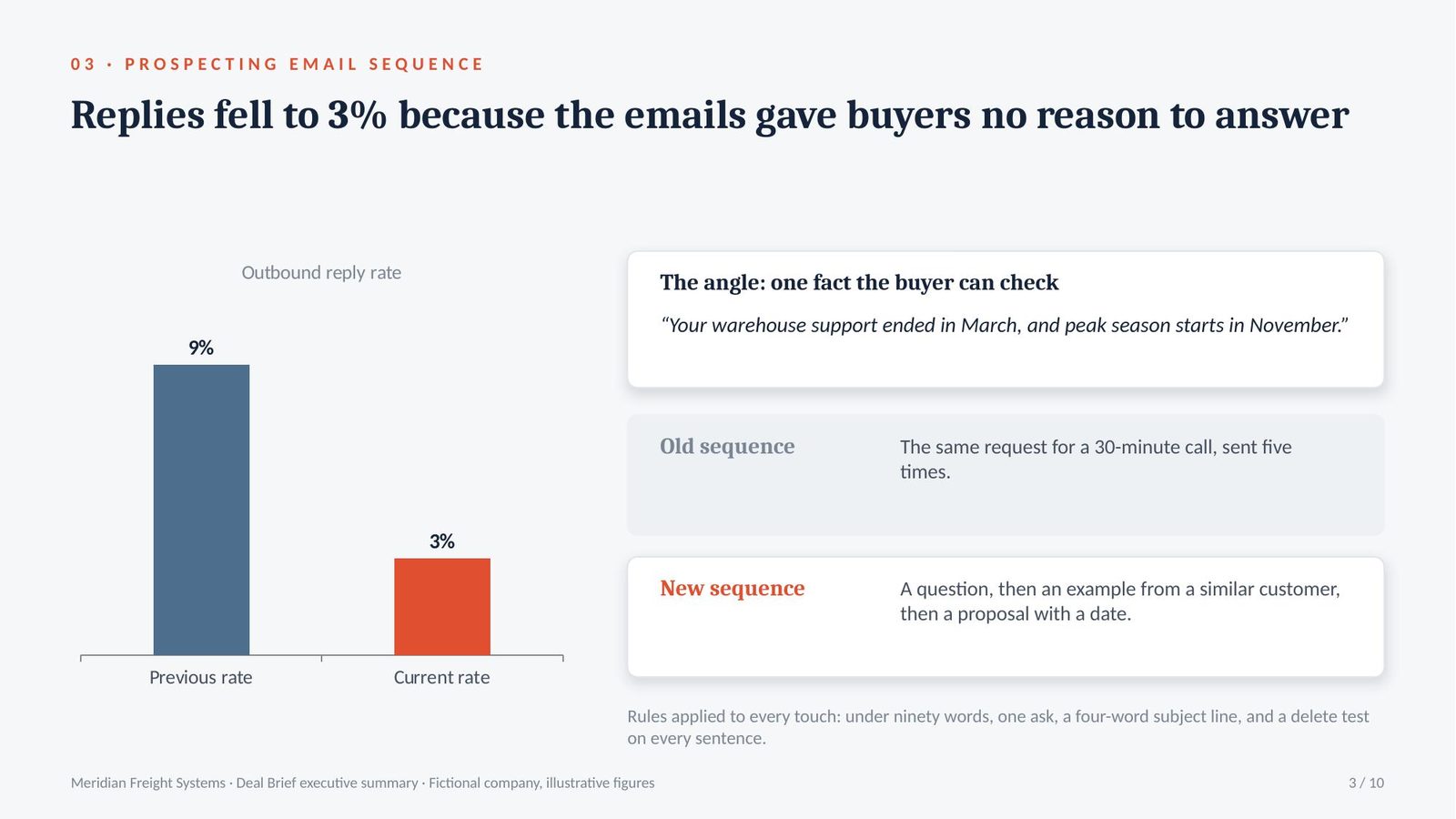
Meridian Freight Systems sells warehouse and supply-chain software to mid-market distributors. $18M in recurring revenue, $110K average deal, five months from first call to signature. Replies to outbound have fallen from 9% to 3%, and 58% of qualified deals now end in no decision rather than a loss to a competitor — which means the pipeline is full and the quarter is short. Here is how the ten prompts take that from a volume problem to one closed deal at Brightwater Distribution.

3%reply rate, from 9%
58%end in no decision
4.4xpipeline coverage, as reported
No decision

The buyer does not choose a rival. They choose to keep doing what they do now, which costs them nothing this quarter.

Single-threaded

The deal depends on a single contact. If that person changes role, the deal usually stalls or ends.

Pipeline coverage

Open pipeline value divided by the sales target. A standard health check, and the easiest sales metric to inflate.

Step by step

Input → what the prompt does → output

Ten prompts, in order. Each one’s output becomes the next one’s input, building a single running Deal Brief.

1
Target

Ideal Customer Profile & Qualification

Defines which accounts are worth a rep’s time, and which to disqualify.

ICP Definition · Trigger Events · Disqualification Criteria
What Meridian brought · Head of Sales

“Everyone in distribution with more than fifty trucks.”

What the prompt returned

“Five of your last eight wins share a condition your targeting ignores.”

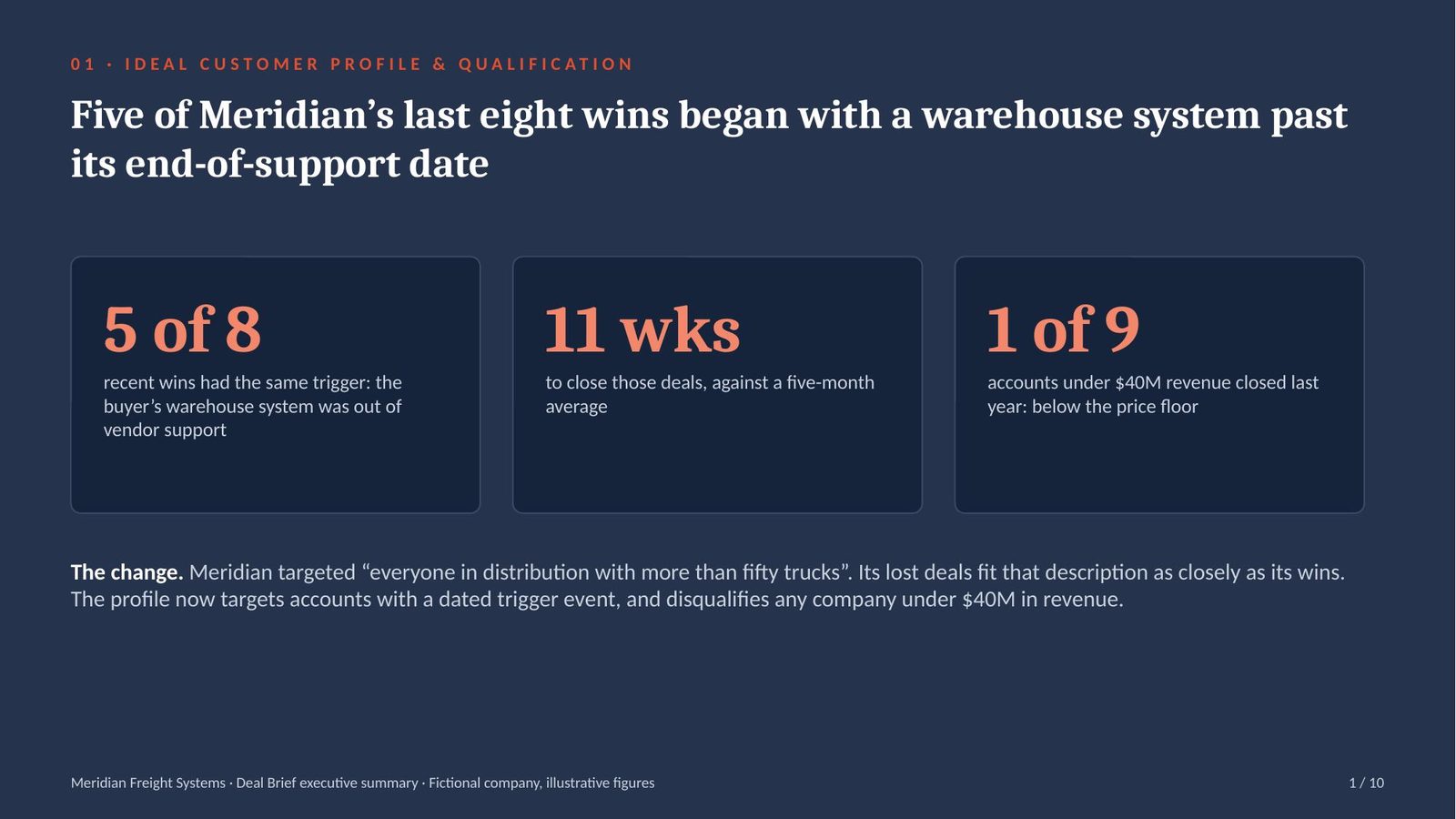
Won deals — warehouse system past end-of-support — 5 of 8
Won deals — a VP Supply Chain under nine months in seat
Lost deals — bought in a budget cycle, no failure event
Disqualify — under $40M revenue — below the price floor
The analysis · Size and industry filters describe Meridian’s lost deals as well as its wins

An ideal customer profile (ICP) describes the accounts a company reliably wins. Meridian built its profile on firmographics, company traits such as size and industry: “everyone in distribution with more than fifty trucks.” Its lost deals match that description as closely as its wins, so the profile does not predict who will buy.

  • The winning condition: 5 of the last 8 wins had the same trigger event, a change at the company that creates urgency to buy. In each case the buyer’s warehouse system had passed its vendor’s end-of-support date. These deals closed in eleven weeks, against a five-month average.
  • The disqualification rule: companies under $40M in revenue cannot afford Meridian’s price. Meridian pursued nine of them last year and closed one.

Takeaway: target accounts with a trigger event, such as an unsupported system or a newly hired supply chain executive, instead of accounts that only meet a size requirement.

2
Target

Account Research & Planning

Turns public information into one reason to call, or a decision not to.

Trigger Check · Buying Group Map · Source Grading
What Meridian brought · Account executive

“Brightwater Distribution, six sites. Here is their annual report and their job ads.”

What the prompt returned

“Their support contract ended in March. The new VP started the same month.”

Trigger present — warehouse support ended March — vendor notice, dated
New VP Supply Chain — six months in seat
Buying group — VP signs · Director of Ops owns it · IT security can block
Deal risks — nothing bought in twelve months, no spending freeze
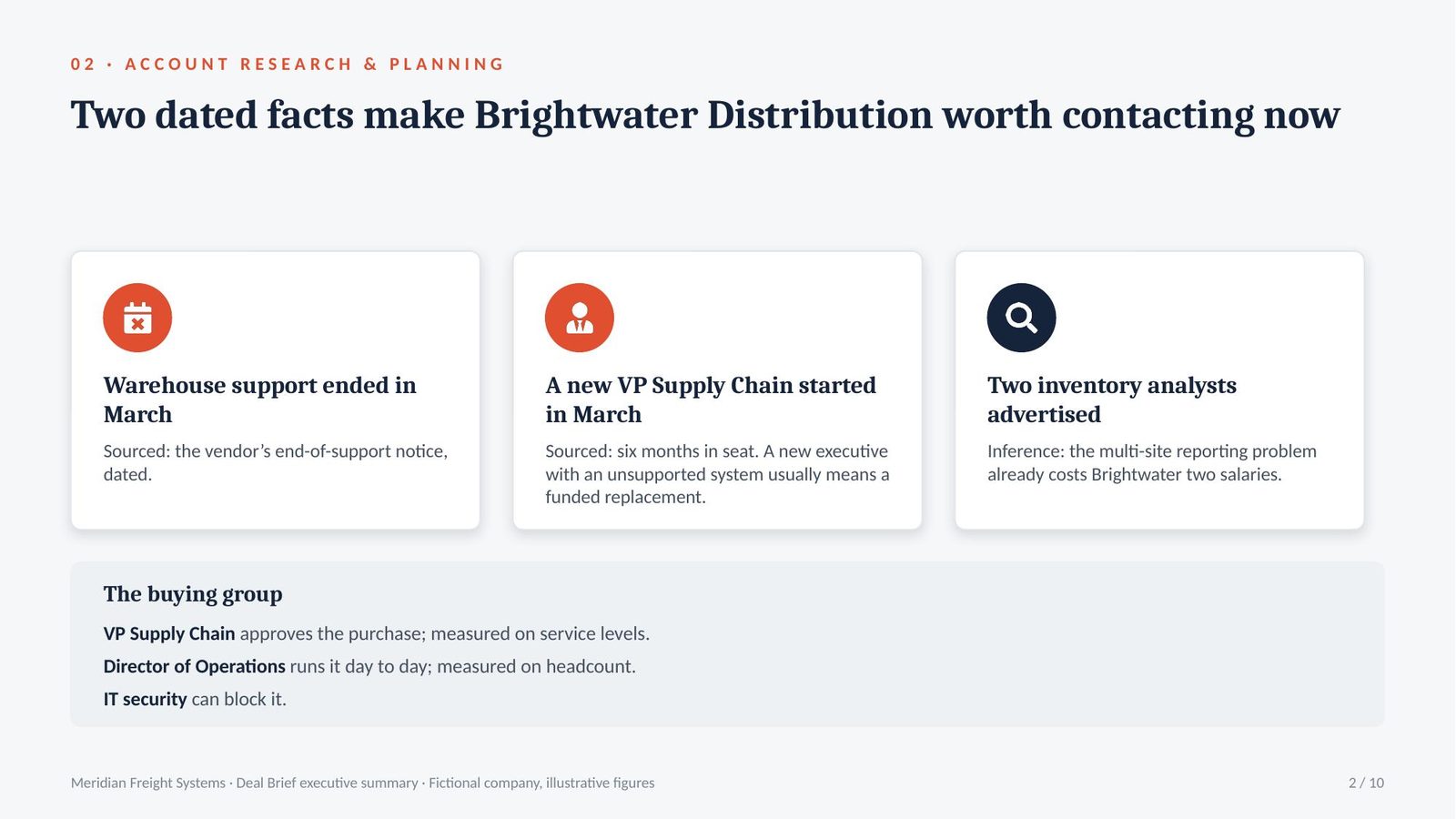
The analysis · Two dated facts give Meridian a reason to contact Brightwater now

Account research collects public facts about one company to decide whether to contact it now, and with what message. Each fact is graded Sourced (a named, dated source), Inference (a reasonable conclusion) or Unverified.

  • Trigger events found: Brightwater’s warehouse system went out of support in March, and a new VP Supply Chain started the same month. A new executive with an unsupported system usually means a funded replacement project.
  • Hiring signal: Brightwater is advertising for two inventory analysts to produce multi-site reports. Meridian’s software does that work, so the problem already costs Brightwater two salaries.
  • Buying group: the people who influence the purchase. The VP approves it and is measured on service levels, the Director of Operations runs it and is measured on headcount, and IT security can block it.

Takeaway: contact an account when research finds a dated trigger event. If there is no trigger, keep monitoring the account and do not start outreach.

3
Reach

Prospecting Email Sequence

Builds a five-touch sequence on one verifiable fact, then applies the delete test to every line.

The Angle · Five-Touch Sequence · Delete Test
What Meridian brought · Sales development rep

“Write me a sequence for Brightwater. Our reply rate is 3%.”

What the prompt returned

“Under ninety words, one ask, subject line of four.”

The angle — support ended March, peak season starts November
Touch 2 — a peer example, not the same ask reworded
Deleted — “I hope this finds you well”, and four more lines
Breakup email — closes the sequence politely, with no false deadline
The analysis · Meridian’s reply rate fell to 3% because its emails gave buyers no reason to answer

An outreach sequence is a planned series of emails, called touches, sent to a prospect who has not asked to be contacted. Each touch must give the buyer new and relevant information.

  • The angle: the specific fact that makes the email relevant. For Brightwater: “Your warehouse support ended in March and peak season starts in November.” The buyer can check both facts.
  • The delete test: every sentence is checked for whether it would make a busy buyer delete the email, and rewritten if so. Openers such as “I hope this finds you well” were removed.
  • Sequence design: Meridian’s old sequence asked for the same 30-minute call five times. The new one moves from a question, to an example from a similar customer, to a proposal with a date.

Takeaway: build outreach around one fact the buyer can check, and make every follow-up add something new. Without a strong fact, the account is not ready for outreach.

4
Convert

Needs Analysis: Discovery Questions

Builds the discovery questions that get the buyer to calculate the cost of inaction.

Cost of Inaction · Decision Process · Disqualifying Questions
What Meridian brought · Account executive

“Thirty minutes with the VP and the Director of Ops on Thursday.”

What the prompt returned

“Eleven late shipments a month, $4,200 each. They said the number.”

Cost of inaction — $554K a year — their contract, their count
Economic buyer — the VP · budget from the deferred upgrade
Disqualifying question — “what happened last time you bought software?”
Next step — agreed with a date before anyone left the call
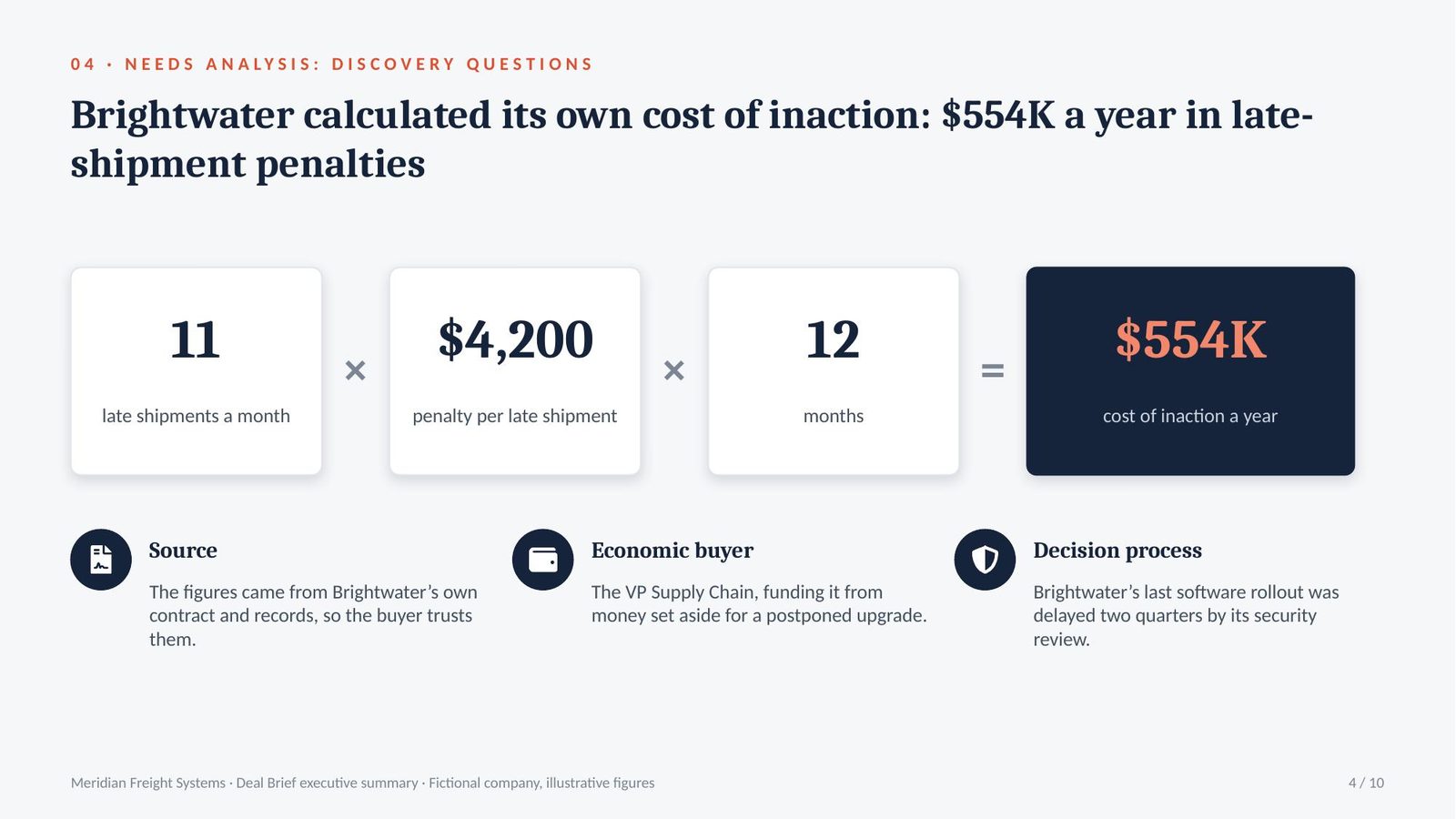
The analysis · Brightwater calculated its own cost of inaction: $554K a year

Cost of inaction is the annual cost of the buyer’s current problem if nothing changes. Buyers approve budget faster when they calculate this figure themselves, because they trust their own numbers more than a seller’s.

  • The calculation: Brightwater misses 11 shipment deadlines a month and pays a $4,200 penalty each time: 11 × $4,200 × 12 = $554K a year. The figures came from Brightwater’s own contract and records.
  • Economic buyer: the person who controls the budget and approves the purchase. At Brightwater it is the VP Supply Chain, using money set aside for a postponed upgrade.
  • Decision process: how the company approved similar purchases before. Brightwater’s last software rollout was delayed two quarters by its security review.

Takeaway: ask questions that lead the buyer to state the cost of the problem in their own numbers, and learn how past purchases were approved. That is why the closing plan in step 10 starts with the security review.

5
Convert

Objection Handling

Classifies the objection before answering it, and concedes what is true.

Constraint / Gap / Proxy · Honest Concession · Prevention
What Meridian brought · Account executive, quoting the buyer

“It is more than we budgeted, and we just spent on the upgrade.”

What the prompt returned

“That is not a price objection. It is a budget-owner objection.”

Classified — proxy — no budget owner established yet
Test question — “if the number were half, who signs?”
Honest concession — year one does cost more than the upgrade
Prevention — this arrives when the economic buyer is met late
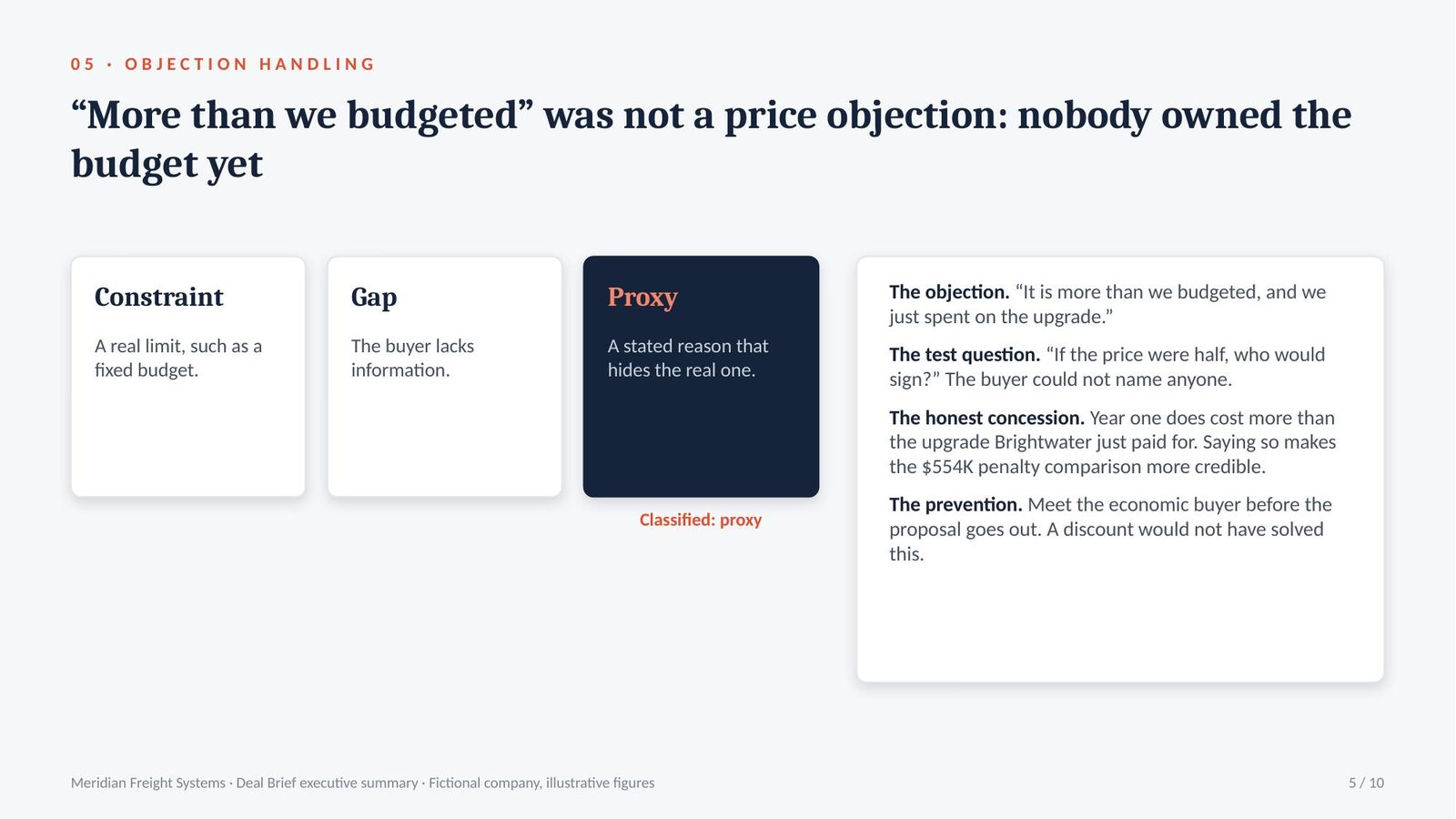
The analysis · Brightwater’s price objection was really a missing budget owner

Objection handling starts by classifying the objection. There are three types: a constraint (a real limit, such as a fixed budget), a gap (the buyer lacks information) and a proxy (a stated reason that hides the real one).

  • The objection: “It is more than we budgeted, and we just spent on the upgrade.” It sounds like a price constraint.
  • The test question: “If the price were half, who would sign?” The buyer could not name anyone, so it was a proxy: nobody had agreed to own the budget.
  • Honest concession: year one does cost more than the upgrade Brightwater just paid for. Admitting this makes the $554K penalty comparison more credible.

Takeaway: identify the objection type before responding, and meet the economic buyer before sending the proposal. A discount would not have solved this objection.

6
Compete

Competitor Analysis & Positioning

A one-page competitor comparison a rep can read in thirty seconds, honest about where the competitor is stronger.

Where They Win · Buyer Questions · Like-for-Like Price
What Meridian brought · Sales manager

“We are against Tallgrass, and against doing nothing.”

What the prompt returned

“Tallgrass wins on integration. Concede it, then compete on multi-site reporting.”

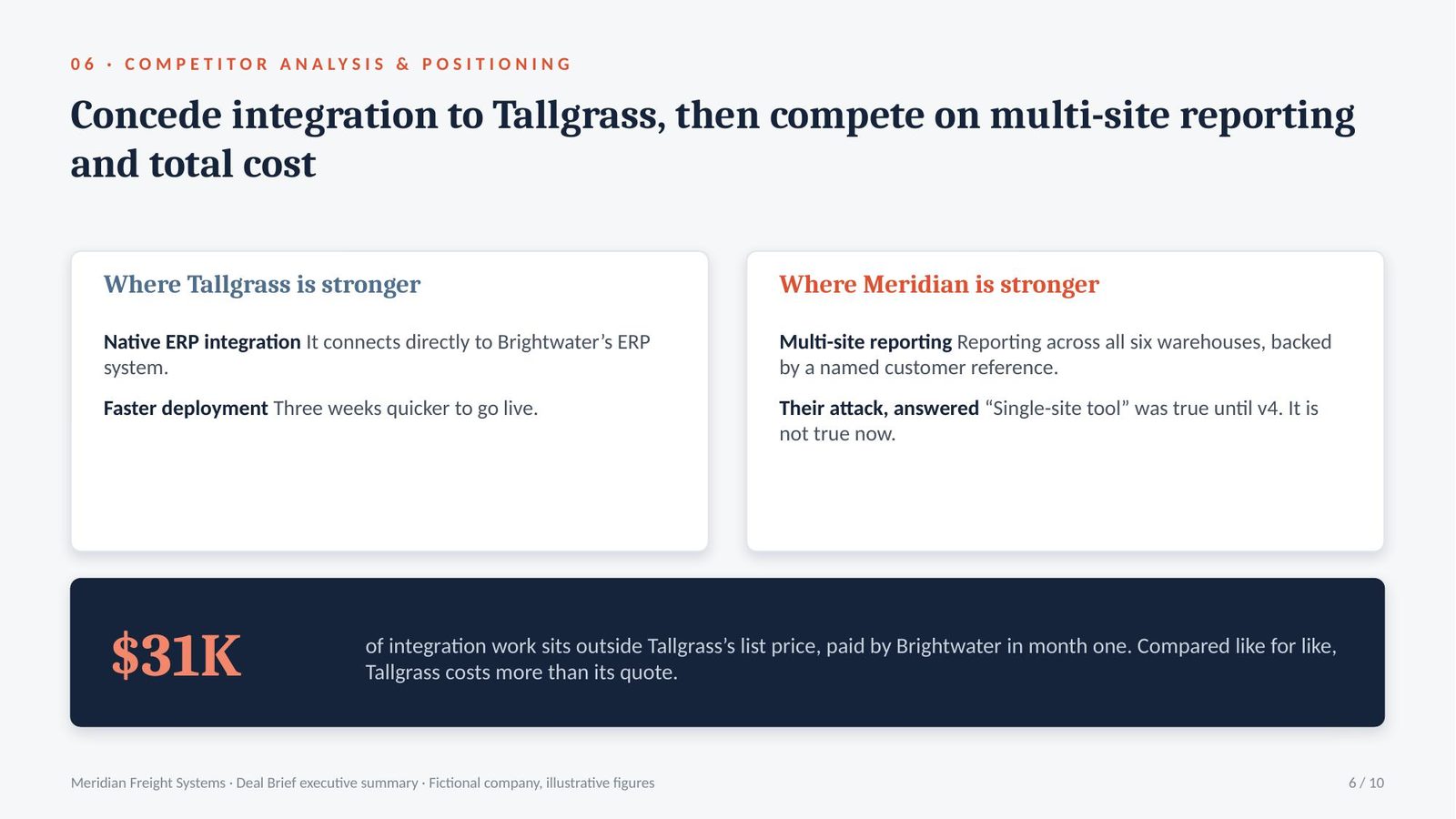
They genuinely win — native ERP integration, three weeks faster to deploy
We win — multi-site reporting — with a named customer as proof
Their attack on us — “single-site tool” — true until v4, then not
Price gap — $31K of integration fees outside their list price
The analysis · A competitor comparison is only useful if it states where the competitor is stronger

Competitor analysis compares a product with one competitor, and its usual sales format is a one-page comparison sheet, often called a battlecard, that reps read before calls. Reps stop using it as soon as a buyer proves one of its claims wrong.

  • Where Tallgrass is stronger: it integrates directly with Brightwater’s ERP system and deploys three weeks faster.
  • Where Meridian is stronger: reporting across multiple warehouses, supported by a named customer reference.
  • Total cost: Tallgrass’s quote leaves out $31K of integration work Brightwater would pay in the first month, so its real price is higher than its list price.

Takeaway: concede the competitor’s real strengths, then compete on the needs where you are stronger, using sourced facts and total cost.

7
Propose

Proposal & Commercial Terms

Writes the proposal page that still works when forwarded to people who were not in the meeting.

One-Page Summary · Conservative Case · Exclusions
What Meridian brought · Account executive

“Proposal by Friday. Procurement reads it, not the VP.”

What the prompt returned

“$128K against $554K they are already paying in penalties.”

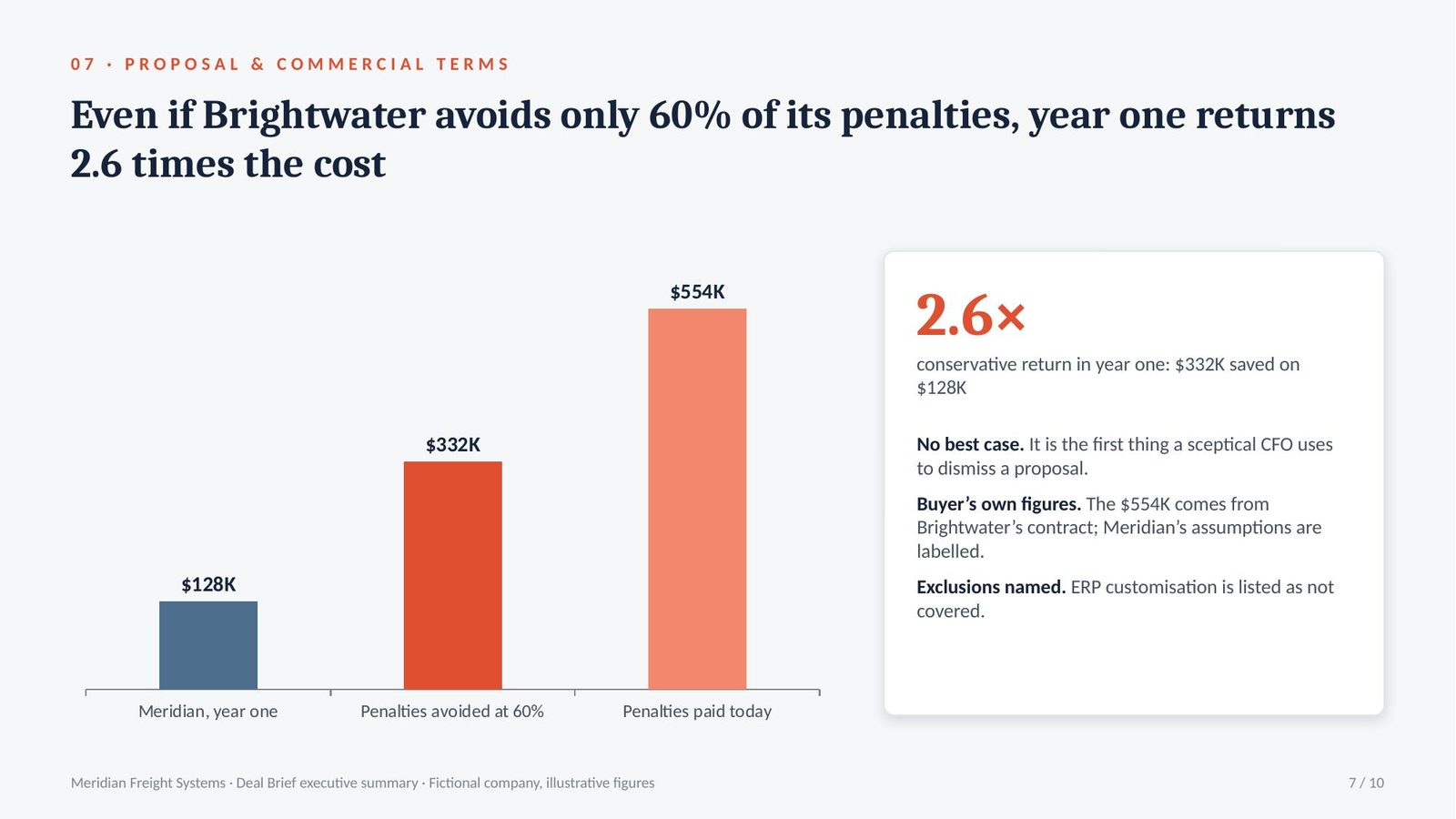
Conservative case — 60% of penalties avoided — still 2.6x in year one
No best case — it is the first thing a sceptical CFO uses to dismiss it
Exclusions — named explicitly — this prevents the month-three fight
Champion’s version — short enough to forward without editing
The analysis · Meridian’s proposal leads with a conservative return of 2.6x

A conservative case estimates the return assuming results come in below plan. Finance teams trust it more than a best case, which they tend to treat as marketing.

  • The numbers: Meridian costs $128K in year one. If Brightwater avoids only 60% of its $554K in penalties, it saves $332K, a 2.6x return.
  • Source of each figure: the $554K comes from Brightwater’s own contract. Meridian’s assumptions are labelled so the buyer can confirm or correct them.
  • Exclusions: the proposal lists what the price does not cover, such as ERP customisation, to prevent disputes after signature.

Takeaway: write the proposal for the finance reader: one recommendation, a conservative return, the buyer’s own figures and a clear list of exclusions.

8
Follow Up

Stalled Deal Follow-Up

Diagnoses why the buyer went silent, then writes follow-ups that each add new information.

Silence Diagnosis · Multithreading · The Direct Message
What Meridian brought · Account executive

“Twenty-three days since the proposal. Dana has gone quiet.”

What the prompt returned

“Four causes, ranked. The top one is not the one the rep assumed.”

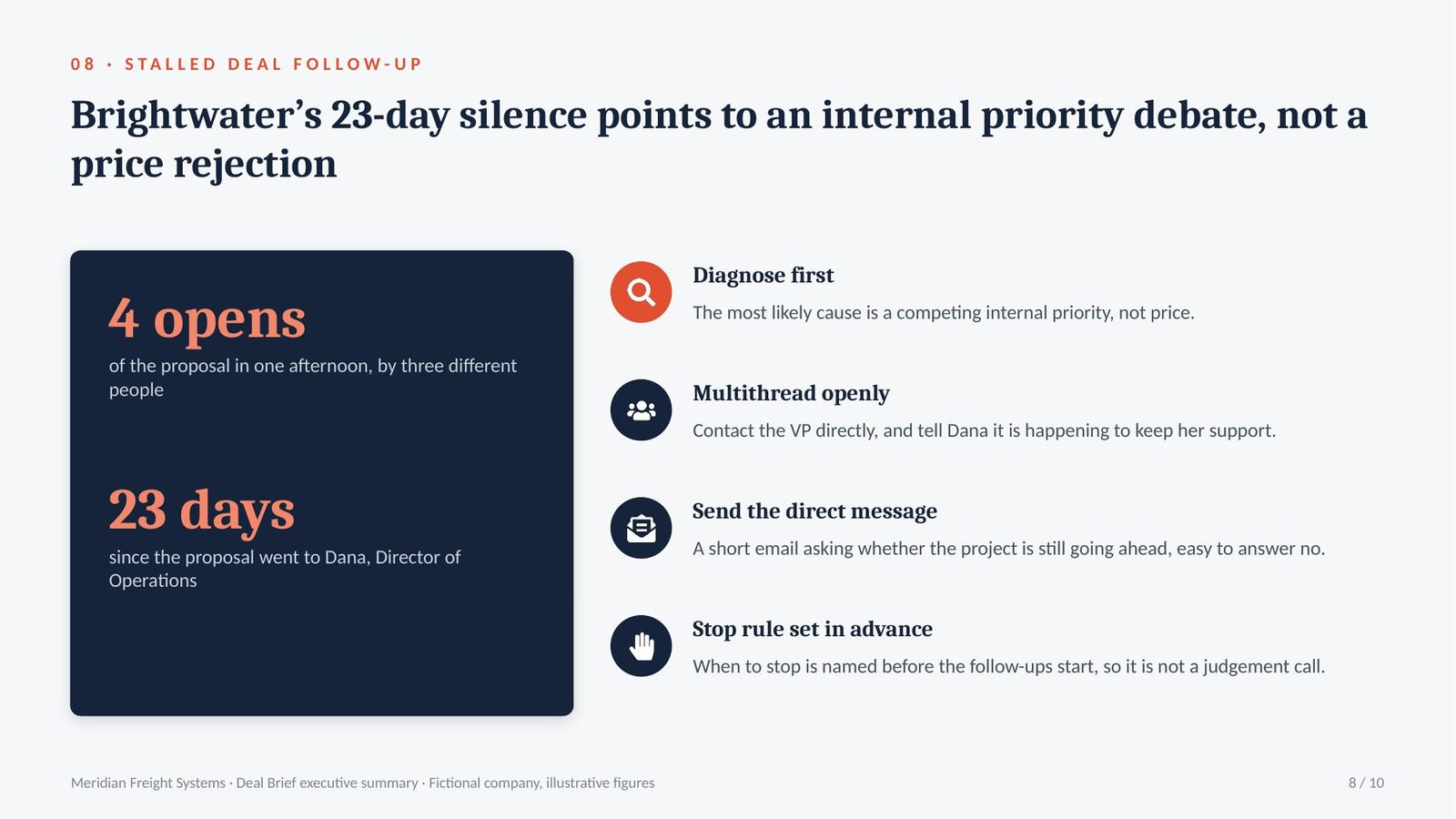
Most likely — a competing internal priority — not price
Touch 2 — the peak-season arithmetic, with dates attached
Multithread — reach the VP openly, with a line to Dana saying so
Stop rule — named in advance, so it is not a judgement call
The analysis · Brightwater’s silence was an internal priority conflict, not a price problem

Follow-up after a proposal should start by diagnosing why the buyer stopped responding. It has been 23 days since Meridian sent the proposal to Dana, the Director of Operations.

  • The evidence: the proposal was opened four times in one afternoon by three different people. That points to an internal debate about priorities, not a rejection on price.
  • Multithreading: building contact with several people at the buyer instead of one. Meridian contacts the VP directly and tells Dana it is doing so, to keep her support.
  • The direct message: a short email asking whether the project is still going ahead, written so the buyer can easily answer no.

Takeaway: diagnose the cause of the silence before following up, contact more than one decision-maker, and send follow-ups that add new information instead of “just checking in”.

9
Inspect

Pipeline Review & Sales Forecast

Tests every open deal for evidence, then re-cuts the forecast on the deals that pass.

Five Evidence Checks · Coverage Re-Cut · Deals to Remove
What Meridian brought · Head of Sales

“$6.2M of pipeline against a $1.4M quarter. We are covered.”

What the prompt returned

“$4.1M of it has no second contact and no scheduled next step.”

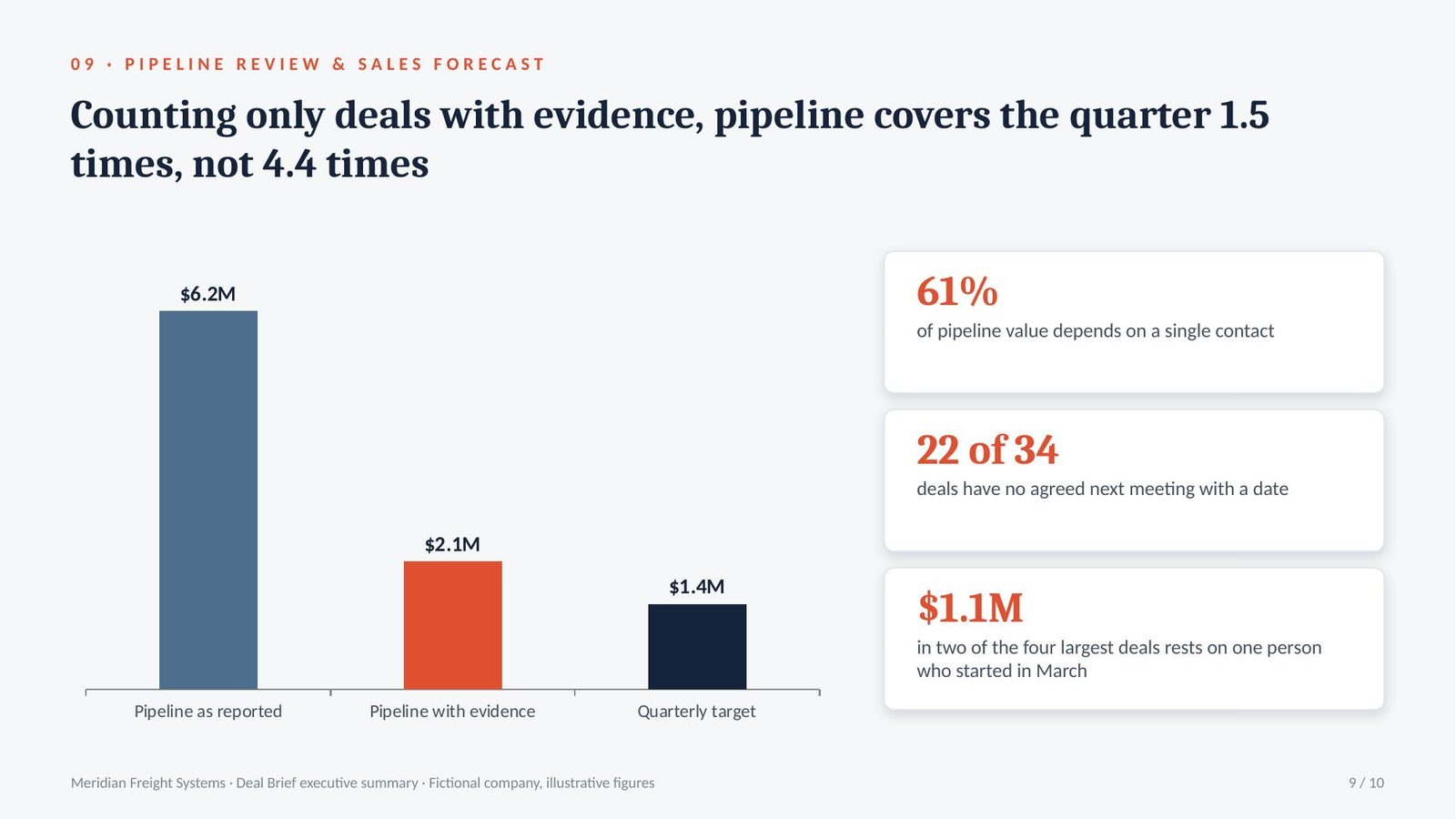
Coverage on paper — 4.4x
Coverage after inspection — 1.5x
Single-threaded — 61% of pipeline value
A dated next step in writing — 12 deals of 34
The analysis · Meridian’s pipeline covers the target 1.5 times, not 4.4 times

Pipeline coverage is the total value of open deals divided by the sales target. Meridian reported $6.2M of pipeline against a $1.4M quarterly target, or 4.4x coverage. Only deals with evidence of progress should count.

  • Single-threaded deals: deals that depend on one contact. They make up 61% of pipeline value; two of the four largest deals, worth $1.1M, rely on one person who started in March.
  • Deals without a next step: 22 of 34 deals have no agreed next meeting with a date. This is the same pattern behind the 58% of deals that end in no decision.
  • Coverage after review: counting only deals with a second contact and a dated next step leaves $2.1M, or 1.5x the target.

Takeaway: forecast from deals with more than one contact and a dated next step, and assign three specific deals for this week to close the shortfall.

10
Close

Closing Plan & Negotiation

Works backwards from the buyer’s go-live date and puts both sides on one schedule.

Mutual Action Plan · Critical Path · Negotiation Boundaries
What Meridian brought · Account executive

“They need it live before peak season. November 1.”

What the prompt returned

“Security review is the critical path. It starts this week or the date moves.”

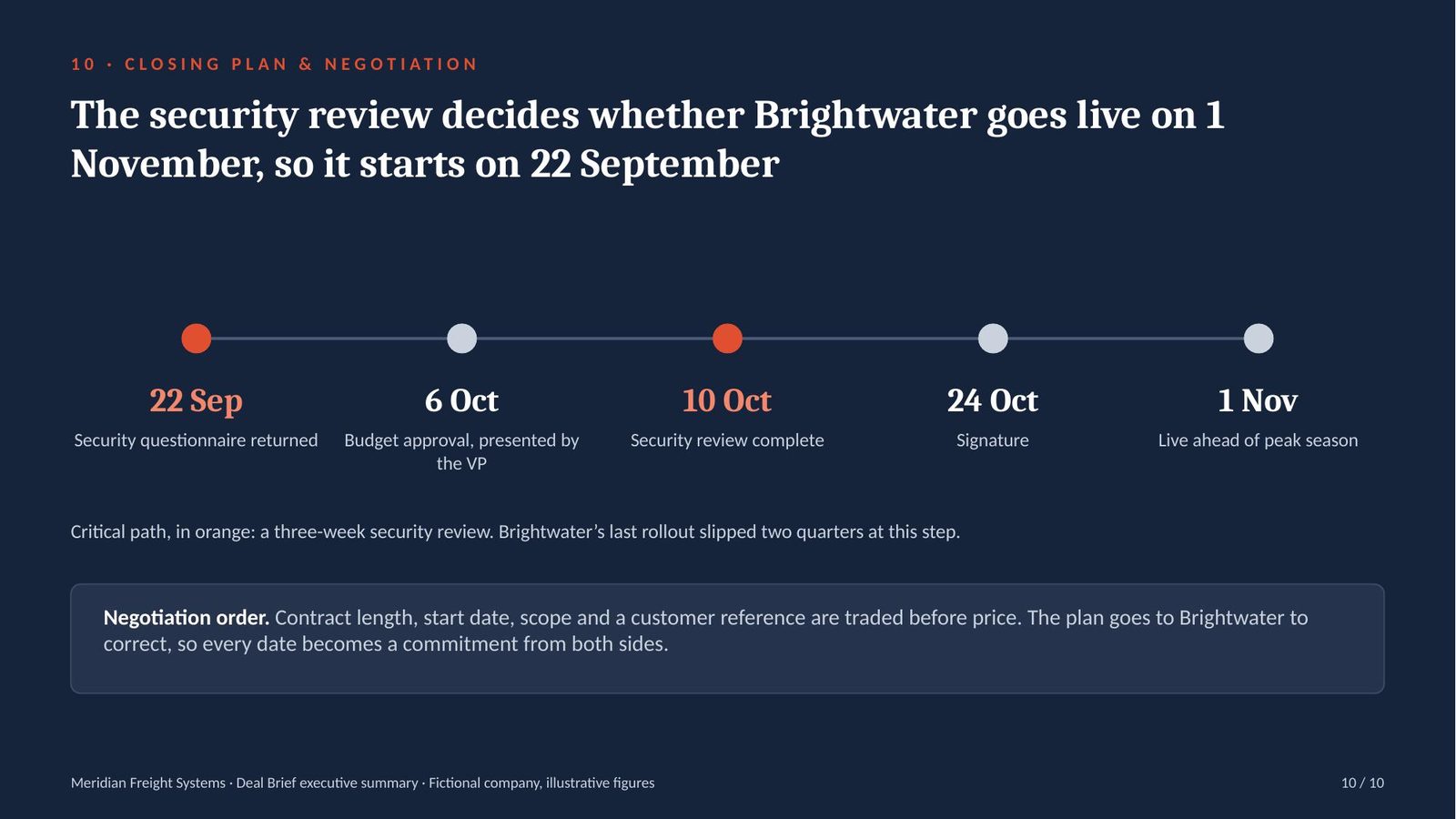
Critical path — security review — three weeks, starts 22 Sep
Budget meeting — 6 Oct — the VP presents, not the rep
Trade before price — term, start date, scope, a reference
If it is no — two questions, and the trigger that justifies returning
The analysis · The security review decides whether Brightwater can go live by 1 November

A mutual action plan (MAP) is a schedule agreed by buyer and seller that lists every step to signature and go-live, each with an owner and a date. It is built backwards from the buyer’s required go-live date.

  • Critical path: the sequence of dependent tasks that determines the earliest possible finish date. For Brightwater it is the three-week security review, which must start on 22 September.
  • Buyer confirmation: Meridian sends the plan to Brightwater to correct, so the dates become commitments from both sides.
  • Negotiation order: contract length, start date, scope and a customer reference are negotiated before price.

Takeaway: plan the close as a joint schedule, start the longest approval step first, and negotiate other terms before price.

The finale · what prompts 07 and 10 produce

The deal package Brightwater received

Three documents from the Brightwater Deal Brief that go to the buyer: the mutual action plan from prompt 10, and the one-page proposal and the champion’s forwardable version from prompt 07.

Brightwater Distribution — mutual action plan

$128,000 · year one
Decision by 24 Oct · live by 1 Nov
StepOwnerDateDepends on
Security questionnaire returnedMeridian22 SepBrightwater IT sends the form
Reference call with a peer distributorMeridian26 SepCustomer consent confirmed
Security review completeBrightwater IT10 OctQuestionnaire
Business case into the budget meetingDana, Dir. Operations3 OctFinal pricing
Budget approvalVP Supply Chain6 OctBusiness case
Legal review and redlinesBoth17 OctApproval
SignatureVP Supply Chain24 OctLegal
Implementation kickoffBoth28 OctSignature
Live ahead of peak seasonBrightwater1 NovKickoff
Critical path, shaded. Brightwater’s last rollout slipped two quarters on security review, so it starts in week one. If the questionnaire is not returned by 22 September, the 1 November go-live moves and the plan says so rather than absorbing it quietly.

Multi-site inventory visibility — recommendation

Prepared for procurement
and the budget meeting, 6 Oct
The situation

Six distribution centres report separately. Month-end consolidation takes four days. Eleven shipments a month miss the contractual window with your largest retail customer.

What it costs today

$554,400 a year in service-level penalties, from your own contract terms and your own shipment count.

Recommendation

Multi-site inventory and exception reporting across all six sites, live before peak season, with the existing ERP left in place.

If nothing changes

Peak season adds volume to the same process. The penalty exposure rises; the four-day close does not shorten.

Year one: $128,000 · penalties avoided at a conservative 60%: $332,640
Net year one: $204,640 · return: 2.6x — modelled at 60%, not at full recovery.
Not included: ERP customisation, data cleansing beyond the twelve-month history, hardware at the two leased sites, training beyond the two scheduled sessions. Assumptions to confirm: six sites in scope, eleven late shipments a month, $4,200 average penalty — all taken from what you told us on 9 September.

The forwardable summary

Written for Dana to send,
in her words, not ours
Subject: Inventory visibility — what I am asking for on 6 October

We are paying roughly $554K a year in service-level penalties on the retail contract. Eleven shipments a month miss the window, and the cause is that the six sites do not see each other’s stock until the month-end close, four days later.

I am asking for $128K to fix it before peak season. On a conservative estimate — 60% of those penalties avoided, not all of them — that returns $332K in the first year. The ERP stays as it is.

Two things worth knowing. Security review is the long pole and IT has the questionnaire now. And if we do not decide by 24 October, it will not be live before peak, which means we run this peak the way we ran the last one.

Happy to walk through the numbers before the meeting.

Prompt output, formatted for this page. The prompts return the same content as text and tables; the figures come from whatever you paste in. Meridian and Brightwater are fictional, so every number here is ours to show you.

Get the Sales & Business Development pack

All 10 prompt templates with full copy-paste text and worked examples — a downloadable PDF plus a plain-text copy file. Lifetime updates.

$15 · 10 prompt templates

Instant download · lifetime updates

Get the pack — $15
Next step · the Presentation Generator

From the Deal Brief to a board deck

The pack ends with the documents above. The McKinsey-Grade PowerPoint Generator is a separate product, $19: paste the Deal Brief into it and it builds a board deck in Claude, as a real .pptx with native, editable charts.

Below is Meridian’s executive summary: ten slides, one for each prompt’s output, unedited.
Meridian Freight Systems Deal Brief executive summary, slide 1 of 10 Meridian Freight Systems Deal Brief executive summary, slide 2 of 10 Meridian Freight Systems Deal Brief executive summary, slide 3 of 10 Meridian Freight Systems Deal Brief executive summary, slide 4 of 10 Meridian Freight Systems Deal Brief executive summary, slide 5 of 10 Meridian Freight Systems Deal Brief executive summary, slide 6 of 10 Meridian Freight Systems Deal Brief executive summary, slide 7 of 10 Meridian Freight Systems Deal Brief executive summary, slide 8 of 10 Meridian Freight Systems Deal Brief executive summary, slide 9 of 10 Meridian Freight Systems Deal Brief executive summary, slide 10 of 10
1 / 10

Meridian and Brightwater are fictional, so every number here is ours to show you. Generated in the NOVA house style.

Microsoft PowerPoint Want the deck built for you in one shot? The McKinsey-Grade PowerPoint Generator — $19

Built in Claude as a real .pptx with native, editable charts. Or take both generators together in the bundle, $25.

Back to The Prompt Library