01Discover
Business Case: Should We Do This Project?
Tests whether the problem is costly, compares the options, and sets out the budget and return needed to approve the project.
See it in Corbel’s examplePrompts for Work · Pack 5 · 10 prompt templates
12 of 12 quality checks passed
The Product & Project Management pack: 10 AI prompt templates for ChatGPT, Claude and Gemini
Plan and run your projects with honest dates and clear owners. Describe the idea and the team, and the project management prompts write the business case and the requirements, rank the backlog, build the roadmap and the schedule, log every risk, price every change request and write the status report.
Free guide: RAID log template and example
Real exampleRoadmap · Prompt 05
“Sales needs dates on everything, or we can’t sell any of it.”
Offline programme roadmap
Benefits of the project management prompts
Four things the project management prompts do, from the first idea to the post-launch review.
Every requirement, risk and benefit traces to a named source. Anything without one is logged as an assumption, with the cheapest test that would confirm it.
Every estimate has a low, likely and high figure. A single date is promised only once the critical path supports it.
Every scope line, risk, change and action has one named owner and a date. “The team” is not an owner.
Any new request names what moves to pay for it, scope, date, cost or benefit, and who approved the trade.
What is in the pack
Each project management prompt works on its own. The prompt asks for what is needed and, in Claude, returns a finished Word or Excel file. Run the one you need, or run all ten in order.
Tests whether the problem is costly, compares the options, and sets out the budget and return needed to approve the project.
See it in Corbel’s exampleDocuments the business rules, functional and non-functional requirements, and acceptance criteria that IT or a product team builds from.
See it in Corbel’s exampleApproves the work, sets what is in and out of scope, and names who can make each decision.
See it in Corbel’s exampleRanks the backlog, shows where team capacity runs out, and shows the cost of changing the order.
See it in Corbel’s exampleOrders the work by the results it should deliver, and only gives dates where the team is confident.
See it in Corbel’s exampleTurns the work into a date range, and shows which tasks decide the finish date.
See it in Corbel’s exampleFinds what could make the project fail while it is still cheap to fix, and gives each risk an owner and a warning sign.
See it in Corbel’s exampleWorks out the cost of every request for new scope before it is scheduled, and sends the decision to the person allowed to make it.
See it in Corbel’s exampleGives leaders a red, amber or green status based on clear rules, the numbers behind it, and the one decision needed.
See it in Corbel’s exampleDecides whether to ship on written criteria, then checks the release against the benefits and metrics its business case and requirements promised.
See it in Corbel’s exampleWorked example
Corbel sells scheduling and dispatch software to heating, air-conditioning and plumbing contractors. Its last major release, Dispatch 3.0, was due on 9 March 2026 and shipped on 25 May: 11 weeks late, $1.66M against a $1.2M budget, with 9 of its 41 pilot customers rolling back. Now the CEO has told the board that technicians will be able to work offline by the end of Q1 2027. Corbel has 14 engineers and 212 requests in its backlog.*
Prompt 01 · Discover
What Corbel brought · CFO
“The board has heard “offline” for a year. Before it approves anything, it wants to know what it costs and what we get back.”
What the prompt returned
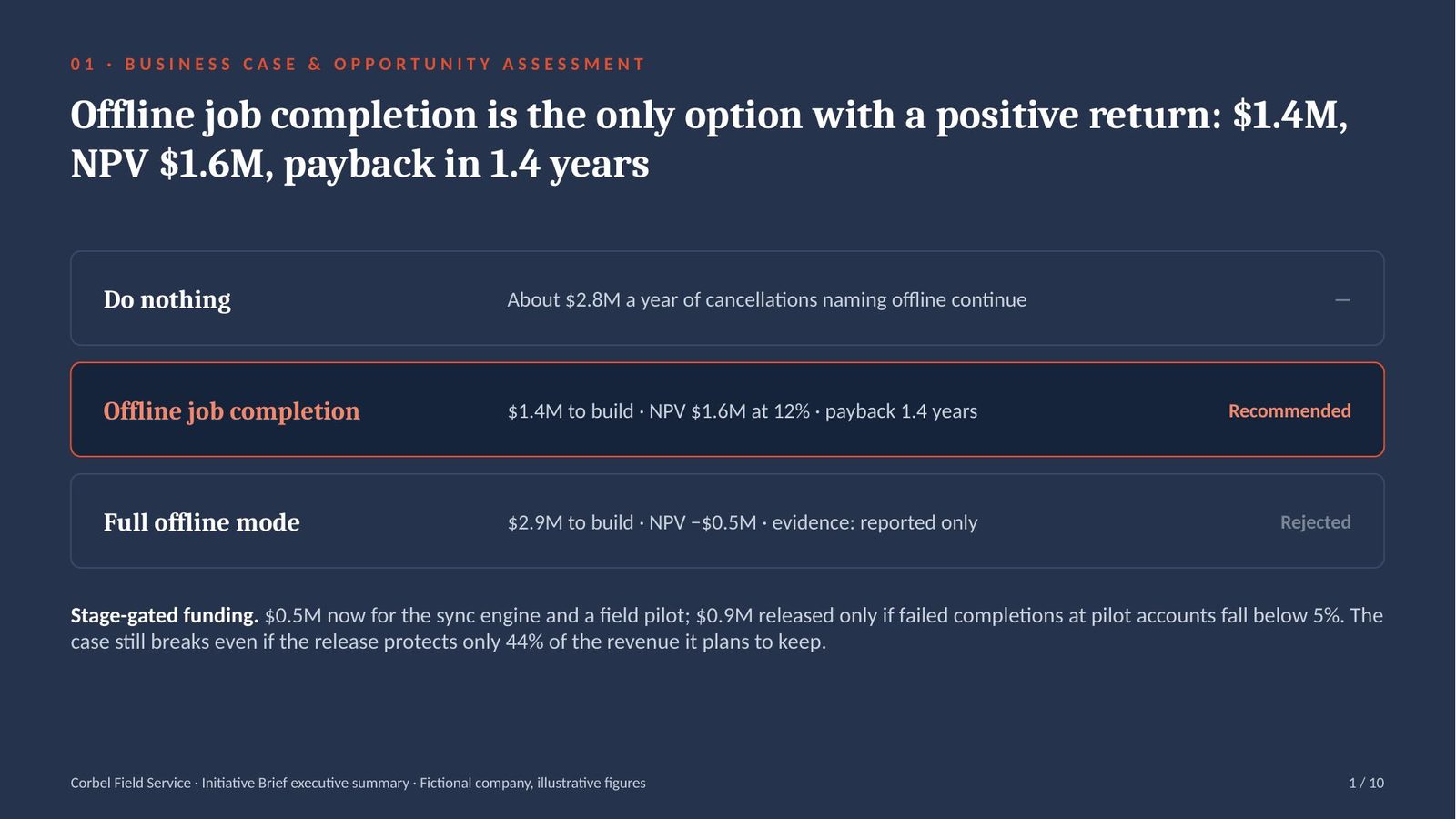
Fund offline job completion: $1.4M, net present value $1.6M at 12%, payback in 1.4 years. Full offline mode costs $2.9M and has a negative net present value.
Takeaway: approve $1.4M for offline job completion in two stages. The case still breaks even if the release protects only 44% of the revenue it plans to keep.
A business case compares the options for solving a problem, including doing nothing, on their costs, benefits and risks, and ends with a funding request. Net present value (NPV) converts future cash flows into today’s money at the required return, 12% at Corbel, and payback is the time needed to recover the investment.
Prompt 02 · Define
What Corbel brought · Engineering lead
“Last time we got a slide and a date. Tell us what ‘offline’ means before you ask us to estimate it.”
What the prompt returned
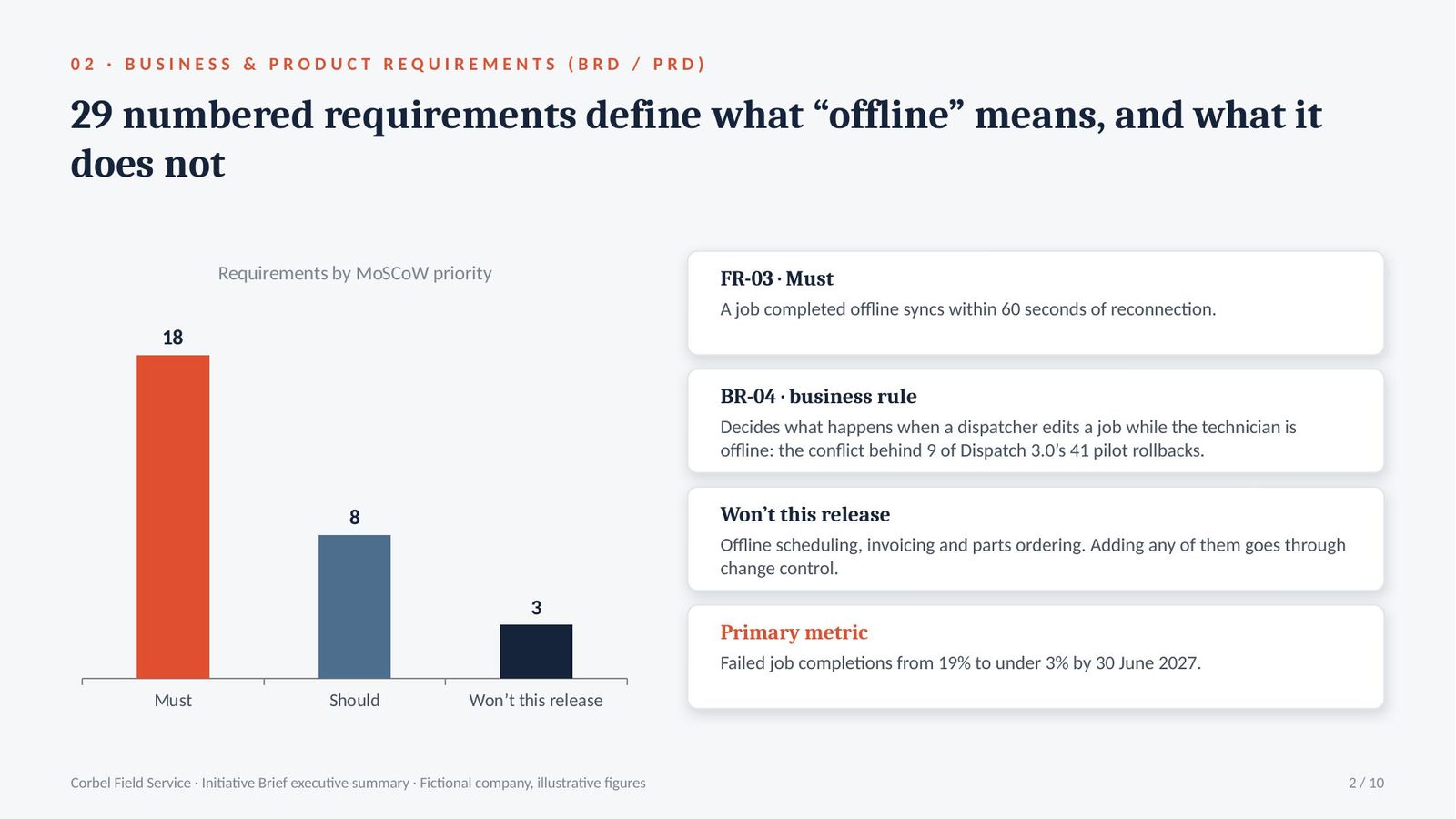
29 numbered requirements: 18 Must, 8 Should, 3 Won’t this release. FR-03: a job completed offline syncs within 60 seconds of reconnection. Scheduling, invoicing and parts ordering stay online.
Takeaway: give every requirement an ID, a priority, a source and an acceptance test, and start measuring sync time before the build, because there is no baseline today.
A business requirements document (BRD) lists what a system must do as numbered requirements, each with a priority, a source and an acceptance test, so IT or a vendor can build and test against it; a product requirements document (PRD) covers the same ground as user stories for a product team. Dispatch 3.0 had neither: it started with 14 user stories and finished with 31.
Prompt 03 · Define
What Corbel brought · Chief Operating Officer
“On Dispatch 3.0, three people could add scope and nobody could say no. I don’t want to find out who owns this in February.”
What the prompt returned
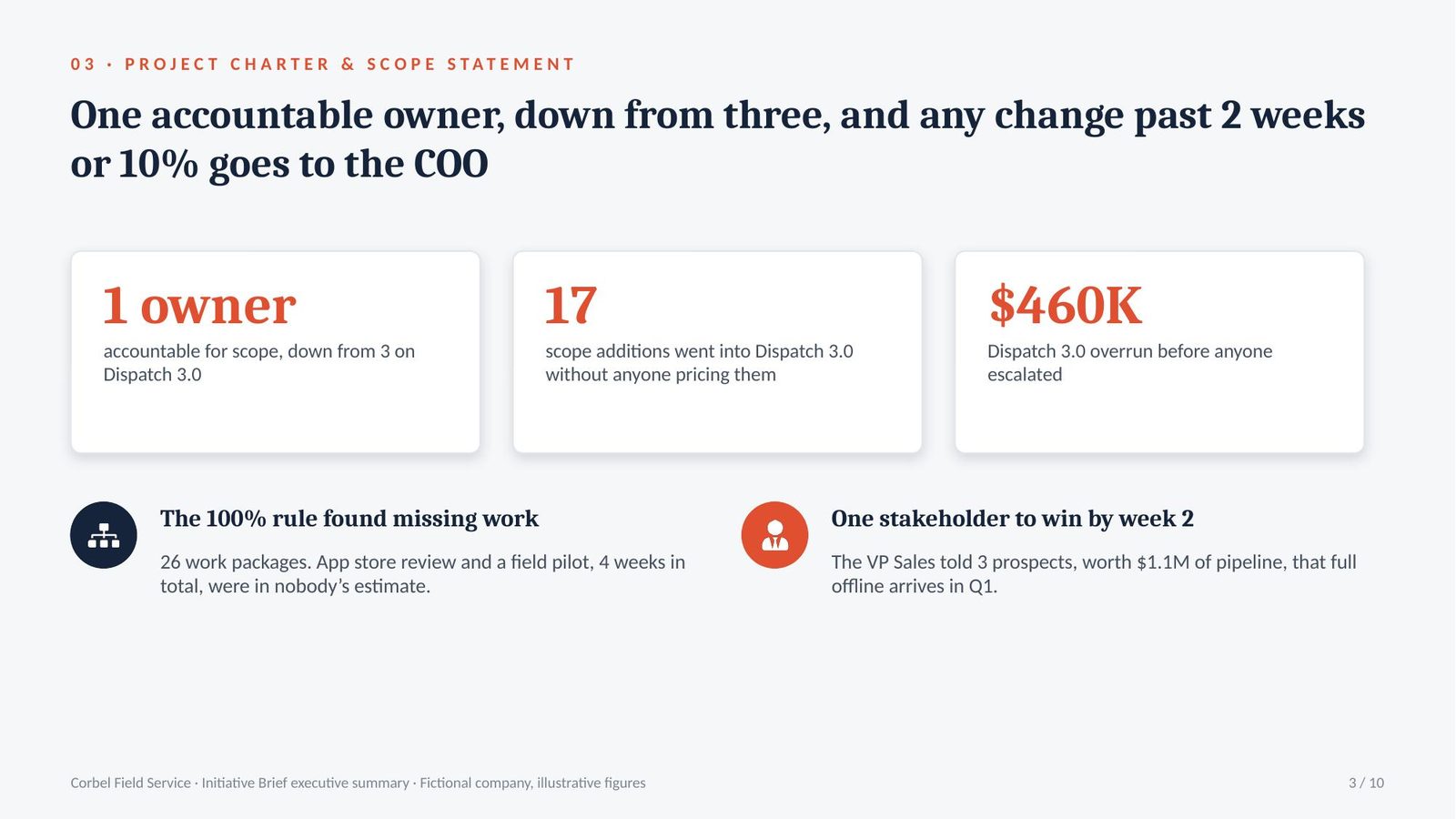
One sponsor, the COO, is accountable for scope, budget and release. Any change beyond 2 weeks or 10% of budget comes to her, not to the project manager.
Takeaway: give each decision one accountable owner, and meet the VP Sales in week 1 to agree what can be promised to prospects.
A RACI chart names who is Responsible, Accountable, Consulted and Informed for each decision, and on Dispatch 3.0 three executives were each Accountable for scope, so 17 additions went in without anyone pricing them.
Prompt 04 · Plan
What Corbel brought · VP Product
“212 requests, 14 engineers, and every one of them is urgent to somebody senior.”
What the prompt returned
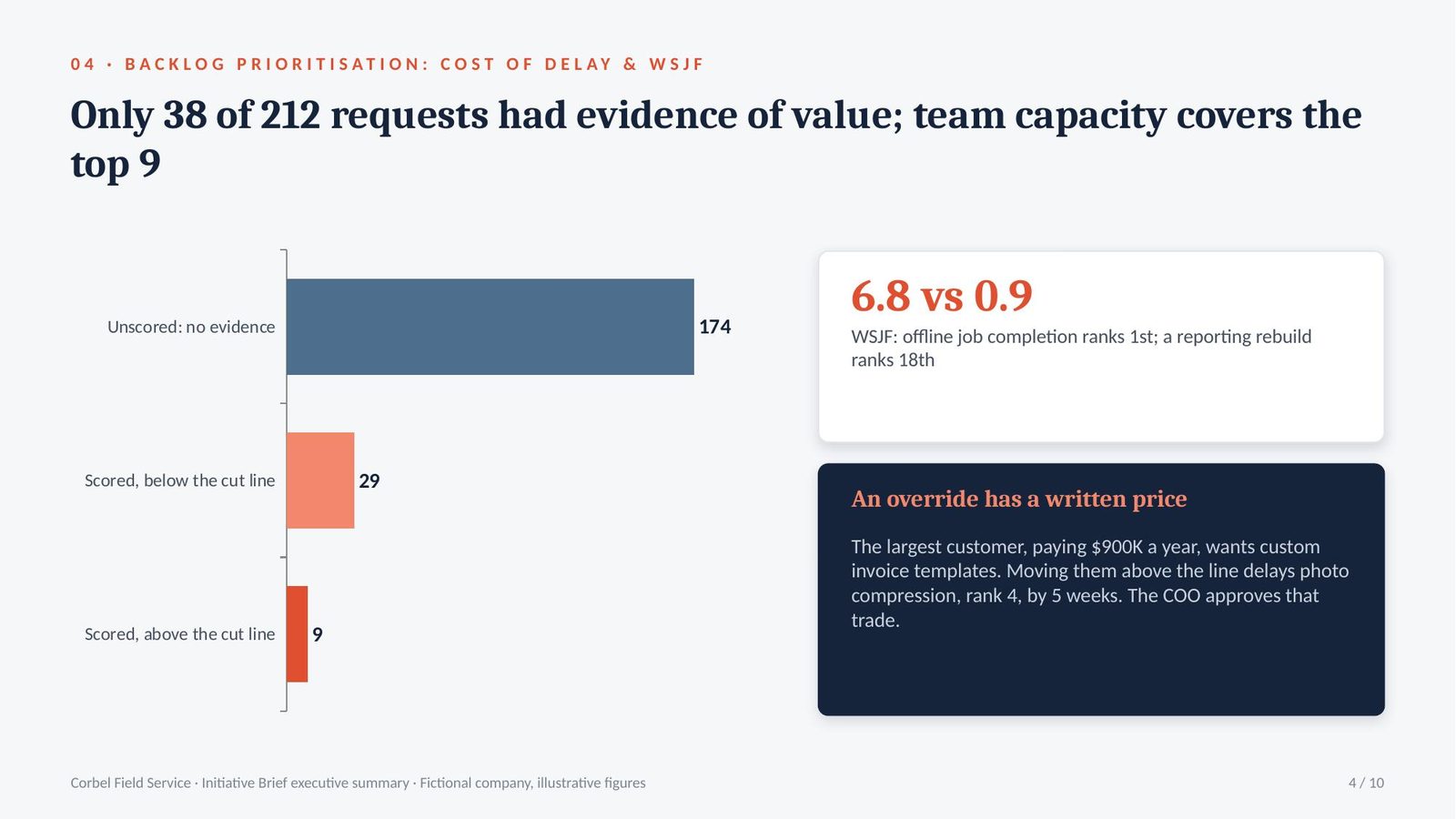
38 requests had evidence and were scored. Offline job completion ranks first. The cut line falls after item 9, and moving custom invoice templates above it delays item 4 by 5 weeks.
Takeaway: work to the cut line, and require the COO to approve any override together with its cost.
Cost of delay is what the business loses for each week an item waits, and weighted shortest job first (WSJF) divides it by the size of the job, which put offline job completion first at 6.8 and a reporting rebuild eighteenth at 0.9.
Prompt 05 · Plan
What Corbel brought · VP Sales
“Sales needs dates on everything, or we can’t sell any of it.”
What the prompt returned
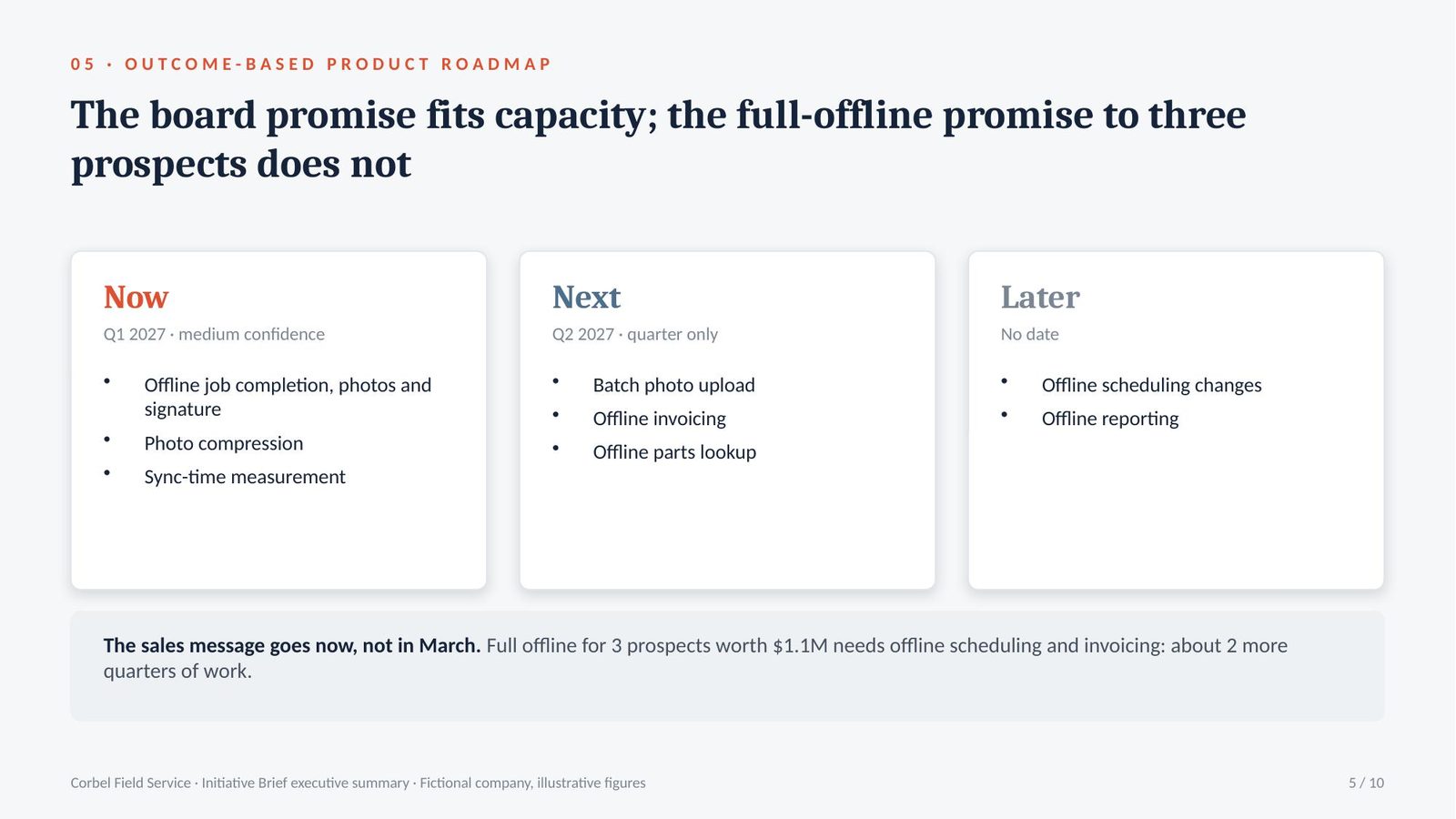
Now: offline job completion, Q1 2027. Next: offline parts lookup, Q2. Later: offline scheduling, no date. The board promise fits as scoped; the promise to three prospects does not.
Takeaway: date only the Now column, and tell the three prospects now that full offline is not in the Q1 release.
An outcome-based roadmap lists the results the company is trying to move rather than a calendar of features, and Corbel’s has three: fewer failed job completions, fewer cancellations that name offline, and faster invoicing at commercial HVAC accounts.
Prompt 06 · Plan
What Corbel brought · Engineering lead
“The board date is 31 March. Honestly, I have no idea whether that’s real.”
What the prompt returned
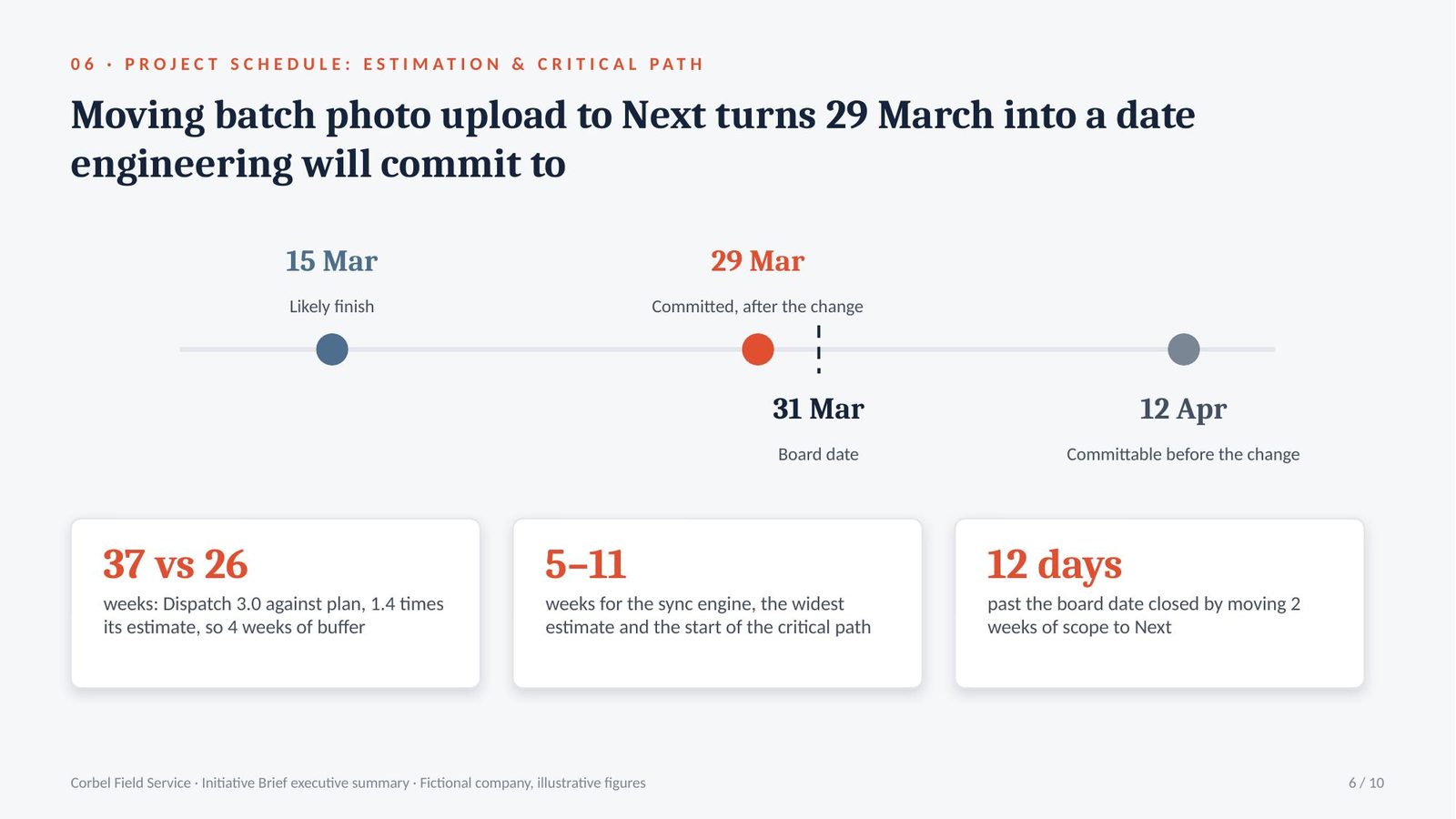
Likely finish 15 March 2027; a date safe to commit to is 12 April, 12 days past the board date. Moving batch photo upload to Next brings the committed date to 29 March.
Takeaway: commit to 29 March 2027 with batch photo upload moved to Next, and show the board the date as a range.
The critical path is the longest chain of work in which each step waits for the one before, and Corbel’s runs through the sync engine, conflict handling, a field pilot and app store review, with no slack anywhere along it.
Prompt 07 · Control
What Corbel brought · Tech lead, in a one-to-one
“If Priya leaves, nobody else understands the sync layer. And our pilot customers disappear in January.”
What the prompt returned
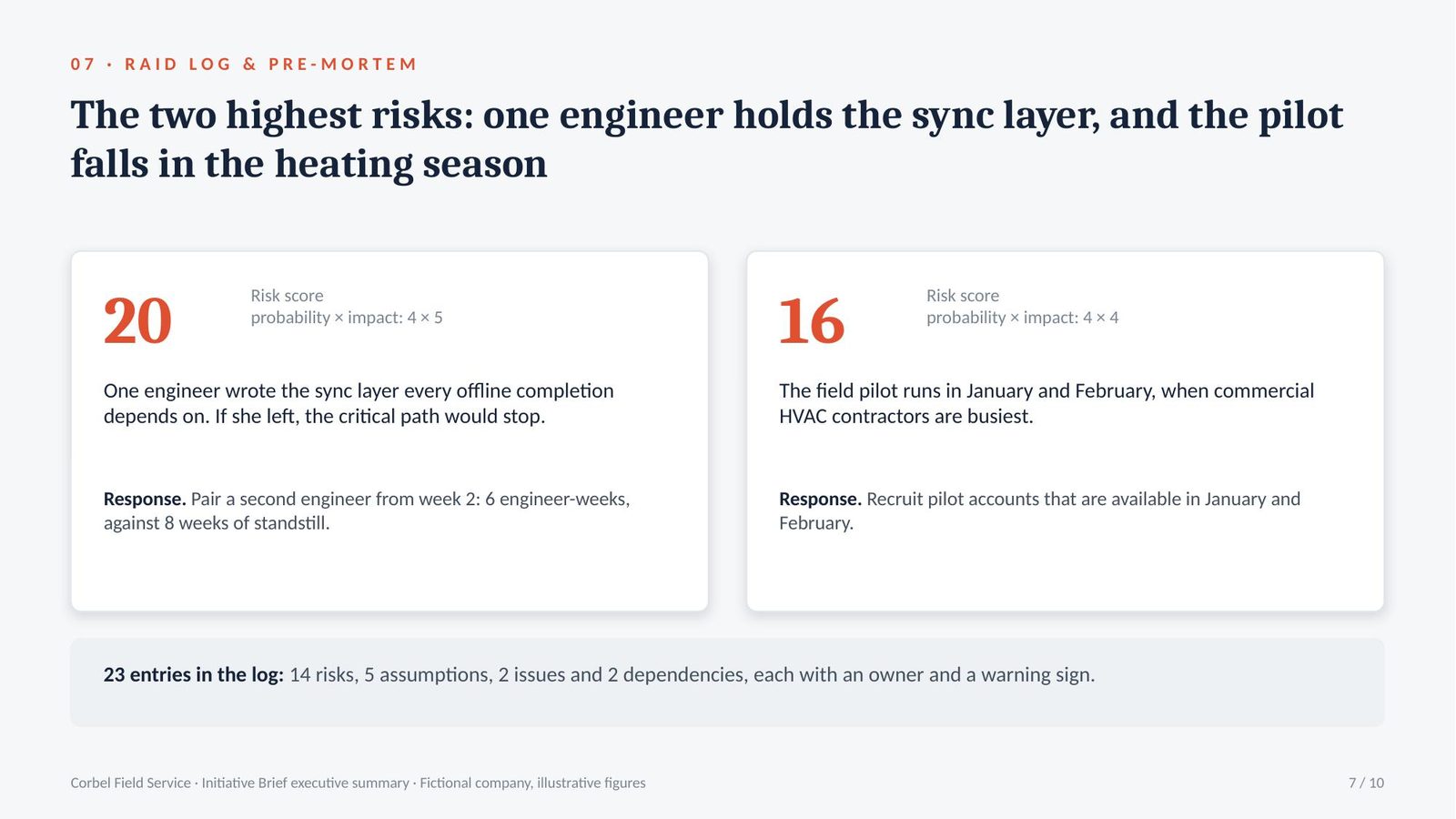
23 entries. Top risk: one engineer holds the sync layer, score 20. Second: the field pilot falls in the heating season, when contractors are busiest, score 16.
Takeaway: pair a second engineer on the sync layer from week 2, and recruit pilot accounts that are available in January and February.
A RAID log tracks Risks, Assumptions, Issues and Dependencies in one place, and a pre-mortem fills it by imagining the project has already failed; Corbel’s produced 23 entries, and the two highest scores were things the team knew but had never written down.
Prompt 08 · Control
What Corbel brought · VP Sales, by email
“Northgate Mechanical will sign for $380K if offline invoicing is in the Q1 release. Can we just add it?”
What the prompt returned
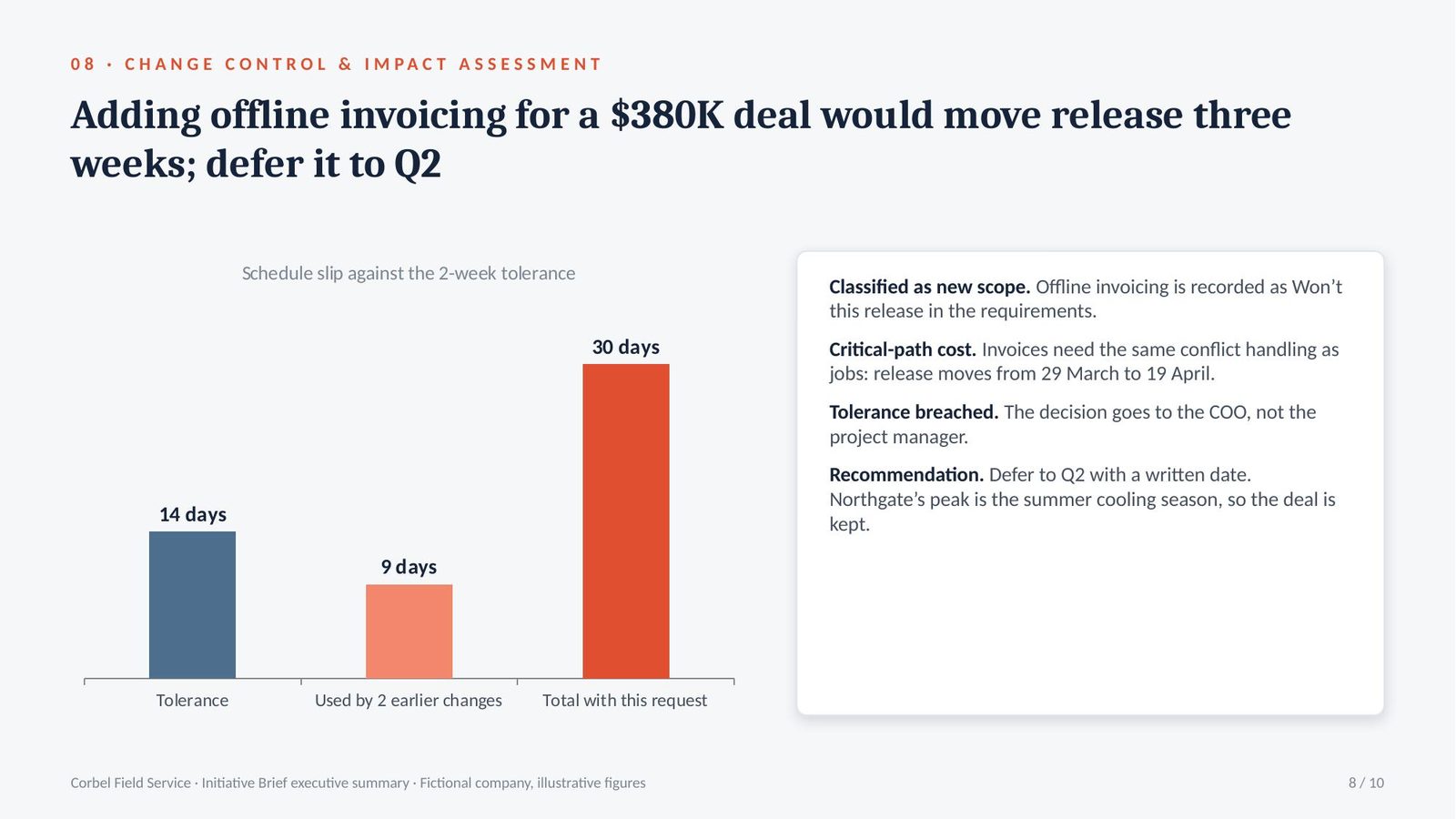
New scope: offline invoicing is a written non-goal. 5 to 8 weeks of work, moving release from 29 March to 19 April and breaching tolerance. Recommended: defer to Q2 with a dated commitment to Northgate.
Takeaway: defer offline invoicing to Q2 with a written date for Northgate, and send the decision to the COO, because tolerance is breached.
Change control prices every request before it is scheduled, and offline invoicing was already recorded in the requirements as Won’t this release, so it could only come in as a change with its cost attached.
Prompt 09 · Control
What Corbel brought · Project manager
“We’re mostly on track. Maybe amber on one thing.”
What the prompt returned
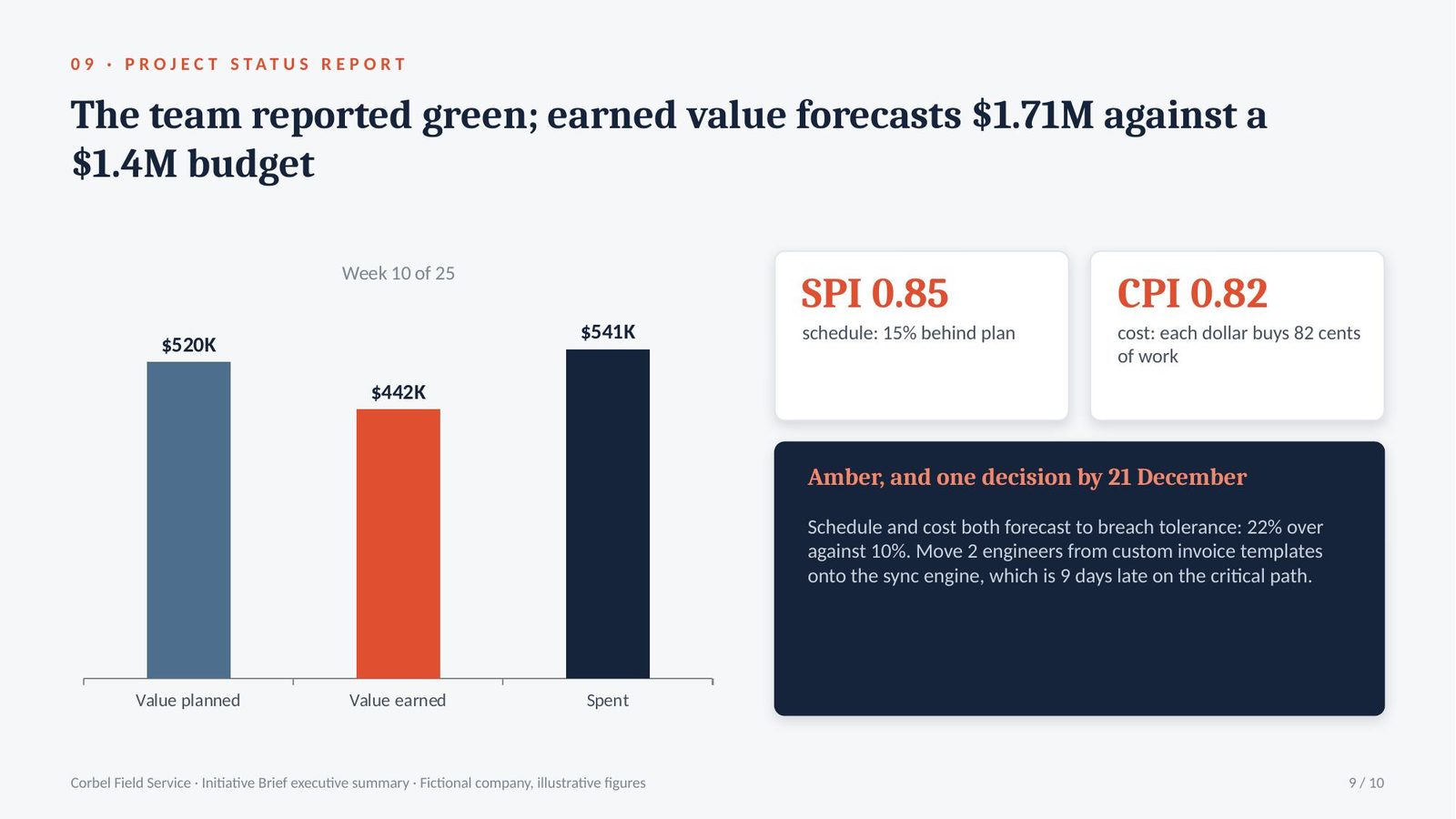
Status: amber. Schedule and cost both forecast to breach tolerance. At a cost performance index of 0.82 the project finishes at $1.71M against $1.4M. Decision needed by 21 December.
Takeaway: report amber, and ask the COO to approve moving two engineers to the sync engine by 21 December.
Earned value compares the work finished with the work planned and the money spent, and at week 10 Corbel had earned $442K of value against $520K planned while spending $541K.
Prompt 10 · Launch
What Corbel brought · Chief Operating Officer
“The pilot’s done and we’re ready to ship. Tell me honestly whether we should.”
What the prompt returned
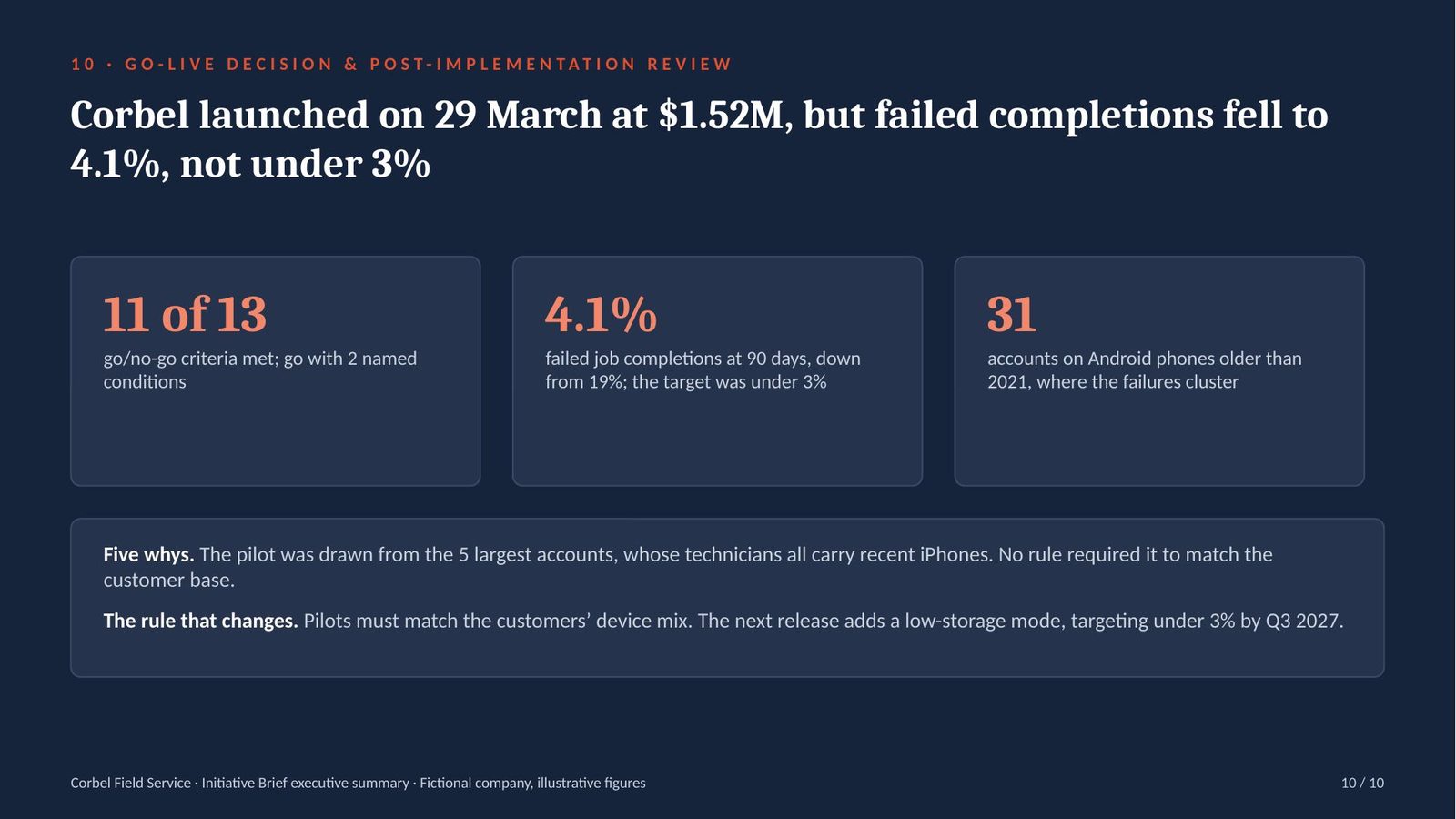
Go, with two conditions: roll out to 20% of accounts first, and publish the support runbook for sync conflicts before day one. At 90 days, failed completions fell from 19% to 4.1%, short of the 3% target.
Takeaway: report each release against its business case benefits and success metrics, not its launch date, and require future pilots to match the customers’ device mix.
A post-implementation review measures benefits realisation, whether a release delivered the benefits in its business case and the metrics in its requirements, rather than whether it launched on time, and Corbel launched on 29 March at $1.52M, inside its 10% tolerance, but moved failed job completions from 19% to 4.1% instead of under 3%.
The three documents Corbel’s COO received in December, produced by prompts 05, 09 and 07: the roadmap after change control, the week-10 status report, and the top of the RAID log.
Offline programme roadmap
Three outcomes, one board promise, dates only where confidence has earned them
Outcome 1
Failed job completions at commercial HVAC accounts
19% → under 3%
Outcome 2
Cancellations that name working offline
48 a year → under 20
Outcome 3
Days from job completion to invoice
4.2 → under 1
Now Q1 2027 · medium confidence
Offline job completion, photos and signature
Outcomes 1, 3 · release 29 Mar 2027Photo compression
Outcome 1 · WSJF rank 4Sync-time measurement
Baseline requirement in the BRDNext Q2 2027 · quarter only
Batch photo upload
Moved from Now to protect the dateOffline invoicing
Outcome 3 · written commitment to NorthgateOffline parts lookup
Outcome 1Later no date
Offline scheduling changes
Evidence: Reported onlyOffline reporting
Evidence: Reported onlyNot doing this year, and what sales can say
“Full offline mode” for every feature: no failure data outside job completion. Sales message to the three prospects sent in October, not March.
Offline programme — status report
For the COO · one page
Overall
Amber
Two tolerances forecast to breach
Schedule
Amber
Forecast 14 Apr vs tolerance 12 Apr
Cost
Amber
Forecast +22% vs 10% tolerance
Scope
Green
2 changes, 9 days, within 2 weeks
What changed. The sync engine, on the critical path, is 9 days late, and the project is buying 82 cents of work for each dollar spent.
What it means. At this rate the release is delivered on 14 April 2027 at $1.71M, past both the 2-week and the 10% tolerance.
Decision needed by 21 December. Move 2 engineers from custom invoice templates to the sync engine. Cost: the templates move to Q2 for the $900K customer.
| Measure | Planned | Actual | Reading |
|---|---|---|---|
| Milestones reached | 3 | 2 | Sync engine prototype missed |
| Value of work finished | $520K | $442K | SPI 0.85 · 15% behind |
| Spend to date | $520K | $541K | CPI 0.82 · 82 cents per dollar |
| Forecast cost at completion | $1.40M | $1.71M | $1.4M ÷ 0.82 |
Colour check. The team reported green. The rules give amber on schedule and cost; the colours above are the restated ones.
RAID log — top five
Risks, assumptions, issues and dependencies leadership needs to see
| ID | Entry | Score | Trigger | Owner · response |
|---|---|---|---|---|
| R1 | Because one engineer wrote the sync layer, her leaving would stop the critical path | 20 | Any sync change reviewed by her alone | Engineering lead · pair a second engineer from week 2 |
| R2 | Because the pilot falls in the heating season, pilot accounts may not give it time | 16 | Fewer than 4 of 5 accounts confirmed by 15 Jan | Head of customer success · recruit 8 accounts, 3 of them plumbing contractors |
| R3 | Because iOS limits background activity, jobs may not sync until the app is reopened | 15 | Background sync test fails beyond 10 minutes | iOS lead · sync on reopen, tested on 4 iOS versions by week 6 |
| A1 | Contractors accept a signature captured offline as proof of completion | – | Confirm with 5 accounts by 30 Nov | Head of product · validate in pilot contracts |
| D1 | Apple and Google app store review, 5 to 10 days | – | Submission not ready by 1 Mar 2027 | Release manager · on the critical path |
Prompt output, formatted for this page. In Claude each prompt returns it as a finished Word or Excel file; other tools return the same content as text and tables. The figures come from whatever you paste in. Corbel is fictional, so every number here is ours to show you.
Yes. The requirements prompt documents the business rules, the functional and non-functional requirements and the acceptance criteria that IT or a product team builds from. In Claude, the PRD comes back as a Word document.
A RAID log tracks a project’s Risks, Assumptions, Issues and Dependencies. The RAID prompt finds what could make the project fail while it is still cheap to fix, and gives each risk an owner and a warning sign.
Yes. The status report prompt gives leaders a red, amber or green status based on clear rules, the numbers behind it and the one decision needed.
ChatGPT, Claude and Gemini. In Claude, every prompt ends with a finished Word or Excel file. ChatGPT and Gemini return the same content as text and tables.
Pack 5 · Product & Project Management
* Corbel Field Service, its people, customers and all figures on this page are fictional and used for illustration only. Output from these prompts depends on the information you supply and the AI tool you use.
Paste the pack’s documents into the AI PowerPoint generator, a separate product at $19, and Claude builds the board presentation as a real .pptx file with editable PowerPoint charts.
Below is Corbel’s executive summary: ten slides, one for each prompt’s output, unedited.
Corbel Field Service is fictional, so every number here is ours to show you. Generated in the NOVA house style.
 Want the presentation built for you?
The AI PowerPoint Generator — $19
Built in  as a real .pptx file with editable charts. Or take both generators together in the bundle, $25.
Nine packs for work, from strategy and finance to sales, HR and operations, each written to the same standard with its own worked example.