Prompts for Life · Pack 11 · 10 prompt templates

Personal Finance
AI Prompt Templates

Ten prompts that take household money from the first net worth statement to the annual review. Every figure comes from your statements, every dollar of take-home pay is allocated before the month starts, and every decision is judged on total cost.

ChatGPT, Claude & Gemini Instant download No subscription Lifetime updates Best in Claude: working Excel spreadsheets

Assess, budget, protect, decide, grow

Run any prompt on its own, or run all ten in order. Each output feeds the next, building one Money Brief that every budget, payment plan and decision draws on.

Four rules in every prompt

These are what stop the AI giving generic money tips instead of a plan built on your own numbers.

Zero-based budget, every month

Take-home pay is allocated in full before the month starts, to costs, savings and debt, until nothing is unallocated. Unspent money moves to savings or debt.

Statements, not memory

Every figure comes from at least three months of bank and card statements. Estimates are labelled, and the gap to the statement is shown.

Total cost, never the monthly payment

Every loan, lease and purchase is compared on its total cost over the full term, with interest and fees. A low payment over a long term often costs most.

Protect before you grow

A starter emergency fund, the full employer match and high-interest debt come before any other saving or investing.

One household, all ten prompts

Priya Raman is a 34-year-old product designer in Denver earning $118,000. In March 2026 her car’s transmission failed. With $400 in savings, the $3,400 repair went on a credit card at 24.99% APR. By August the balance was $11,200, costing about $2,800 a year in interest, and she was contributing 2% of her salary to her 401(k) when her employer would match up to 4%: $2,360 a year left unclaimed. Here is how the ten prompts took her from a $270 monthly deficit to a cleared card and a net worth up $31,800 in a year, one step at a time.*

$11,200

credit card balance at 24.99% APR

$2,800

a year in card interest

$2,360

of employer match unclaimed each year

$400

of savings: 3 days of essential costs

Step 1 · Assess

Net Worth & Cash-Flow Statement

Lists everything you own and owe, and shows whether money is coming in faster than it goes out.

Net worth statementCash-flow statementLiquidity

What Priya brought · her balances and statements

“I earn $118,000. I don’t understand why my card balance keeps going up.”

What the prompt returned

Net worth $23,050. Money going out averages $7,120 a month against take-home pay of $6,850: a $270 shortfall every month, paid for with the credit card.

Assets$49,750: checking $1,850, savings $400, 401(k) $38,500, car $9,000
Liabilities$26,700: credit card $11,200, phone financing $900, student loan $14,600
Cash flowtake-home $6,850 against $7,120 going out: −$270 a month
Net worth$23,050

The analysis · A $118,000 salary was running a $270 monthly deficit

The net worth statement lists assets (what you own) and liabilities (what you owe); net worth is the difference. The cash-flow statement compares take-home pay with the money going out over the same months. Liquidity is the cash available within days.

  • $270 a month short: Priya spent $270 more than her take-home pay every month, and the credit card covered the gap without her noticing.
  • $400 of liquidity: her essential costs are $3,700 a month, about $123 a day. Her savings covered 3 days without income.
  • $2,800 a year in interest: the card balance of $11,200 at 24.99% APR costs about $233 a month, more than her subscriptions and phone combined.

Takeaway: measure net worth and cash flow together; a high salary does not prevent a monthly deficit.
Step 2 · Assess

Spending Analysis & Subscription Audit

Sorts three months of spending into categories, compares it with what you thought you spent, and lists the recurring charges to cancel.

Category analysisRecurring chargesEstimate against statement

What Priya brought · three months of statements

“I’d guessed $350 a month on eating out, and about five subscriptions.”

What the prompt returned

Eating out and delivery: $840 a month. Subscriptions: 14, at $287 a month, and 5 of them unused for more than 90 days.

Eating out and deliveryestimate $350; statements $840 a month
Subscriptionsestimate 5; statements 14, at $287 a month
Shopping and household$1,160 a month, most of it under $40 a purchase
Unused subscriptions5, at $96 a month: cancelled

The analysis · Her estimates missed $490 a month on eating out alone

A spending analysis sorts every transaction into a category and compares the averages with what the person believed they spent. A recurring charge is a payment taken automatically each week, month or year.

  • $350 guessed, $840 spent: small, frequent purchases are the ones people forget. Delivery orders under $30 made up most of the gap.
  • 14 subscriptions, not 5: nine were charged to the credit card, where Priya rarely read the statement. Five had not been used in over 90 days.
  • $1,152 a year: cancelling the five unused subscriptions saves $96 a month before any other change to her spending.

Takeaway: read the statements before setting any budget; memory underestimates small, frequent spending.

Step 3 · Budget

Zero-Based Budget (50/30/20 Check)

Allocates every dollar of take-home pay before the month starts, checks the split against the 50/30/20 rule, and builds the budget spreadsheet.

Zero-based budget50/30/20 ruleExcel spreadsheet

What Priya brought · the Money Brief

“Take-home is $6,850. I want the card gone and some savings.”

What the prompt returned

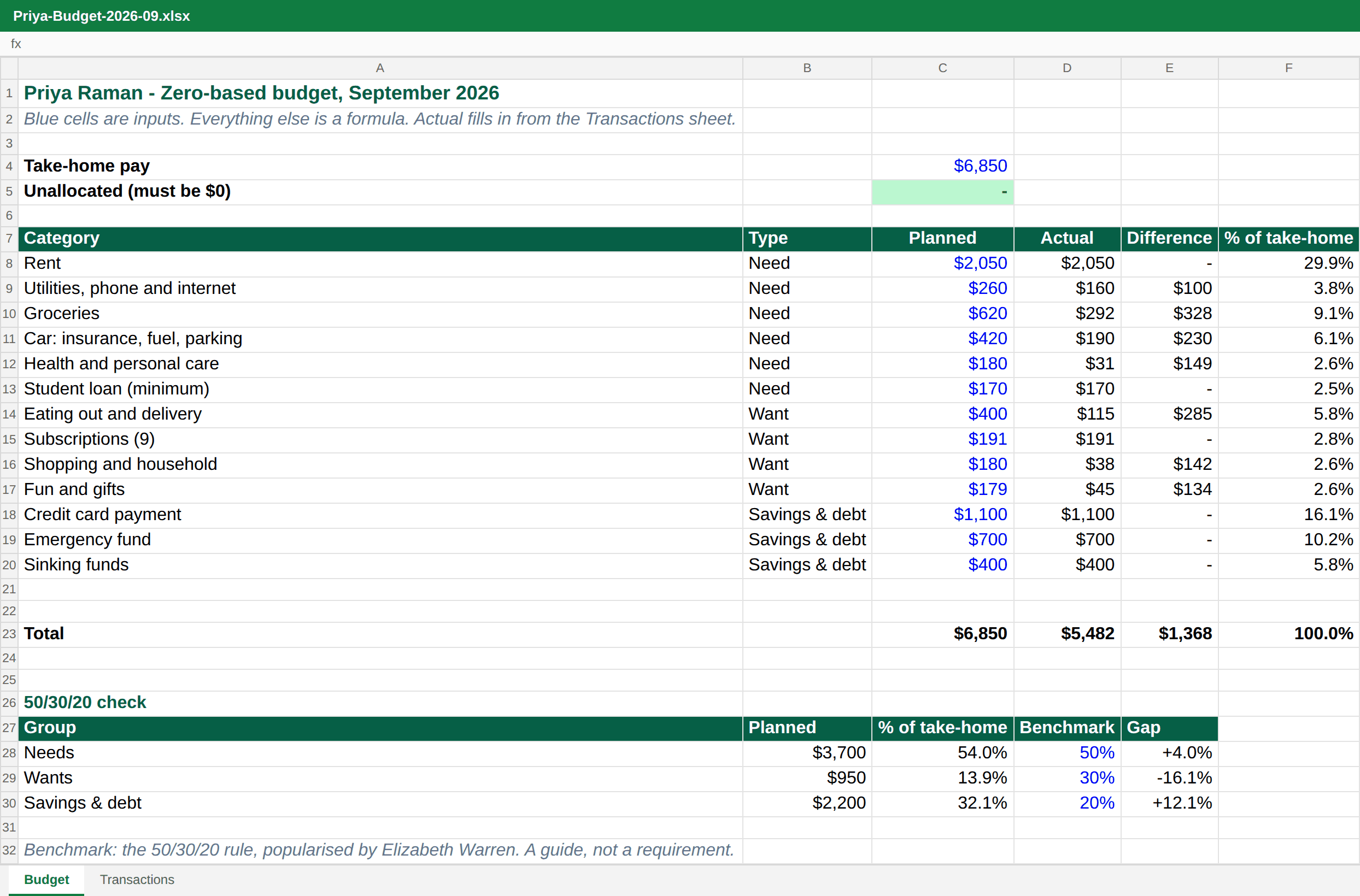
$6,850 allocated, $0 unallocated: needs $3,700 (54%), wants $950 (14%), savings and debt $2,200 (32%). Built in Claude as a working Excel budget.

Needs$3,700: rent, utilities, groceries, car, health, student loan minimum
Wants$950, from $2,867: eating out $400, subscriptions $191, shopping $180, fun and gifts $179
Savings and debt$2,200: card $1,100, emergency fund $700, sinking funds $400
Unallocated$0

The analysis · $330 of card minimums became $2,200 a month of savings and debt payments

A zero-based budget allocates all take-home pay before the month starts, to costs, savings and debt payments, so income minus allocations equals zero. The 50/30/20 rule, popularised by Elizabeth Warren, is a benchmark: 50% to needs, 30% to wants, 20% to savings and extra debt payments.

  • Wants cut from $2,867 to $950: eating out from $840 to $400, shopping from $1,160 to $180, fun from $580 to $179, and five subscriptions cancelled. Gifts and travel now come from sinking funds. Both large cuts are flagged, with the weekly check that keeps them realistic.
  • 32% to savings and debt: above the 20% benchmark, and deliberately so while the card costs 24.99%. Needs at 54% are slightly above 50%, because rent is $2,050.
  • $0 unallocated: in the spreadsheet, the cell turns green only when every dollar is allocated, and actual spending fills in from the transactions sheet.

Takeaway: allocate the full take-home pay before the month starts, and compare actual spending with the plan every week.

Step 4 · Budget

Sinking Funds & Irregular Expenses

Turns predictable irregular costs — car repairs, gifts, annual renewals — into fixed monthly savings.

Irregular expensesSinking funds12-month calendar

What Priya brought · her last two years

“The transmission felt like bad luck.”

What the prompt returned

Irregular costs of $4,780 a year, including $1,800 of car maintenance and repairs: $400 a month across five sinking funds.

Car maintenance and repairs$1,800 a year: $150 a month
Gifts and holidays$1,380 a year: $115 a month
Travel$1,200 a year: $100 a month
Renewals and medical$400 a year: $35 a month (total $4,780, $400 a month)

The analysis · A $3,400 repair on a nine-year-old car was predictable

An irregular expense is predictable in total but not in timing. A sinking fund saves for it every month, the annual cost divided by twelve, so the bill is paid from savings rather than on a credit card.

  • $3,400 on the card: the transmission repair started the debt. A 2017 car with 104,000 miles was due major repairs; only the month was unknown.
  • $4,780 a year: five categories of irregular costs came from her statements and calendar. Before this step, none of them had a budget line.
  • $150 a month for the car: the next repair is paid from the car fund. The emergency fund stays for costs that could not be predicted.

Takeaway: give every predictable irregular cost its own monthly saving, so it never reaches the credit card.

Step 5 · Protect

Emergency Fund Plan

Sets the size of your emergency fund from your essential costs and your income risk, and the plan to build it.

Emergency fundEssential expensesLiquidity

What Priya brought · her savings account

“I have $400 in savings. Is that a problem?”

What the prompt returned

Essential costs are $3,700 a month. Target: three months, $11,100. Starter fund of $2,000, reached in November 2026 at $700 a month.

Now$400: 3 days of essential costs
Starter fund$2,000, reached November 2026 ($400 + 3 × $700)
Risk profilesingle income; stable employer; about 4 months to replace her job
Full fund3 months, $11,100, by October 2027 after the card is cleared

The analysis · Her savings covered 3 days of essential costs

An emergency fund is cash held for costs that cannot be predicted, sized in months of essential expenses: the costs that continue if income stops. It must be liquid: available within days, without penalty or risk of loss.

  • $3,700 a month essential: rent, utilities, groceries, car, health and loan minimums continue if income stops. Eating out and subscriptions do not.
  • Starter fund first: $2,000 comes before extra card payments, so the next surprise does not go back on a 24.99% card.
  • $11,100 target: three months suits one income from a stable employer. The fund is completed after the card, when the card payment moves to savings.

Takeaway: hold a starter fund before paying down debt, then build to three to six months of essential costs.

Step 6 · Protect

Insurance Coverage Review

Checks what your insurance covers, where the gaps are, and whether you are paying for cover you do not need.

PremiumDeductibleCoverage gaps

What Priya brought · her policy documents

“Car, renters, and whatever my employer provides.”

What the prompt returned

One overlap: roadside assistance on her car policy and her credit card, $96 a year. One gap: no liability cover on her renters policy.

Overlaproadside assistance paid twice: $96 a year
Gaprenters policy with no liability cover
Car deductible$500, now payable from the starter emergency fund
Disabilityemployer long-term cover at 60% of salary, already provided

The analysis · She was paying twice for one cover and had none for another

A policy is judged on four terms: the premium (what you pay), the deductible (what you pay before the insurer pays), the coverage limit (the most it pays) and the exclusions. Liability cover pays if you are responsible for injury to someone or damage to their property.

  • $96 a year of duplicate cover: her credit card already included roadside assistance, the same service her car policy charged $8 a month for.
  • No liability cover: if a leak in her apartment damaged the unit below, she would pay for the repairs herself. Adding it costs about $10 a month.
  • Deductible matched to savings: a $500 deductible only works if $500 is available in cash. The starter fund makes it payable.

Takeaway: check what each policy actually covers against what you own and owe, and match deductibles to your emergency fund.

Step 7 · Decide

Debt Payoff Plan (Avalanche vs Snowball)

Orders your debts, compares the two standard payoff methods, and builds the payment schedule and debt-free date.

APRAvalanche methodExcel spreadsheet

What Priya brought · her three debts

“Card $11,200 at 24.99%, phone financing $900 at 0%, student loan $14,600 at 5.5%.”

What the prompt returned

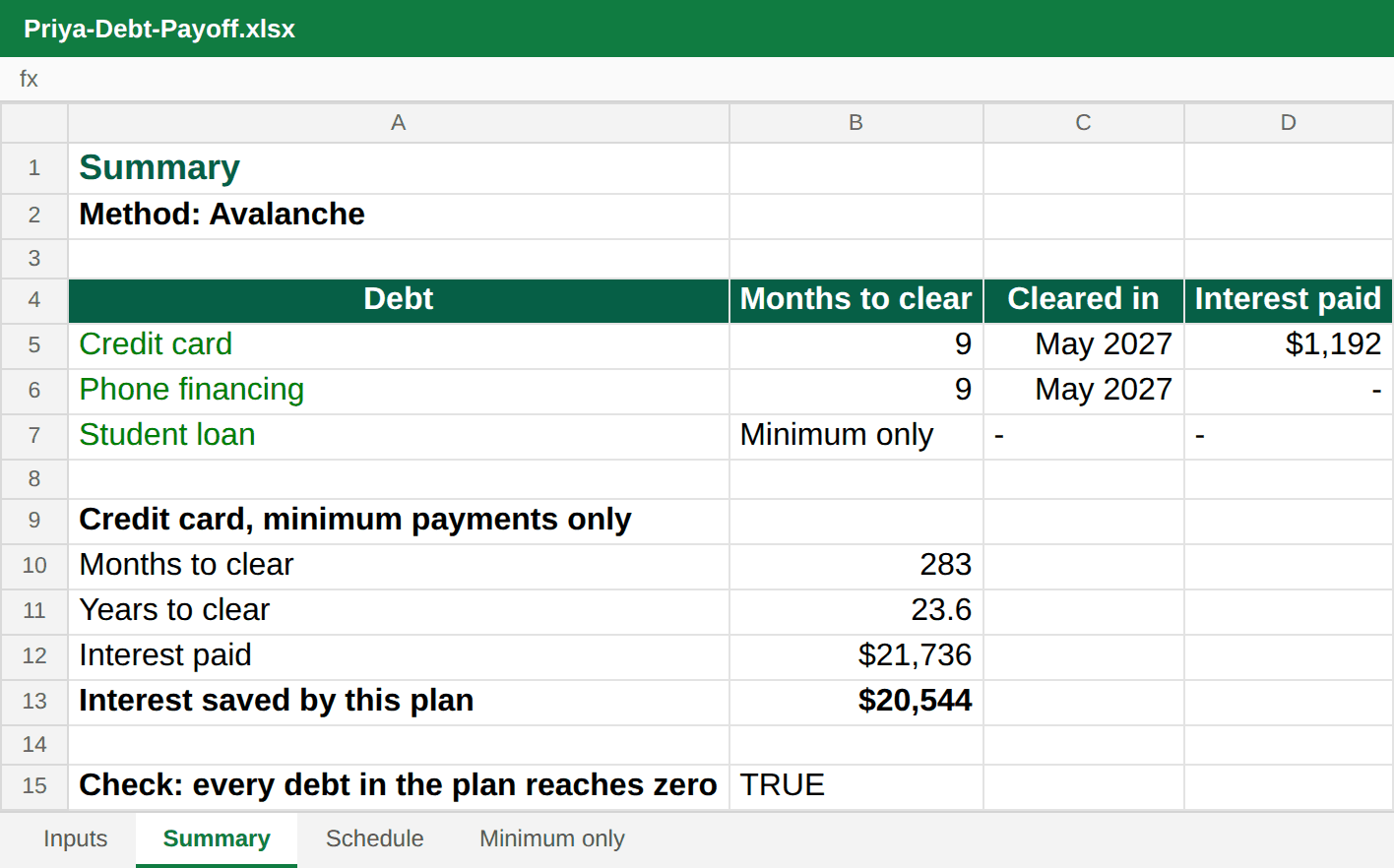
Minimum payments only: 23 years and $21,700 of interest on the card. Avalanche at $1,100 a month, then $1,800: card cleared in May 2027 with $1,190 of interest.

Minimum payments only283 months (23.6 years), $21,736 of interest
Snowballphone first, card cleared May 2027, $1,312 of interest
Avalanchecard first, cleared May 2027, $1,192 of interest
Interest saved$20,544 against the minimum

The analysis · Paying the minimum would have cost $21,736 over 23 years

The APR (annual percentage rate) is the yearly cost of borrowing. The avalanche method puts every extra dollar on the highest APR first, which costs least. The snowball method, described by Dave Ramsey, pays the smallest balance first, which clears accounts sooner.

  • A minimum that barely moves: the card’s minimum is interest plus 1% of the balance. At $11,200, $233 of the first $345 minimum is interest.
  • $120 between the methods: snowball clears the $900 phone loan in October but costs $120 more interest. Avalanche is recommended, and the spreadsheet switches between the two.
  • $1,800 from December: when the starter emergency fund is reached, its $700 a month moves to the card. The card is cleared in May 2027.

Takeaway: pay the highest APR first, and compare any plan with the minimum-only case to see the real saving.

Step 8 · Decide

Big-Purchase Decision: Total Cost of Ownership

Compares the options for a large purchase on their full cost over the years you will own them, not the monthly payment.

Total cost of ownershipDepreciationOpportunity cost

What Priya brought · a dealer’s quote

“The dealer says a new car lease is only $429 a month.”

What the prompt returned

Three-year cost: lease $19,703; keeping her repaired 2017 car $8,900. Keeping the car costs $10,803 less.

Lease$429 × 36 = $15,444, plus $2,999 at signing
Lease insurance$35 a month more: $1,260 (lease total $19,703)
Keep the carrepairs $150 a month: $5,400, plus $3,500 depreciation
Keep the car, total$8,900: $10,803 less over three years

The analysis · “Only $429 a month” was a $19,703 decision

Total cost of ownership (TCO) is every cost of an option over a set period, less what it is worth at the end. Depreciation is the fall in an asset’s value over time. Opportunity cost is what the same money could have done instead.

  • $2,999 at signing: the monthly figure left out the amount due at signing and the higher insurance a leased car requires.
  • $3,500 of depreciation: her 2017 car is worth about $9,000 now and about $5,500 in three years. That fall is a real cost of keeping it, and it is counted.
  • $10,803, close to the card balance: the opportunity cost of the lease was almost the whole $11,200 card balance at 24.99%.

Takeaway: compare options on total cost over the same period, including depreciation, never on the monthly payment.

Step 9 · Grow

Savings & Retirement Contribution Plan

Sets how much to save and in what order, starting with the employer match, and shows the effect on take-home pay.

Employer matchVestingSavings rate

What Priya brought · her benefits summary

“I put 2% in my 401(k). The company matches up to 4%.”

What the prompt returned

Raising her contribution to 4% claims $2,360 a year of match and costs about $145 a month in take-home pay, covered by two budget lines.

Match unclaimed2% of $118,000: $2,360 a year
Take-home cost of 4%about $145 a month, after tax (estimate)
Budget changeeating out $400 to $325; fun and gifts $179 to $109
Savings rate4% to 8% of gross, including the match

The analysis · She was leaving $2,360 a year of salary unclaimed

An employer match is money the employer adds when you contribute, up to a limit; vesting is how long you must stay to keep it. A 401(k) is a tax-advantaged account: contributions reduce taxable income. The savings rate is the share of gross income saved in a year.

  • $2,360 a year: her employer matches 100% of contributions up to 4% of salary. At 2%, half the match went unclaimed. Her match vests after two years, which she passes in January.
  • $145 of take-home, $393 invested: raising her contribution by $197 a month costs about $145 after tax, and the match adds another $197.
  • Match before extra debt payments: the order in "protect before you grow" puts the full match ahead of anything except the starter fund, because it is an immediate 100% return.

Takeaway: claim the full employer match before any other saving; it is part of your pay.

Step 10 · Grow

Annual Financial Review & Money Goals

Compares the year’s results with the plan, updates net worth, and sets the goals and budget for the next twelve months.

Annual reviewSMART goalsNet worth tracking

What Priya brought · the Money Brief, a year on

“It’s August 2027. Did the plan work?”

What the prompt returned

Card cleared in May 2027. Emergency fund at $8,050. Net worth $54,800, up $31,800, before investment returns.

Credit card$11,200 to $0, cleared May 2027
Emergency fund$400 to $8,050
401(k)$38,500 to $47,940 from contributions and match alone
Net worth$23,050 to $54,800, before investment returns

The analysis · Net worth up $31,800 in twelve months, before any market gains

An annual financial review compares actual results with the plan and explains every gap. Goals are written as SMART goals: specific, measurable, achievable, relevant and time-bound.

  • $2,800 a year of interest gone: the card was cleared in May 2027, the month the September 2026 schedule set out.
  • Money saved, not market luck: the $31,800 rise counts only money saved and debt repaid. Investment returns are reported separately.
  • Next goal: three months of essential costs, $11,100, by October 2027, then a home deposit fund of $400 a month.

Takeaway: review the year against the plan once a year, and separate what you saved from what markets did.

The finale · what prompts 03, 07 and 08 produce

What Priya built

Three documents from Priya’s Money Brief: the budget spreadsheet from prompt 03, the debt payoff spreadsheet from prompt 07, and the car decision from prompt 08.

Zero-based budget — September 2026

Budget sheet · Actual fills in from the Transactions sheet

Priya-Budget-2026-09.xlsx
Unallocated: $0

Priya’s zero-based budget in Excel: $6,850 allocated across 13 categories, $0 unallocated, and the 50/30/20 check
The Excel budget built in Claude to prompt 03’s specification, at the weekly check on 10 September.

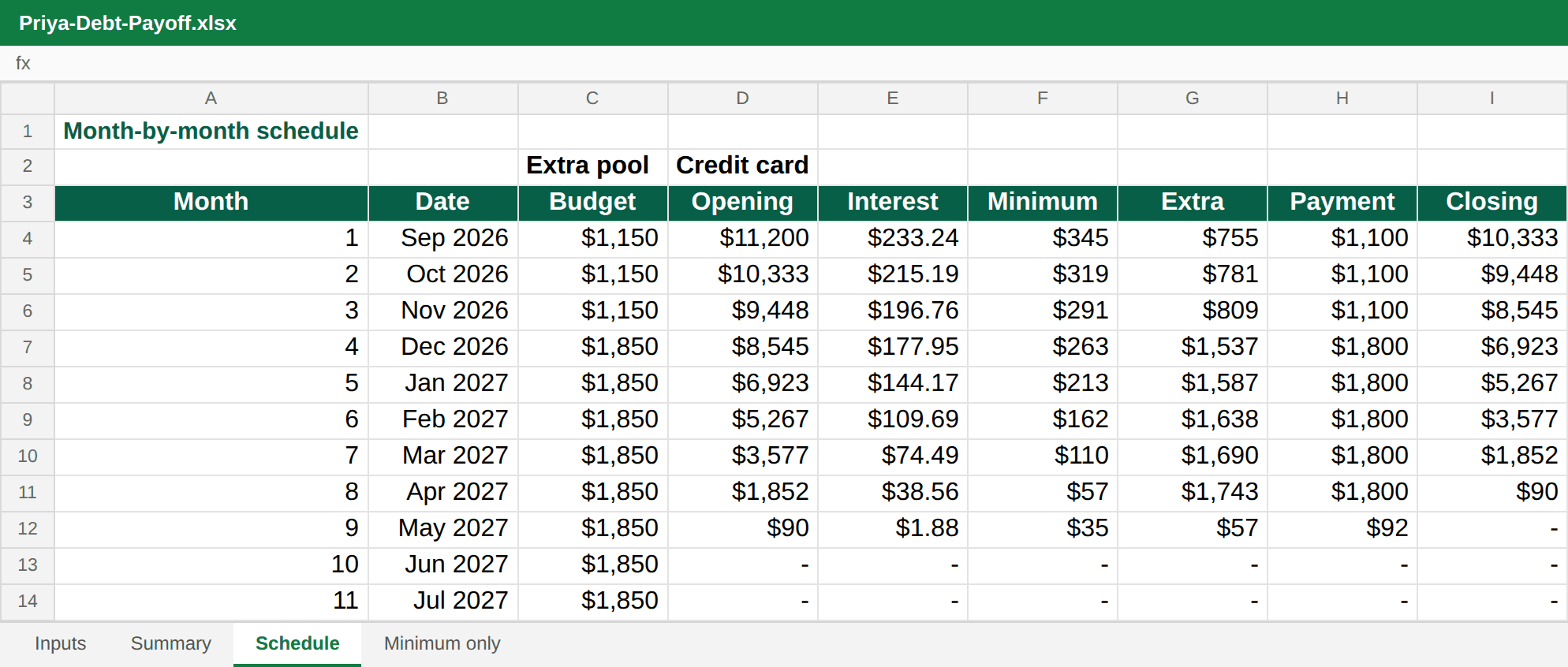
Debt payoff plan — avalanche method

Summary sheet and the first months of the schedule

Priya-Debt-Payoff.xlsx
Card cleared: May 2027

Debt payoff summary: card cleared in 9 months with $1,192 of interest, against 283 months and $21,736 on minimum paymentsMonth-by-month schedule for the credit card, September 2026 to May 2027
The Excel payoff plan built in Claude to prompt 07’s specification. The method cell switches between avalanche and snowball.

Lease a new car, or keep the 2017 car?

Total cost of ownership over three years

Dealer quote: $429 a month
Period: 36 months

CostLease a new carKeep the 2017 car
Monthly payments$429 × 36 = $15,444
Due at signing$2,999
Extra insurance$35 × 36 = $1,260
Repairs and maintenanceIncluded in warranty$150 × 36 = $5,400
DepreciationNone owned at the end$9,000 to $5,500 = $3,500
Total cost of ownership$19,703$8,900

Monthly against total. The lease is $429 a month; its three-year cost is $19,703. Keeping the car averages $247 a month including depreciation.

Opportunity cost. The $10,803 difference is close to the whole $11,200 card balance at 24.99%.

Sensitivity. The lease wins only if repairs on the old car exceed $450 a month, three times the planned $150.

Recommendation. Keep the car. Fund repairs from the $150-a-month car sinking fund and reconsider when the card is cleared.

Prompt output, formatted for this page. In other AI tools the prompts return the same content as tables and text; the figures come from whatever you paste in. Priya Raman is fictional, so every number here is ours to show you.

Pack 11 · Personal Finance

Ten prompt templates, one running brief

  • Net worth and cash-flow statement, spending analysis and subscription audit
  • Zero-based budget and debt payoff plan, built as working Excel spreadsheets in Claude
  • Sinking funds, emergency fund and insurance review
  • Big-purchase total cost of ownership, retirement contributions, annual review
  • Text file and formatted PDF · ChatGPT, Claude and Gemini · best in Claude

$15

One-time purchase · instant download

Get the pack

† These prompts give general information for planning and are not personal financial, tax, investment or insurance advice. They do not recommend specific investments, lenders or insurers. * Priya Raman and all figures on this page are fictional and used for illustration only. Output depends on the information you supply and the AI tool you use. Tax, retirement and credit rules differ by country and state.

More Prompts for Life

Nine packs for everyday life, from career and money to travel and health, each written to the same standard with its own worked example.

See all Prompts for Life
Back to The Prompt Library