Prompt LibraryMarketing & Brand
Prompts for Work · Pack 3

Claims you can
actually defend.

Ten AI prompt templates that run real brand work — what buyers actually want, what every rival claims, the position, the message, the copy, then the brief. Below, watch one company travel all ten.

$15 · 10 prompt templates · lifetime updates
Get the pack — $15 Jump to the deck ↓

The scenario

Verity: a good product that nobody can tell apart from five others

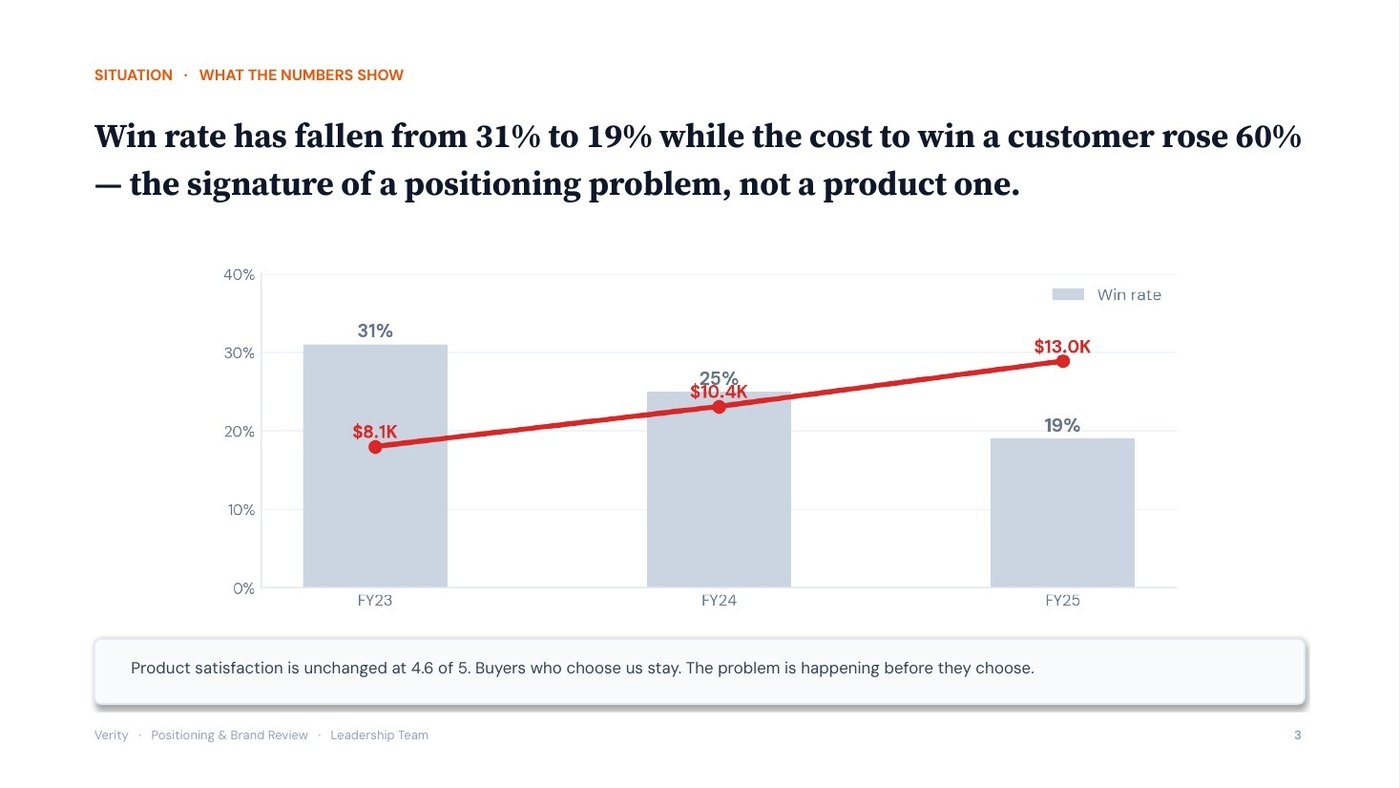
A compliance-training platform, $12M ARR, selling to mid-market companies. Customers rate it 4.6 out of 5 and renew. But five competitors promise almost exactly the same thing in almost the same words, the win rate has fallen from 31% to 19%, and sales is discounting to close. Here is how the ten prompts take that from a sameness problem to a position — one step at a time.

$12MARR
19%win rate, from 31%
+60%cost to acquire

The journey

Input → what the prompt does → output

Ten prompts, in order. Each one's output becomes the next one's input, building a single running Brand Brief.

1
Ground

Customer Needs & Insight

Works out what buyers are really trying to fix, and collects the exact words they use for it.

Jobs-to-be-Done · Voice of Customer · Buying Triggers
Input

“40 reviews, a quarter of sales calls, and our lost-deal notes.”

Output & framework

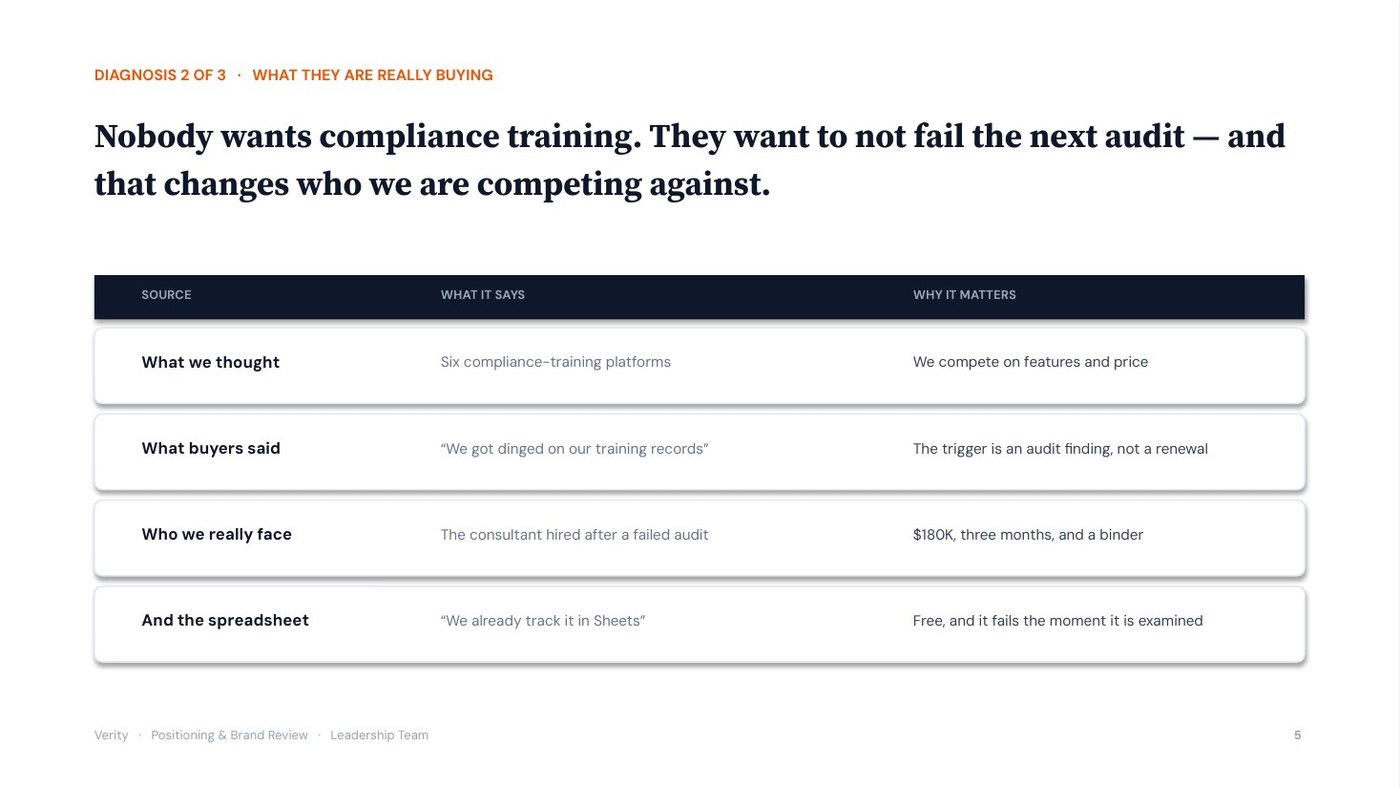
“The job is not training. It is not failing the next audit.”

What they say — “we got dinged on our training records”
What we say — “comprehensive compliance enablement”
Real competitor — the consultant hired after a failed audit
And — the spreadsheet they already have
The analysis · Nobody wants compliance training

They want to not fail the next audit. Jobs-to-be-done is the habit of asking what a buyer is really trying to fix, rather than what they are shopping for — and the answer usually changes who you are competing against.

  • Verity thought it had six competitors, all training platforms. On the job the buyer actually has, its real rival is the consultant a company calls after a failed audit, at $180K, and the spreadsheet they are already using, at nothing.
  • The language bank is evidence, not invention. Customers say “we got dinged on our training records”. Verity’s homepage says “comprehensive compliance enablement”. Nobody has ever typed the second phrase into a search box.
  • The trigger is a moment, not a condition. Not “companies need compliance” but “an auditor found a gap eleven days ago”. That is when budget appears.

Every finding is tagged Evidence-Based, Inference or Assumption. The prompt refuses to invent a single customer phrase.

2
Ground

Competitive Frame of Reference

Maps what every rival actually claims, and finds the ground nobody has taken.

Claim Map · Crowded Language · White Space
Input

“Here are six competitor homepages, pasted word for word.”

Output & framework

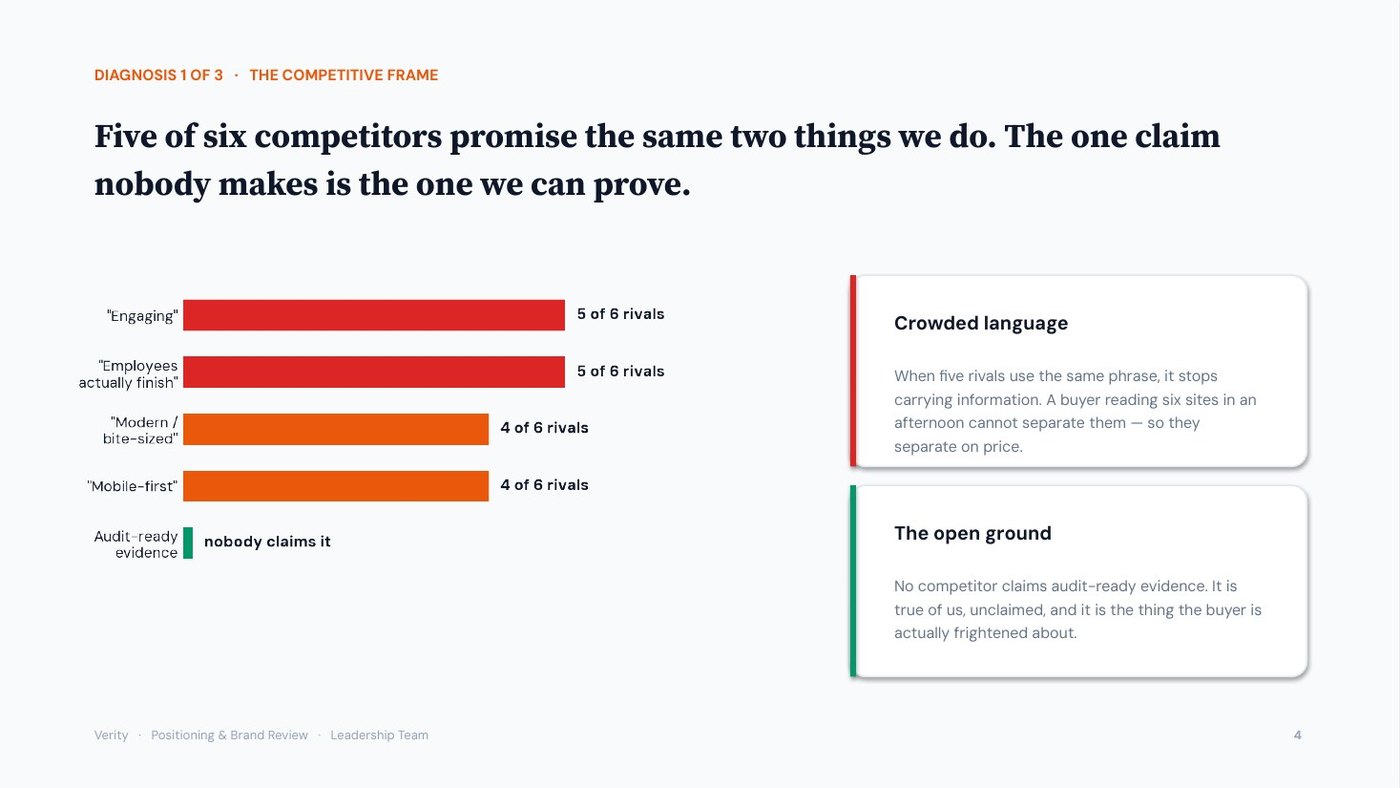
“Five of six promise the same thing. One claim is unoccupied.”

“Engaging” — 5 of 6 rivals
“Employees actually finish” — 5 of 6 rivals
“Mobile-first” — 4 of 6 rivals
Audit-ready evidence — nobody claims it
The analysis · When five rivals use your phrase, it has stopped meaning anything

Crowded language is the term for a claim so widely used it no longer carries information. A buyer reading six sites in one afternoon cannot separate them — so they separate on price, which is the conversation Verity keeps losing.

  • The competitive frame is the set of alternatives a buyer holds in their head when comparing. It is often not the set you think, and it decides what you have to argue against.
  • White space has to clear three tests: true of us, unclaimed by anyone else, and something a buyer actually cares about. Two out of three is not an opening. Only one Verity claim survived all three.
  • The complaint pattern is the tell. Across every rival’s one-star reviews, the same failure repeats — reporting breaks when an auditor asks for it. A category-wide complaint is an invitation.

The prompt also names the ground Verity cannot take. Someone already owns cheapest, and attacking it would just spend the budget.

3
Position

Segmentation, Targeting & Positioning

Picks the segment to win — and names the ones being given up.

STP · Segment Scoring · Positioning Statement
Input

“We sell to anyone who needs compliance training.”

Output & framework

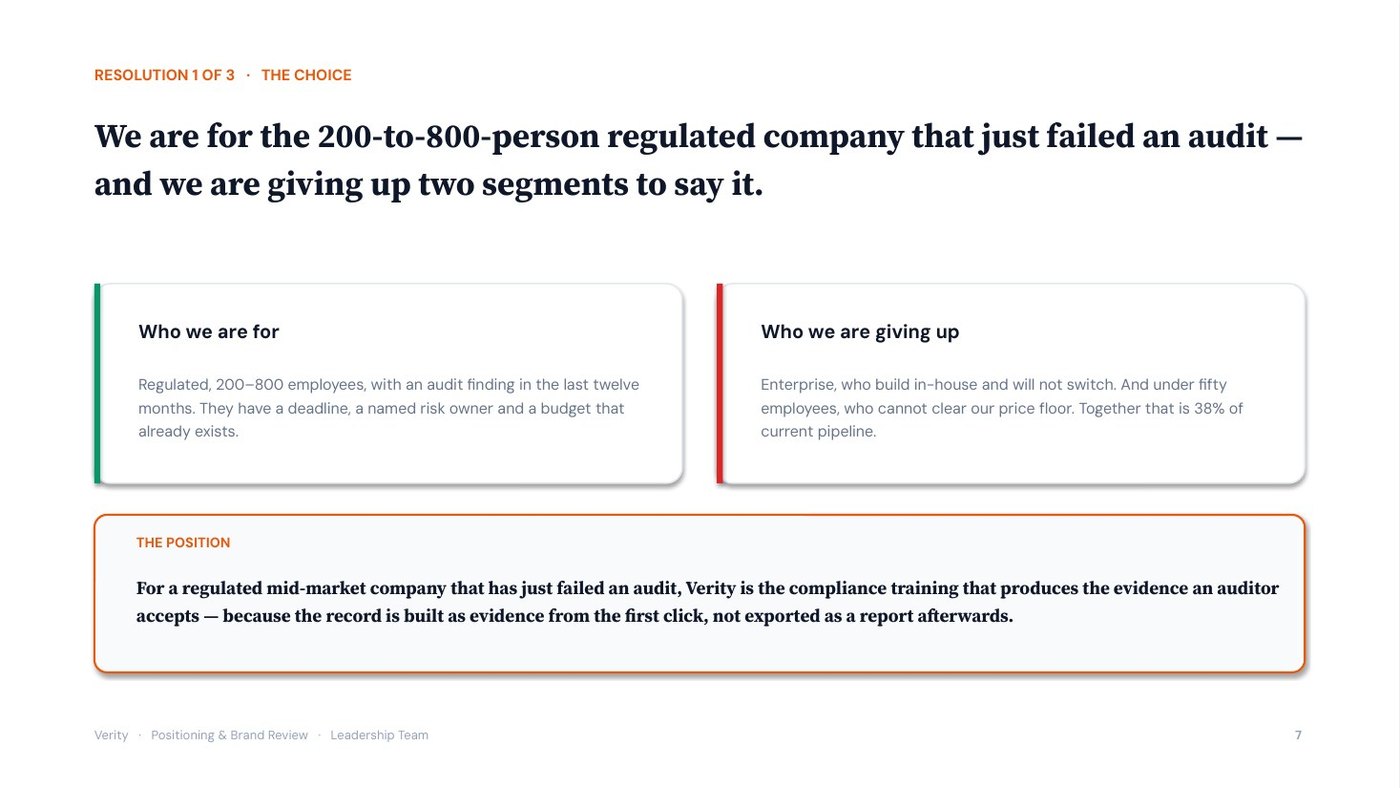
“You are for the 200-to-800-person company that just failed an audit.”

Primary — regulated mid-market, post-audit finding
Secondary — regulated mid-market, pre-renewal
Giving up — enterprise — they build in-house
Giving up — under 50 employees — below the price floor
The analysis · A position you cannot name the cost of is a description

Segmentation, targeting and positioning is one decision in three steps: cut the market into groups, choose which to serve, then say what you are to them. Most companies do the first two and skip the third, or do all three without giving anything up — which is not positioning, it is a description.

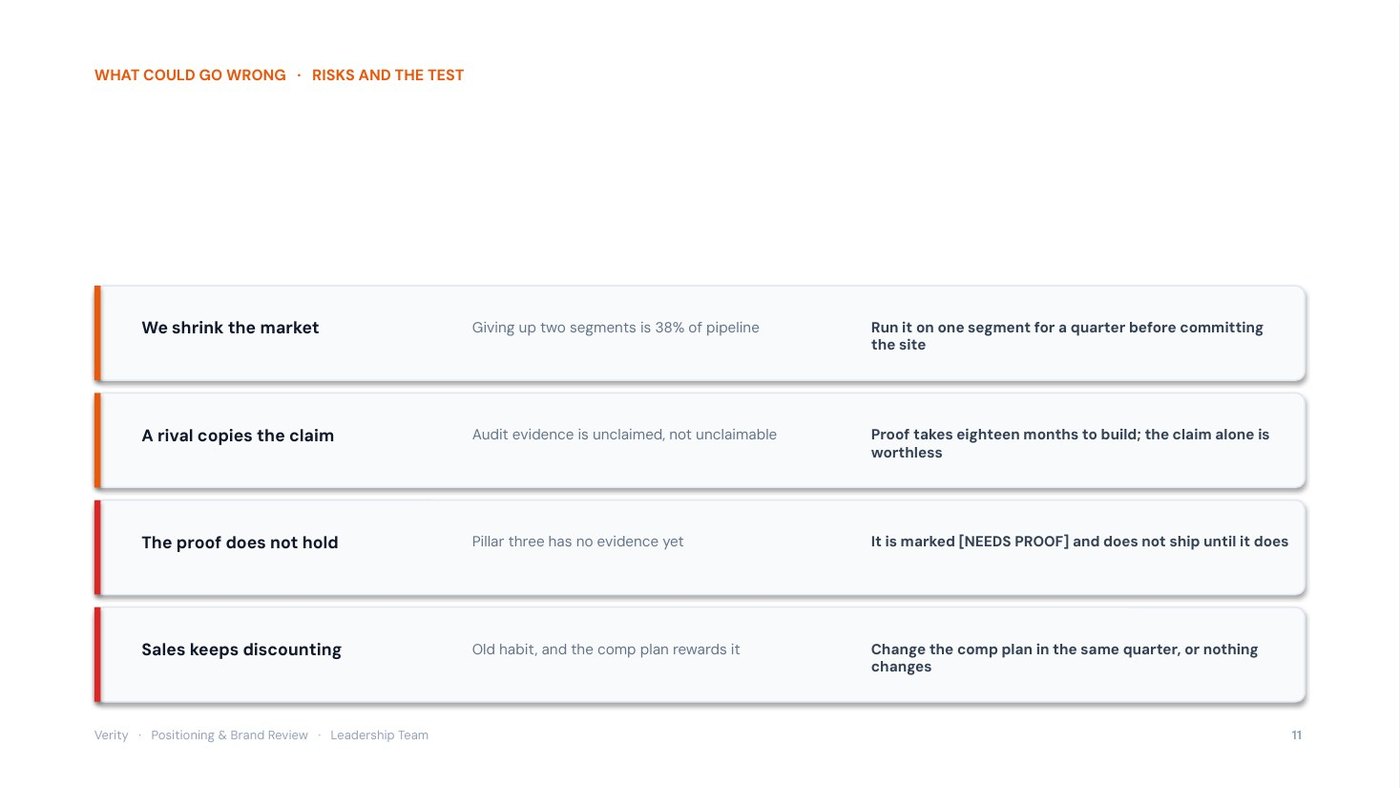
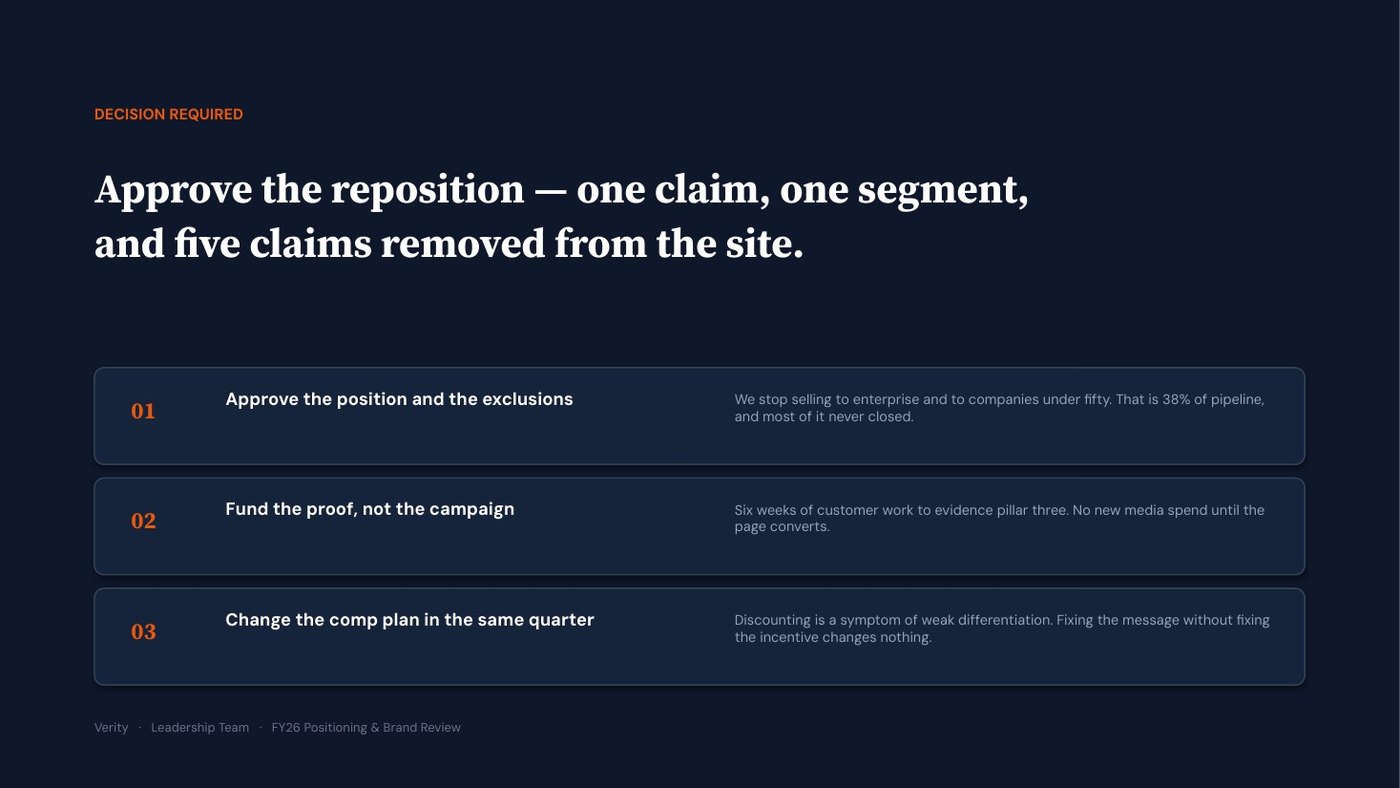
  • The part that gets skipped: naming who you are not for. Verity gives up enterprise, who build their own, and companies under fifty, who cannot clear the price floor. Together that is 38% of current pipeline.
  • Segments defined by situation, not size. “Mid-market” is a demographic. “Mid-market with an audit finding in the last twelve months” is a segment with a deadline and a budget that already exists.

The first two positioning statements failed the competitor test — a rival could have said them without lying. The prompt shows both rejected versions and why, rather than only the one that worked.

4
Position

Points of Parity & Points of Difference

Separates what gets you considered from what gets you chosen, then audits the proof.

POP / POD · Competitor Test · Proof Audit
Input

“Here are the nine things our homepage is proud of.”

Output & framework

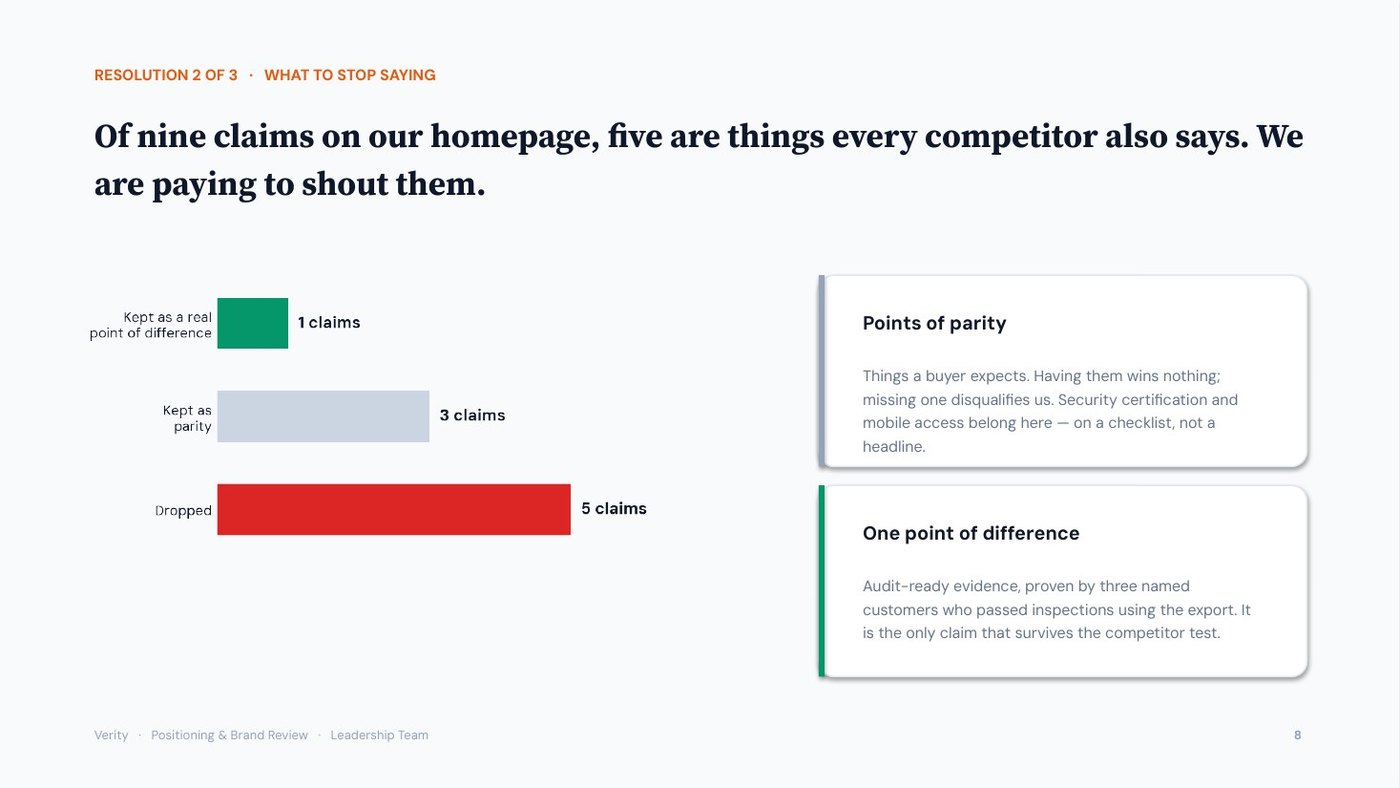
“Five are parity. Three are noise. One is a real difference.”

Kept as a difference — audit-ready evidence — PROVEN
Kept as parity — security, mobile, integrations
Dropped — 5 claims every rival also makes
Proof gap — 1 pillar marked [NEEDS PROOF]
The analysis · Could a competitor say this?

Points of parity are the things a buyer expects. Having them wins nothing; missing one disqualifies you. Security certification lives here — being certified never won a deal, and not being certified has lost plenty.

Points of difference are the reason someone picks you over an adequate alternative. Most marketing confuses the two and spends the whole budget shouting about parity.

  • The test that separates them: could a named competitor put this exact sentence on their own site without lying? Verity’s “engaging content employees actually finish” survives about four seconds of that.
  • The proof audit grades each survivor PROVEN, CLAIMED or [NEEDS PROOF] — and the prompt will not invent a statistic or a customer name to close a gap. It says what evidence is missing and the cheapest way to get it.

Seven of nine claims moved to the stop-saying list. That list being longer than the keep list is the normal result, and the prompt says so rather than softening it.

5
Express

Value Proposition & Messaging Hierarchy

One message, three pillars, and the evidence beneath each.

Value Proposition · Messaging Hierarchy · Proof Ranking
Input

“Every team writes their own version of what we do.”

Output & framework

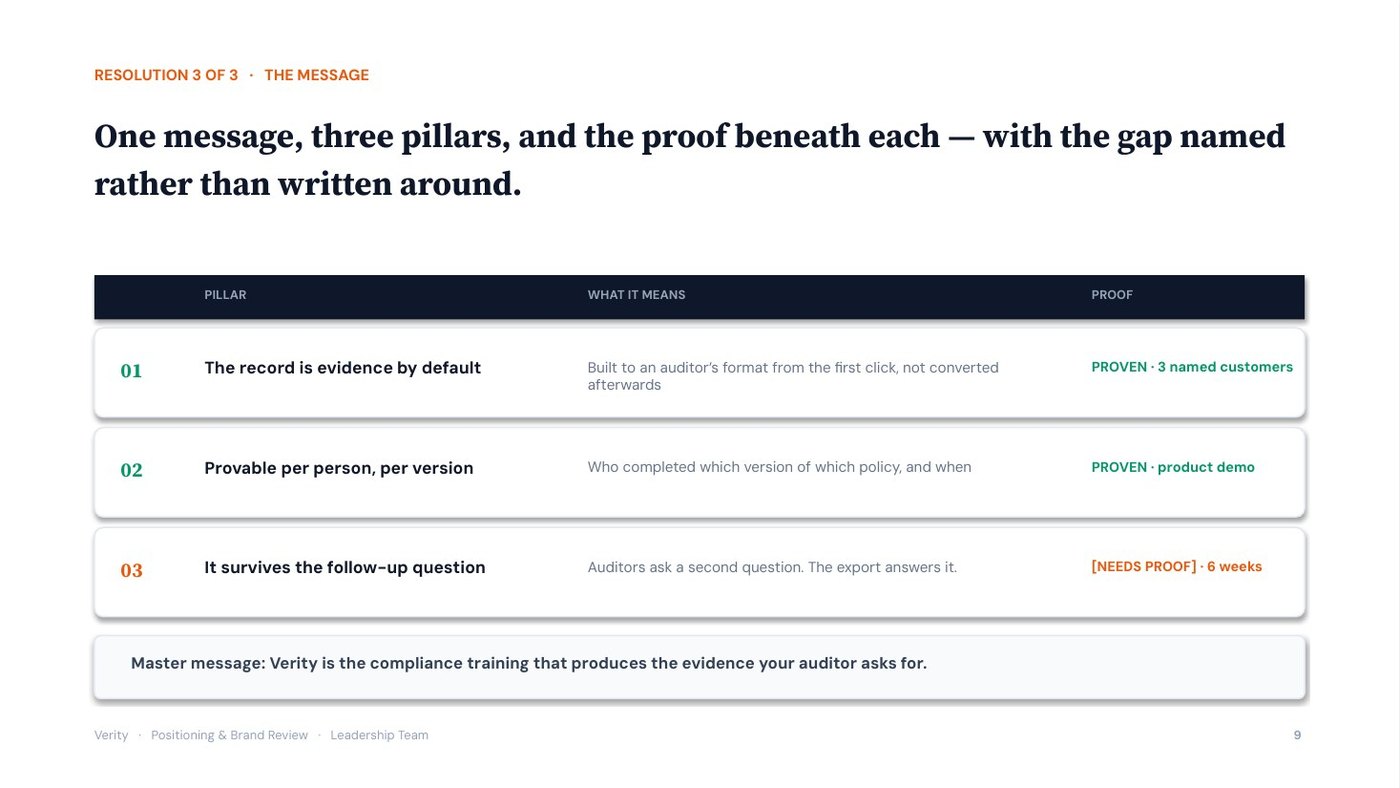
“One master message. Three pillars. Proof under two of them.”

Master message — the training that produces the evidence your auditor asks for
Pillar 1 — evidence by default — PROVEN
Pillar 2 — provable per person, per version — PROVEN
Pillar 3 — survives the follow-up — [NEEDS PROOF]
The analysis · A hierarchy exists so five teams say one thing

Without it, every writer invents their own value proposition and the market never builds a single clear idea of what you do. A hierarchy is the map everyone writes from: one master message, three supporting pillars, and evidence beneath each.

  • The pillars have to be MECE — mutually exclusive, collectively exhaustive. No overlap, no gaps. Overlapping pillars are the same argument twice, which reads as padding.
  • Proof is ranked, not assumed: measured results beat named customers, which beat third-party validation, which beats a demo, which beats a logo wall.
  • The gap is named, not written around. Verity’s third pillar has no evidence yet, so it is marked and does not ship. Writing persuasively around a hole is how unprovable claims reach a customer.

The whole hierarchy then compresses into one sentence a customer could repeat accurately to a colleague. If it cannot, it is not finished.

6
Express

Brand Identity, Voice & Tone

A voice defined as constraints, plus a pass that strips the tells of machine-written copy.

Voice Principles · Word List · The De-Slop Pass
Input

“Unlock seamless, engaging compliance enablement for the modern workforce.”

Output & framework

“Compliance training that hands your auditor the evidence, not a spreadsheet.”

Empty verb — “unlock”
Empty adjectives — “seamless”, “engaging”
Abstraction for a buyer — “the modern workforce”
Four tells — in eleven words
The analysis · A voice is a set of constraints, not a list of adjectives

“Professional yet approachable” constrains nothing and describes every company on earth. A usable voice is stated as trade-offs — plain over clever, specific over comprehensive — because a trade-off can be applied to a sentence and an adjective cannot.

  • The de-slop pass is the part nobody else has. Machine-written copy has tells: opening on a grand abstraction, empty verbs like unlock and elevate, the rule of three used as a tic, the “not just X, but Y” construction, and closing paragraphs that summarise what was just said.
  • Verity’s headline carried four of them in eleven words and said nothing a competitor could not also say.
  • The read-aloud test catches the rest. Any sentence you cannot speak in one breath without sounding like a press release gets rewritten.

There is something useful about an AI prompt whose job includes telling you how not to sound like an AI. The tells are predictable, which is exactly why they can be listed and removed.

7
Activate

Communication Objectives & Campaign Brief

Names what the audience believes today and what they must believe after.

Belief Shift · Communication Objective · Creative Brief
Input

“We need a campaign for Q3. Budget is $180K.”

Output & framework

“From ‘they are all the same’ to ‘the evidence is the product’.”

They believe now — compliance training is a box to tick
They must believe — the training is not the deliverable, the evidence is
Objective — comprehension, not awareness
Failure defined — before the campaign runs, not after
The analysis · A campaign is an attempt to change a belief

A campaign is not a set of assets. It is an attempt to move a specific group of people from one belief to another. Briefs that skip that produce activity and no result, which is most briefs.

  • The honest version of “what they believe now” is the hardest line to write, because it is usually unflattering. Verity’s buyers think every vendor in the category is interchangeable. They are largely right, which is the problem.
  • The communication objective has to be one thing. Awareness, comprehension, preference, trial or action. Most briefs claim all five, which means the campaign is optimised for none. Verity does not have an awareness problem; it has a comprehension problem.
  • The insight is an observation, not a statistic. Nobody is proud of buying compliance training. They are frightened of the audit. Everything in the campaign follows from that sentence.

The brief also states what result would mean it failed — before it runs, while that is still an honest number rather than a negotiation.

8
Activate

Integrated Marketing Communications Pack

The page, the ads, the email and the posts — every line traceable to a pillar.

Channel Copy · One-Variable Tests · Traceability Table
Input

“Now write the landing page, the ads and the nurture sequence.”

Output & framework

“Every claim mapped to a pillar and its proof. Two rows blocked.”

Landing page — headline, three sections, proof block
Ad variants — each changes exactly one element
AI-findable — claim and evidence in adjacent sentences
Blocked — 2 rows marked [NEEDS PROOF]
The analysis · If a test changes three things, it proves nothing

Every ad variant changes exactly one element from the control — the hook, the proof, or the call to action — and says which. Change three and a winning variant tells you nothing about why it won, which is how teams run tests for a year and learn nothing.

  • The traceability table is the control that matters. Every headline and claim is mapped to its pillar and its evidence. Any row without proof is marked and does not ship. Two of Verity’s did not ship.
  • Findable by AI assistants is a real requirement now. Buyers increasingly ask Claude or ChatGPT rather than a search box, and an assistant quotes a sentence out of context. So the claim goes in one complete sentence, the evidence sits in the sentence beside it, and the company is named rather than called “we”.

The prompt finishes by running the de-slop list over its own output and reporting what it caught. Marking your own homework is imperfect, but it catches the obvious cases.

9
Measure

Customer Journey Diagnostics & Test Design

Finds the one stage that is actually costing you, then designs a test that can fail.

Layered Diagnosis · Binding Constraint · Kill Criteria
Input

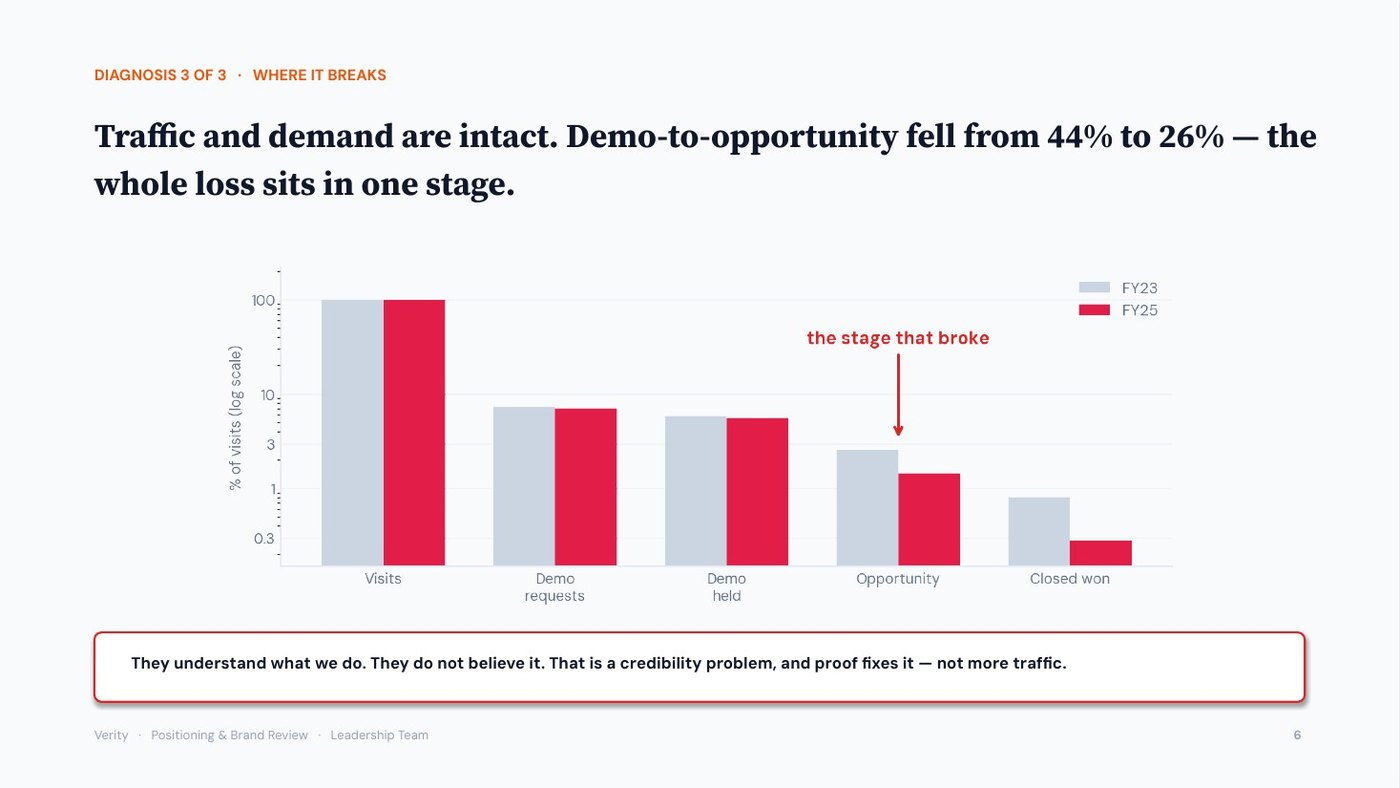
“Traffic is fine, demos are fine, and revenue is down.”

Output & framework

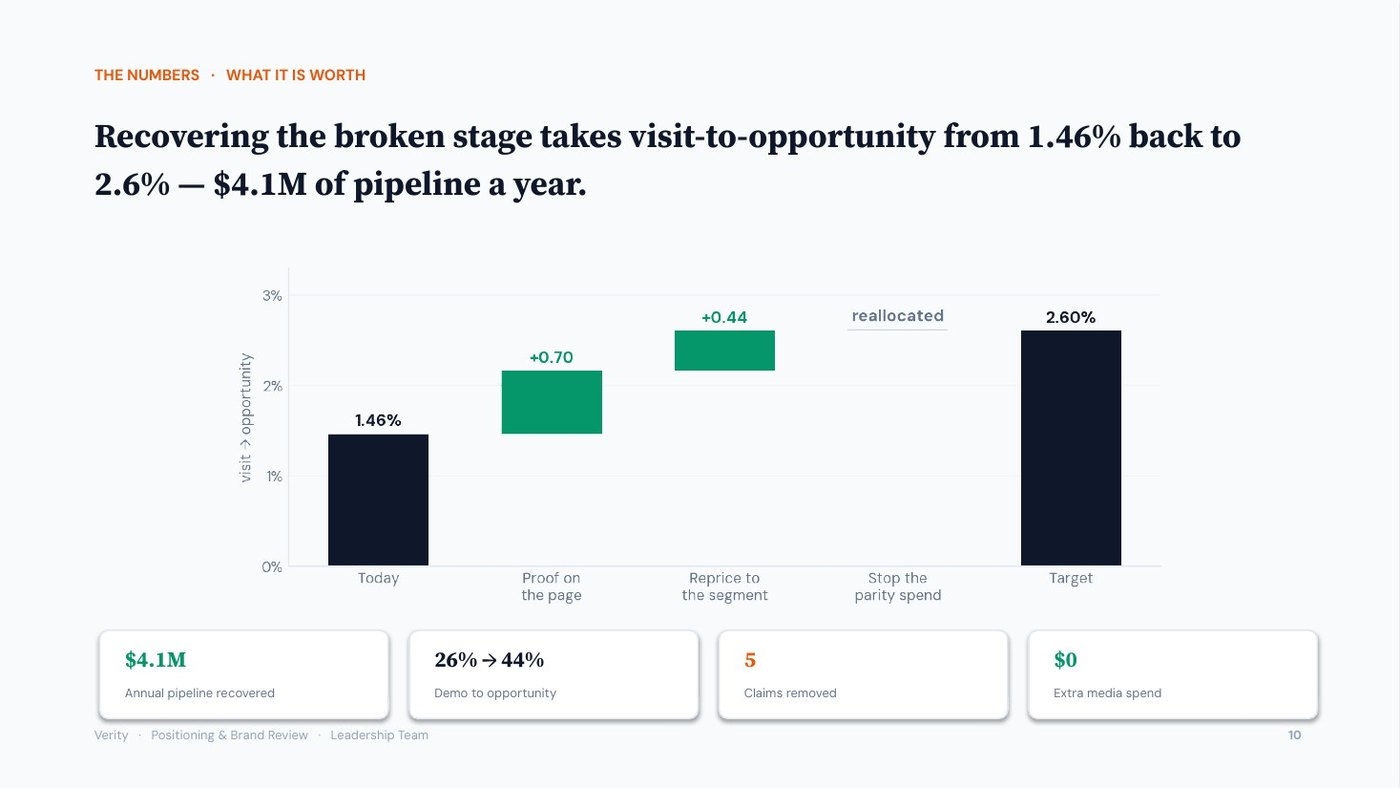
“Credibility. Demo-to-opportunity fell 44% to 26%. $2.1M a quarter.”

Reach — not the constraint
Relevance — not the constraint
Comprehension — not the constraint
Credibility — THE BINDING CONSTRAINT
The analysis · Find the one constraint, not five problems

The prompt works through six layers in order and commits to one answer. Reach, relevance, comprehension, credibility, friction, fit. Listing all six as problems is what a report does; naming the binding one is what an analyst does.

  • Verity’s buyers understand the claim and do not believe it, because nothing on the site proves it. That is credibility, and it is fixed with evidence rather than more traffic — which is where the budget was going.
  • The cost is computed, not asserted: $2.1M of pipeline a quarter, with the arithmetic shown, so the fix can be prioritised against everything else competing for the same week.
  • A hypothesis has to be falsifiable. One variable, a minimum lift worth acting on, the traffic needed before the number means anything, and a kill criterion agreed in advance. Without the kill criterion a failing test just runs longer.

It also names what to stop doing. An analysis that only adds work has not finished.

10
Codify

Brand Brief & Marketing Guardrails

The document anyone can follow without asking you.

Brand Brief · Guardrails · Review Trigger
Input

“Every freelancer we hire writes something slightly off-brand.”

Output & framework

“Three pages. Who we are for, what we claim, and what we never say.”

Who it is for — and who it is deliberately not for
The one difference — with its proof attached
Never say — “engaging”, or any unproven claim
Review trigger — what makes this brief go stale
The analysis · Brand strategy dies in decks nobody opens

Most positioning work ends as a sixty-slide deck that three people have read. A three-page brief a freelancer can act on is worth more than all of it, because the test of brand work is whether someone else can produce on-brand work from it without asking you a question.

  • Guardrails are the section nobody writes. Not what we say — what we will never say, and why. No “engaging”. No implication that a regulator has approved the product. No customer named without written permission.
  • The review trigger stops it going quietly stale. A competitor move, a new segment, a product change — named in advance, so the brief gets revisited deliberately rather than being quietly ignored for three years.

If a section cannot be completed because the upstream work is missing, the prompt says which one to run rather than filling the hole with something generic. A brief with an honest gap is more useful than a complete one that is partly invented.

Get the Marketing & Brand pack

All 10 prompt templates with full copy-paste text and worked examples — a downloadable PDF plus a plain-text copy file. Lifetime updates.

$15 · 10 prompt templates

Instant download · lifetime updates

Get the pack — $15
The finale · one prompt away

The deck the Brand Brief produces

The ten prompts above produce the thinking: the customer insight, the competitive frame, the position, the message and the guardrails. That is the hard part, and it is what this pack delivers.

Feed the Brief into the McKinsey-Grade PowerPoint Generator — our standalone flagship — and it builds this in Claude: a real .pptx with native, editable charts. Twelve slides, unedited.
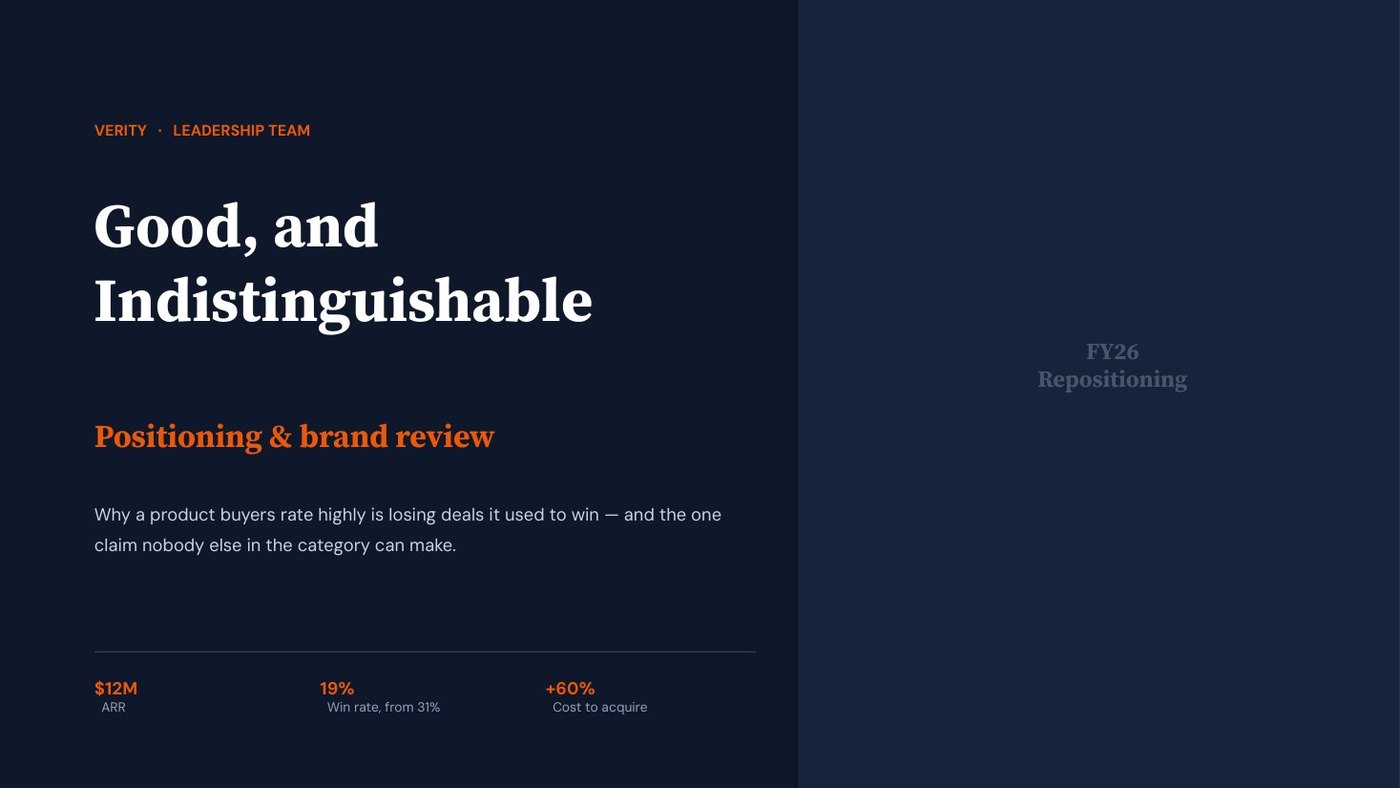
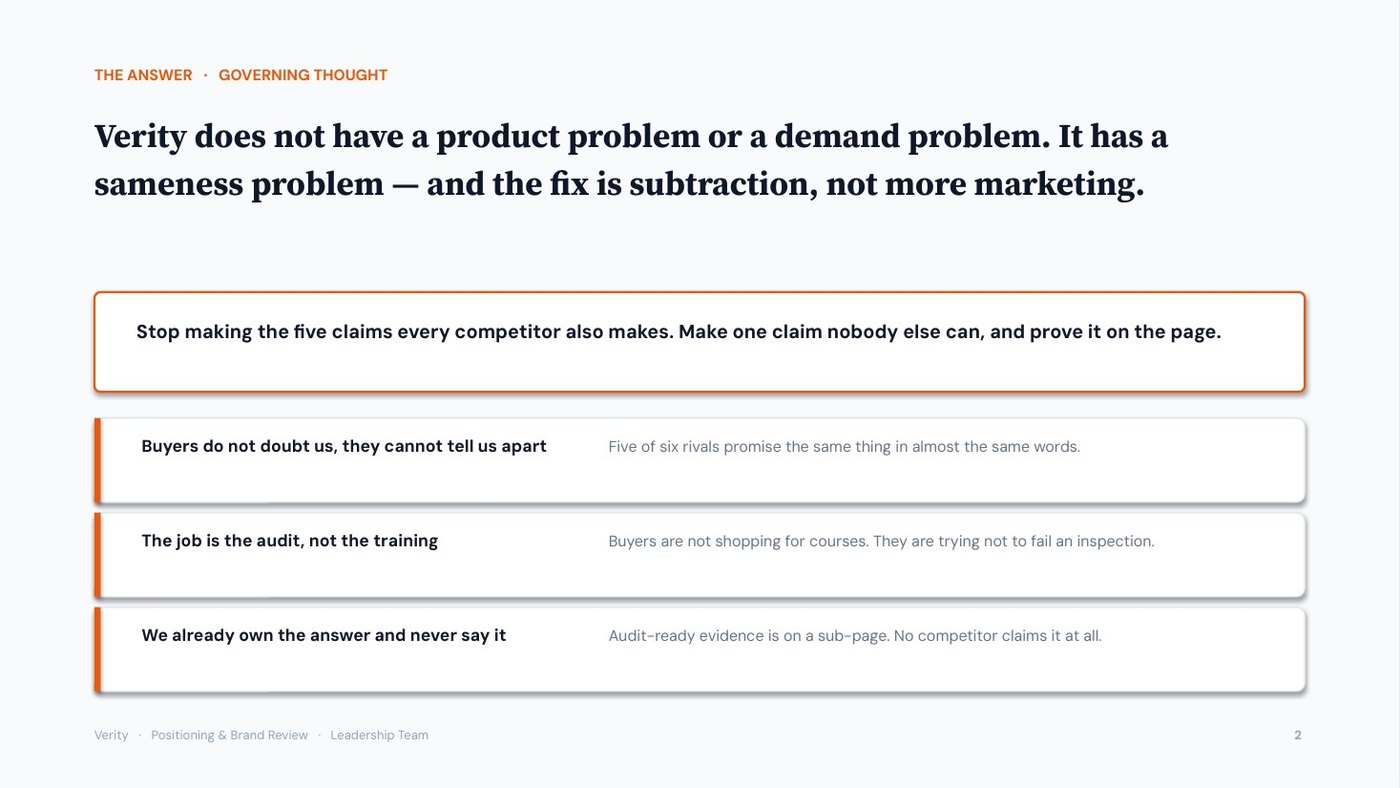
Verity positioning deck, slide 1 of 12 Verity positioning deck, slide 2 of 12 Verity positioning deck, slide 3 of 12 Verity positioning deck, slide 4 of 12 Verity positioning deck, slide 5 of 12 Verity positioning deck, slide 6 of 12 Verity positioning deck, slide 7 of 12 Verity positioning deck, slide 8 of 12 Verity positioning deck, slide 9 of 12 Verity positioning deck, slide 10 of 12 Verity positioning deck, slide 11 of 12 Verity positioning deck, slide 12 of 12
1 / 12

Verity is a fictional company, so every number here is ours to show you. Generated in the NOVA house style.

Microsoft PowerPoint Want the deck built for you in one shot? The McKinsey-Grade PowerPoint Generator — $19

Built in Claude as a real .pptx with native, editable charts. Or take both generators together in the bundle, $25.

Back to The Prompt Library