Ten AI prompt templates that run real brand work: what buyers actually want, what every competitor claims, the position, the message, the copy, then the brief. Below, one company is worked through all ten.
What’s inside
Run any prompt on its own, or run all ten in order. Each output feeds the next, building one Brand Brief.
Research
01Customer Insight Research (Jobs-to-Be-Done)Works out what buyers are really trying to fix, and collects the exact words they use for it.02Competitive Frame of ReferenceMaps what every competitor claims, and finds the position nobody has taken.Position
03Segmentation, Targeting & PositioningPicks the segment to win — and names the ones being given up.04Points of Parity & Points of DifferenceSeparates what gets you considered from what gets you chosen, then audits the proof.Messaging
05Value Proposition & Messaging HierarchyOne message, three pillars, and the evidence beneath each.06Brand Identity, Voice & ToneA voice defined as constraints, plus a pass that strips the tells of machine-written copy.The scenario
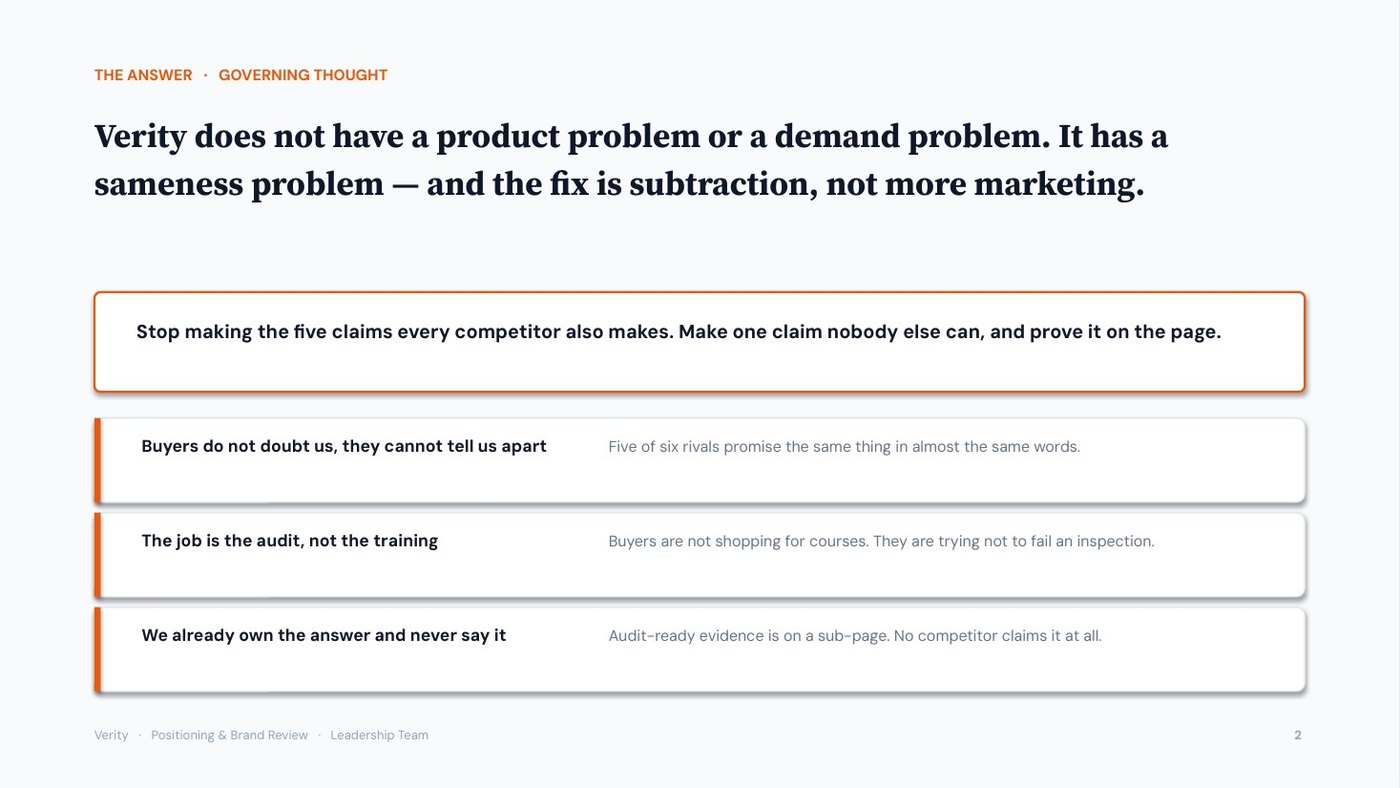
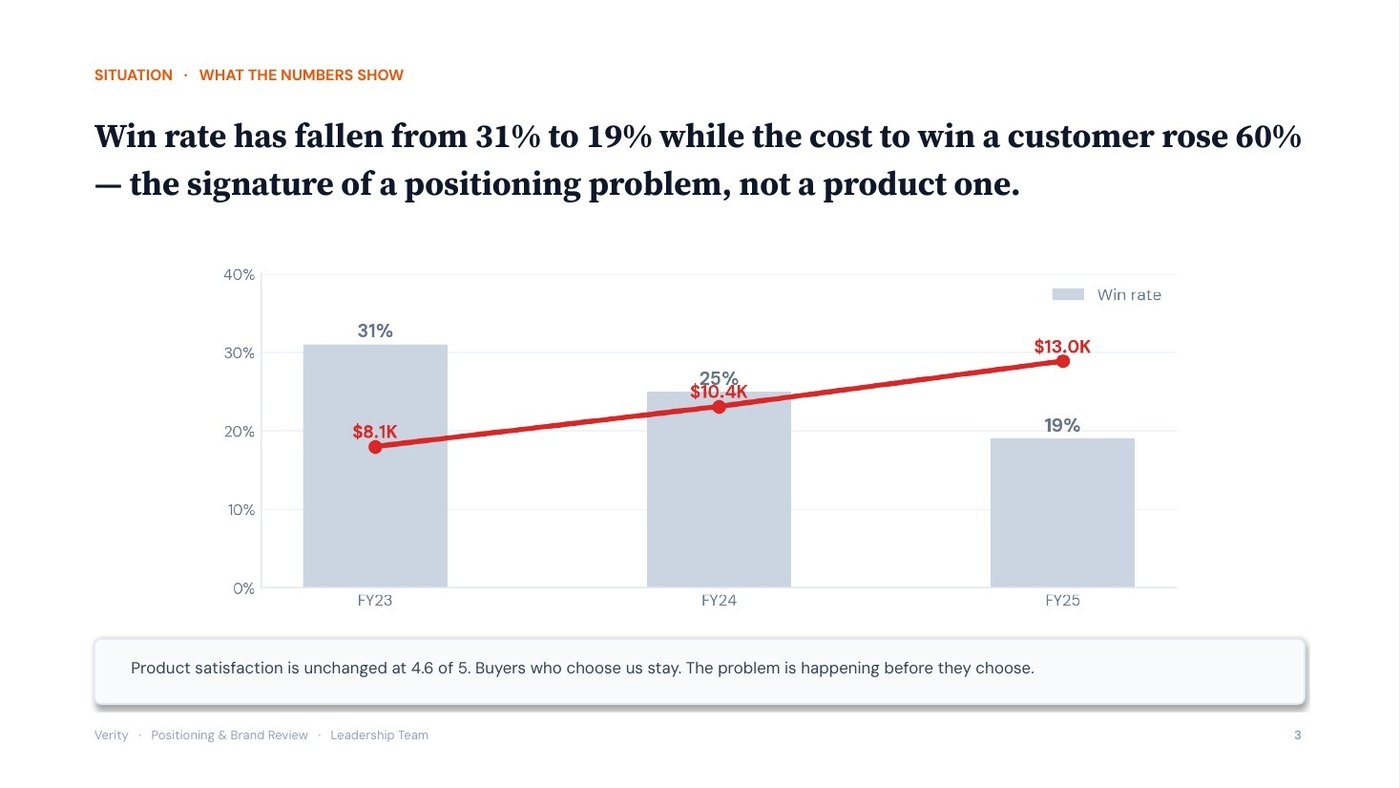
A compliance-training platform, $12M ARR, selling to mid-market companies. Customers rate it 4.6 out of 5 and renew. But five competitors promise almost exactly the same thing in almost the same words, the win rate has fallen from 31% to 19%, and sales is discounting to close. Here is how the ten prompts take that from a sameness problem to a position — one step at a time.
Step by step
Ten prompts, in order. Each one's output becomes the next one's input, building a single running Brand Brief.
Works out what buyers are really trying to fix, and collects the exact words they use for it.
“40 reviews, a quarter of sales calls, and our lost-deal notes.”
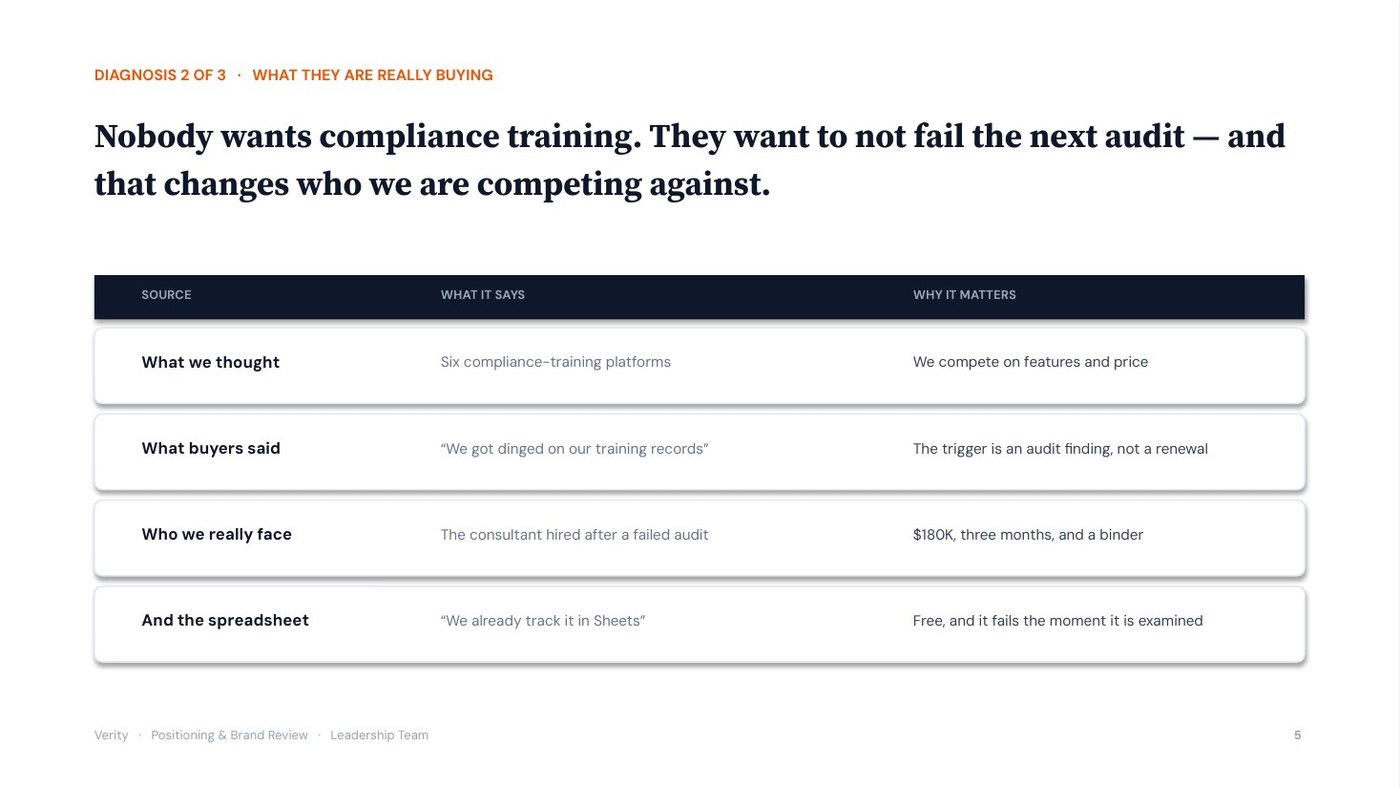
“The job is not training. It is not failing the next audit.”
Jobs-to-be-done (JTBD) is a method for identifying the result a buyer is trying to achieve, rather than the product category they buy. It often shows that the real competitors are not the obvious ones.
Takeaway: describe the product in the buyer’s own words, such as “we got dinged on our training records”, and time marketing to audit findings.
Maps what every competitor claims, and finds the position nobody has taken.
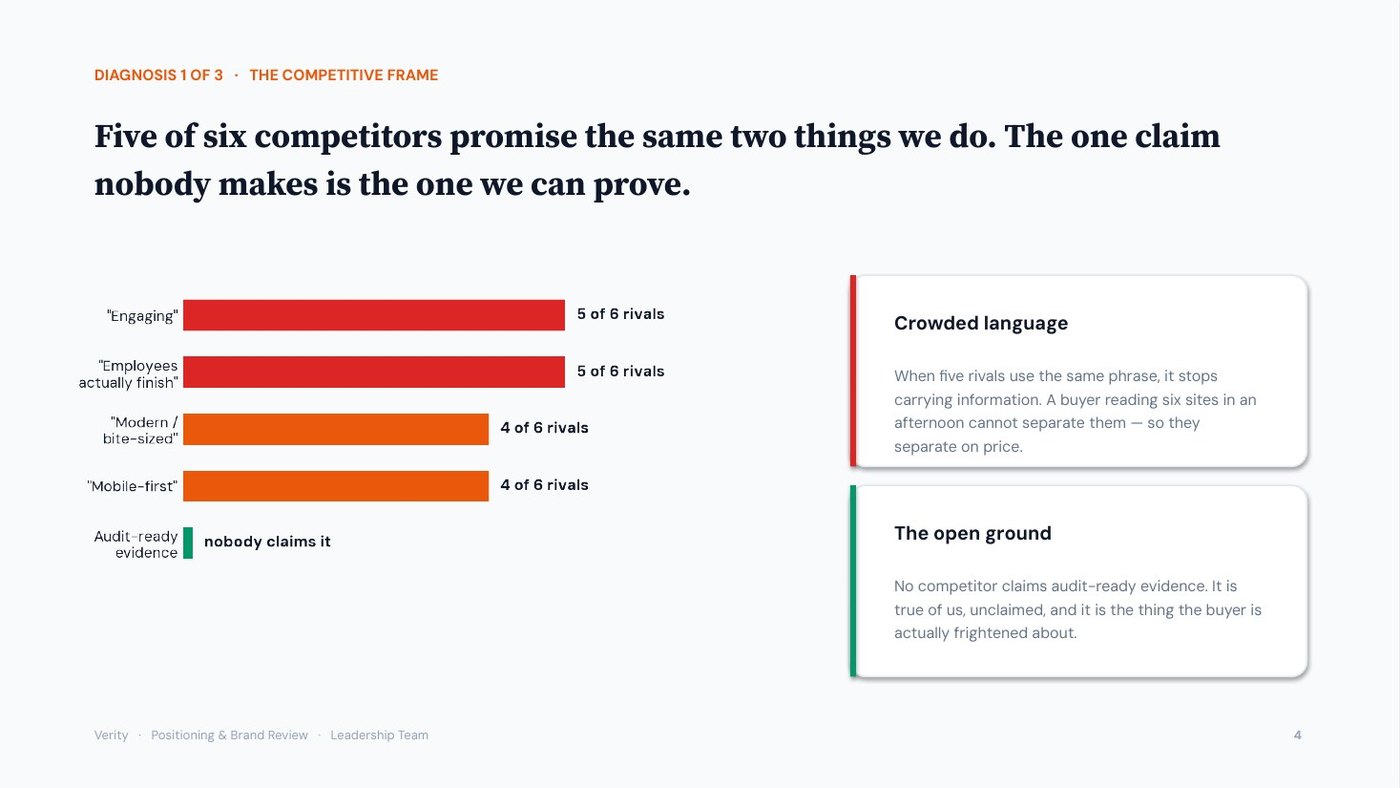
“Here are six competitor homepages, pasted word for word.”
“Five of six promise the same thing. One claim is unoccupied.”
A competitive frame of reference is the set of alternatives a buyer compares when choosing a supplier. When every company in that set uses the same phrases, the phrases no longer help the buyer decide, and price becomes the deciding factor.
Takeaway: build Verity’s positioning on audit-ready evidence, and do not compete on low price, a position a competitor already holds.
Picks the segment to win — and names the ones being given up.
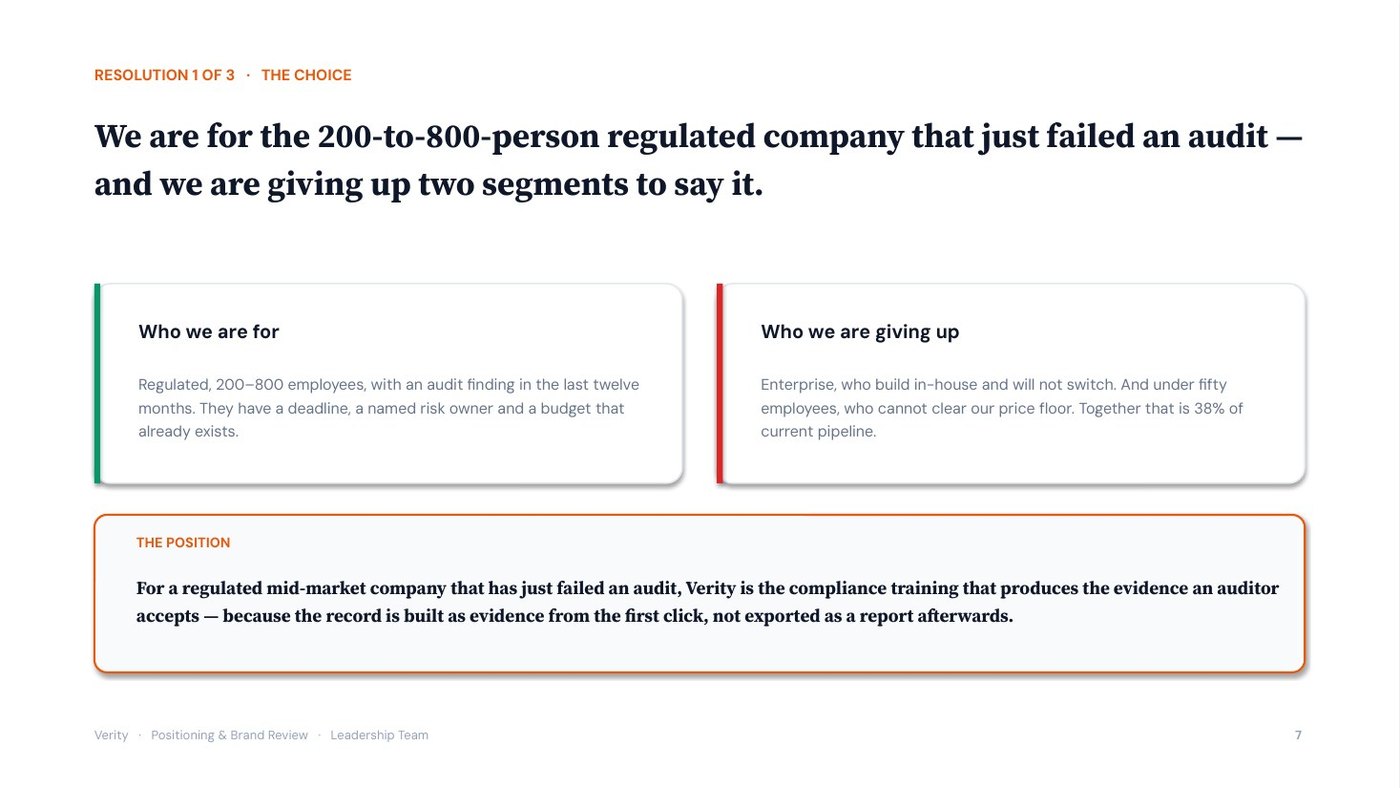
“We sell to anyone who needs compliance training.”
“You are for the 200-to-800-person company that just failed an audit.”
Segmentation, targeting and positioning (STP) is a three-step process: divide the market into groups with similar needs, choose the groups to serve, and define how the product should be seen by those groups. Positioning also means deciding which groups not to serve.
Takeaway: focus sales and marketing on the post-audit segment, and accept giving up the 38% of pipeline that does not fit.
Separates what gets you considered from what gets you chosen, then audits the proof.
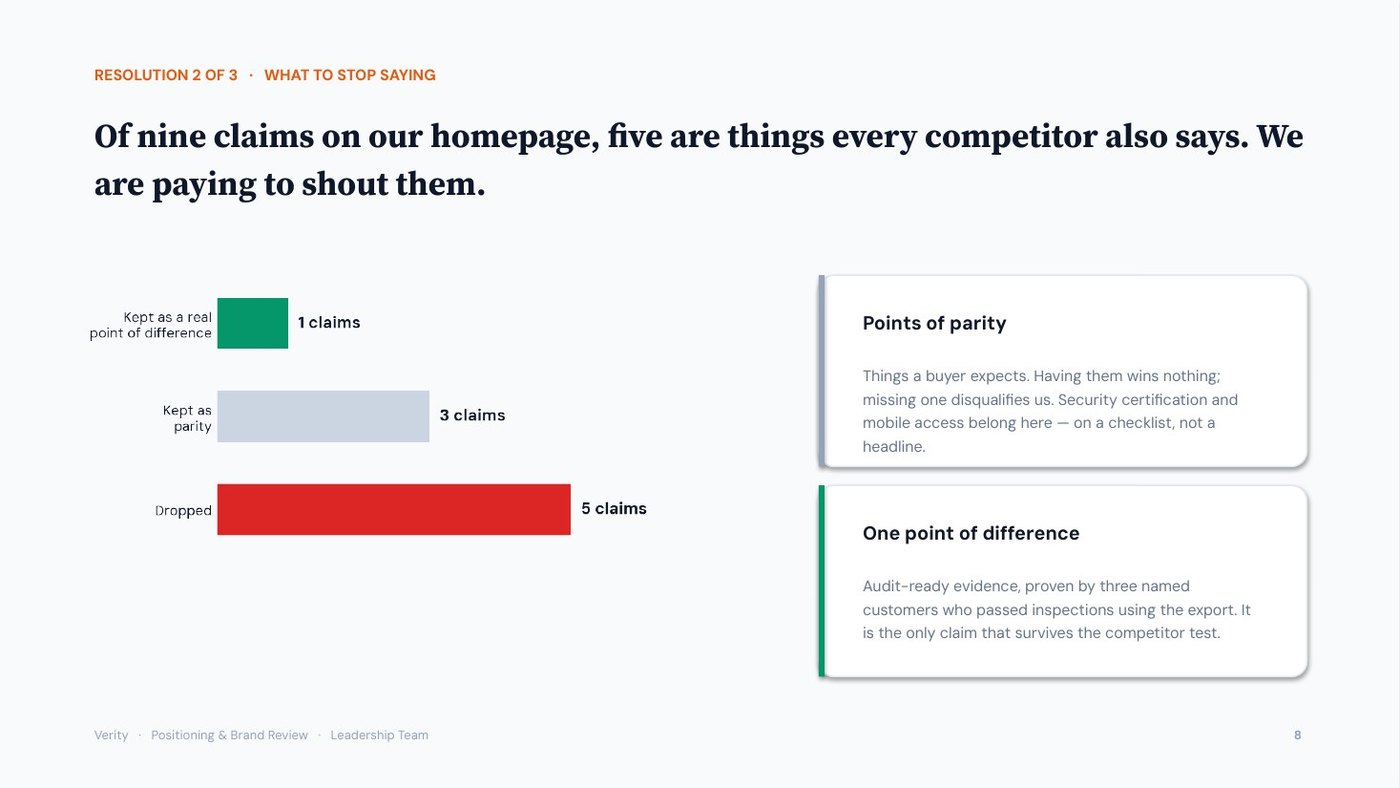
“Here are the nine things our homepage is proud of.”
“Five are parity. Three are noise. One is a real difference.”
Points of parity (POP) are features buyers expect from every supplier; points of difference (POD) are the benefits that make buyers choose one supplier over another. Parity features prevent rejection, but only points of difference win deals.
Takeaway: lead with the one point of difference, mention parity features briefly, and stop using the seven claims that do not differentiate.
One message, three pillars, and the evidence beneath each.
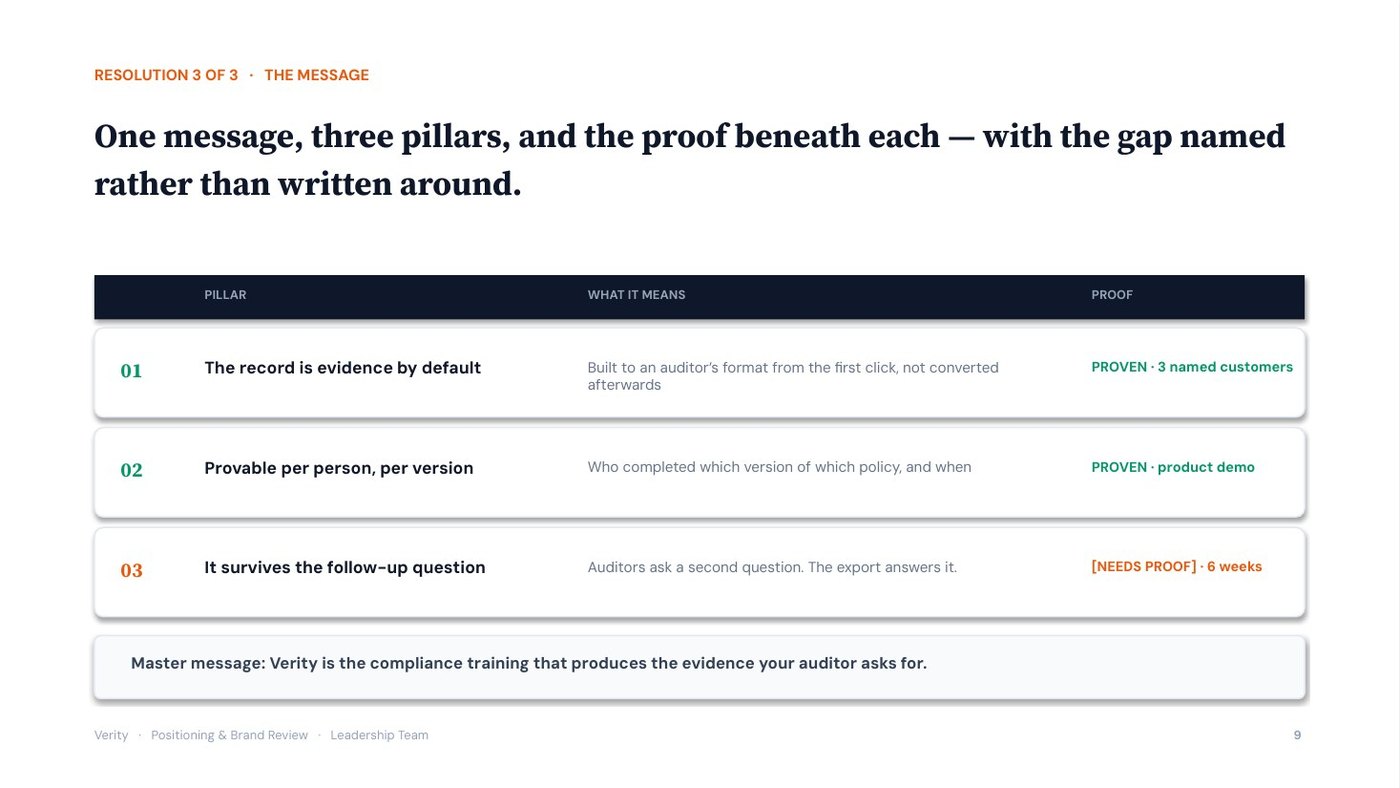
“Every team writes their own version of what we do.”
“One master message. Three pillars. Proof under two of them.”
A value proposition states the main benefit a customer receives; a messaging hierarchy organises it into one main message, three supporting points and the proof for each. Without a hierarchy, each team describes the company differently.
Takeaway: give every team the same hierarchy, and publish only the supporting points that have proof.
A voice defined as constraints, plus a pass that strips the tells of machine-written copy.
“Unlock seamless, engaging compliance enablement for the modern workforce.”
“Compliance training that hands your auditor the evidence, not a spreadsheet.”
Brand voice is the consistent style a company uses in all its writing. It is best defined as writing choices, such as plain over clever, because a writer can apply a choice to a sentence. A description such as “professional yet approachable” gives no direction.
Takeaway: define the voice as writing choices, remove common AI phrases, and read each sentence aloud before publishing.
Names what the audience believes today and what they must believe after.
“We need a campaign for Q3. Budget is $180K.”
“From ‘they are all the same’ to ‘the evidence is the product’.”
A communication objective is the single change a campaign must create in its audience: awareness, comprehension, preference, trial or purchase. Campaigns that try to achieve all five usually achieve none.
Takeaway: set one objective per campaign, and agree before launch which result would count as failure.
The page, the ads, the email and the posts — every line traceable to a pillar.
“Now write the landing page, the ads and the nurture sequence.”
“Every claim mapped to a pillar and its proof. Two rows blocked.”
Integrated marketing communications (IMC) means every channel, including the website, ads, email and social posts, delivers the same message. A traceability table links each headline and claim to its supporting point and its evidence.
Takeaway: check all content against the traceability table, and test one change at a time.
Finds the one stage that is actually costing you, then designs a test that can fail.
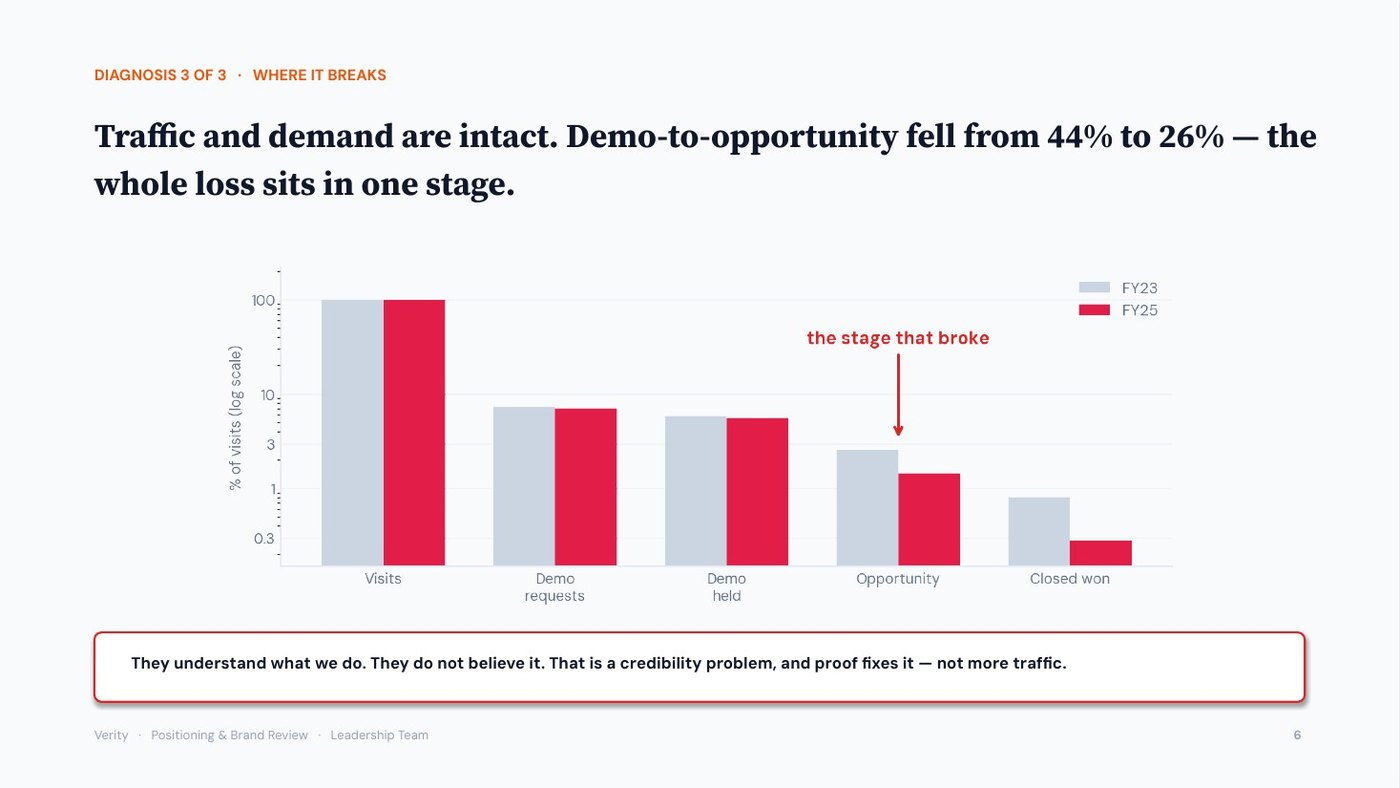
“Traffic is fine, demos are fine, and revenue is down.”
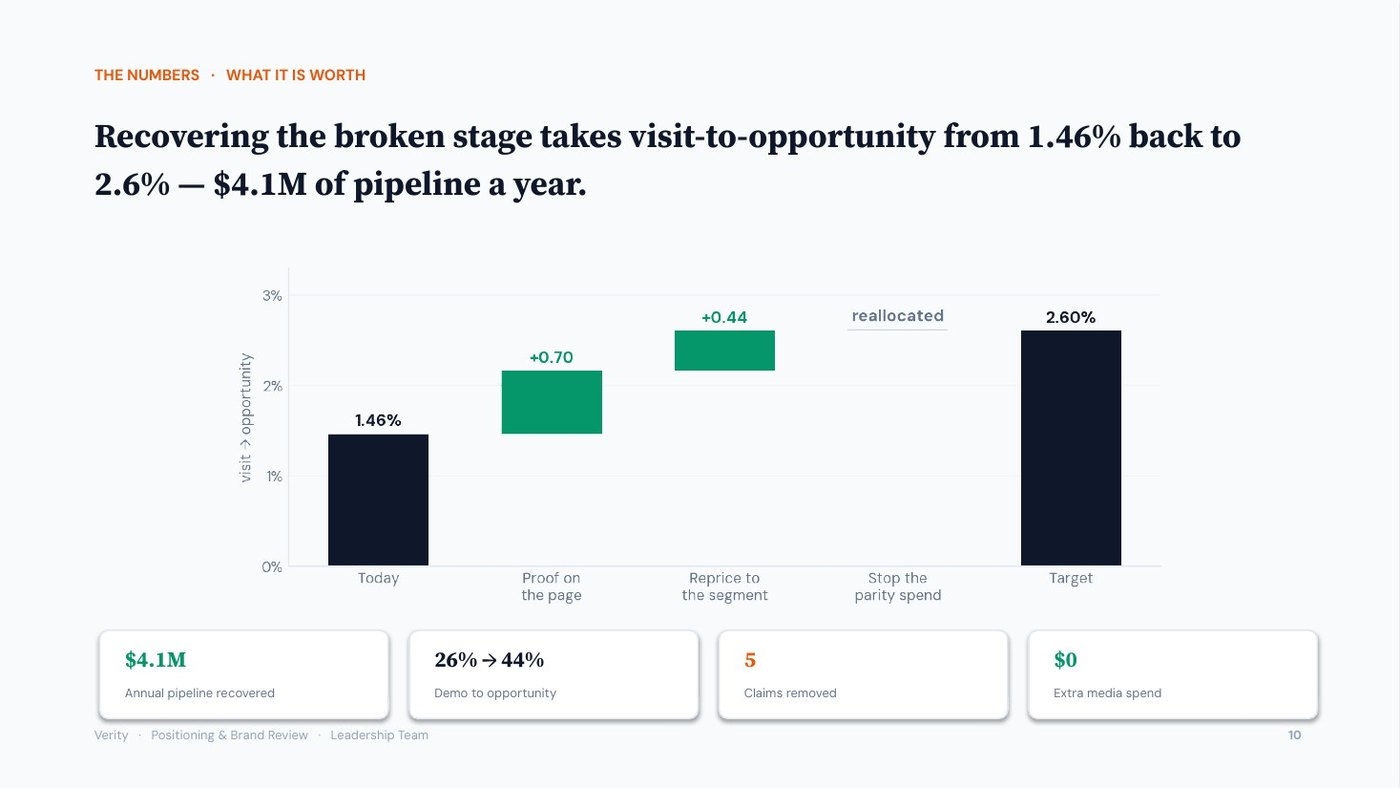
“Credibility. Demo-to-opportunity fell 44% to 26%. $2.1M a quarter.”
Customer journey analysis examines each stage from first contact to purchase to find the binding constraint: the stage that limits results the most. The stages checked are reach, relevance, comprehension, credibility, friction and fit.
Takeaway: spend on proof, such as case studies and audit results, instead of on more traffic.
The document anyone can follow without asking you.
“Every freelancer we hire writes something slightly off-brand.”
“Three pages. Who we are for, what we claim, and what we never say.”
Brand guidelines are a short document that tells anyone creating content who the brand serves, what it claims and how it writes. Long strategy decks are rarely read by the freelancers and agencies who produce the work.
Takeaway: give every writer the three-page brief and the list of banned claims before they start work.
Three documents from Verity’s Brand Brief: the messaging hierarchy every team uses, the brief for the $180K Q3 campaign, and the brand guidelines given to every writer.
One master message, three supporting points, and the proof beneath each
| Supporting point | Proof status |
|---|---|
| Evidence by default | PROVEN |
| Provable per person, per version | PROVEN |
| Survives the follow-up | [NEEDS PROOF] |
Communication objective and creative brief
Audience
Regulated companies with 200 to 800 employees and an audit finding in the last twelve months.
Objective
Comprehension, not awareness. Buyers already know Verity exists but do not understand how it differs.
They believe now
Compliance training is a box to tick, and every vendor is the same.
They must believe after
The training is not the deliverable. The evidence it produces is.
Three pages: who we are for, what we claim, and what we never say
For
Regulated companies of 200 to 800 employees that have just had an audit finding.
Not for
Large enterprises, which build in-house, and companies under 50 employees, which are below the price floor.
The one difference
Audit-ready evidence. No competitor claims it, and it is proven.
Voice, in one example
Not “Unlock seamless, engaging compliance enablement for the modern workforce.” Instead: “Compliance training that hands your auditor the evidence, not a spreadsheet.”
Prompt output, formatted for this page. The prompts return the same content as text and tables; the figures come from whatever you paste in. Verity is fictional, so every number here is ours to show you.
All 10 prompt templates with full copy-paste text and worked examples — a downloadable PDF plus a plain-text copy file. Lifetime updates.
Instant download · lifetime updates
The pack ends with the documents above. The McKinsey-Grade PowerPoint Generator is a separate product, $19: paste the Brand Brief into it and it builds a board deck in Claude, as a real .pptx with native, editable charts.
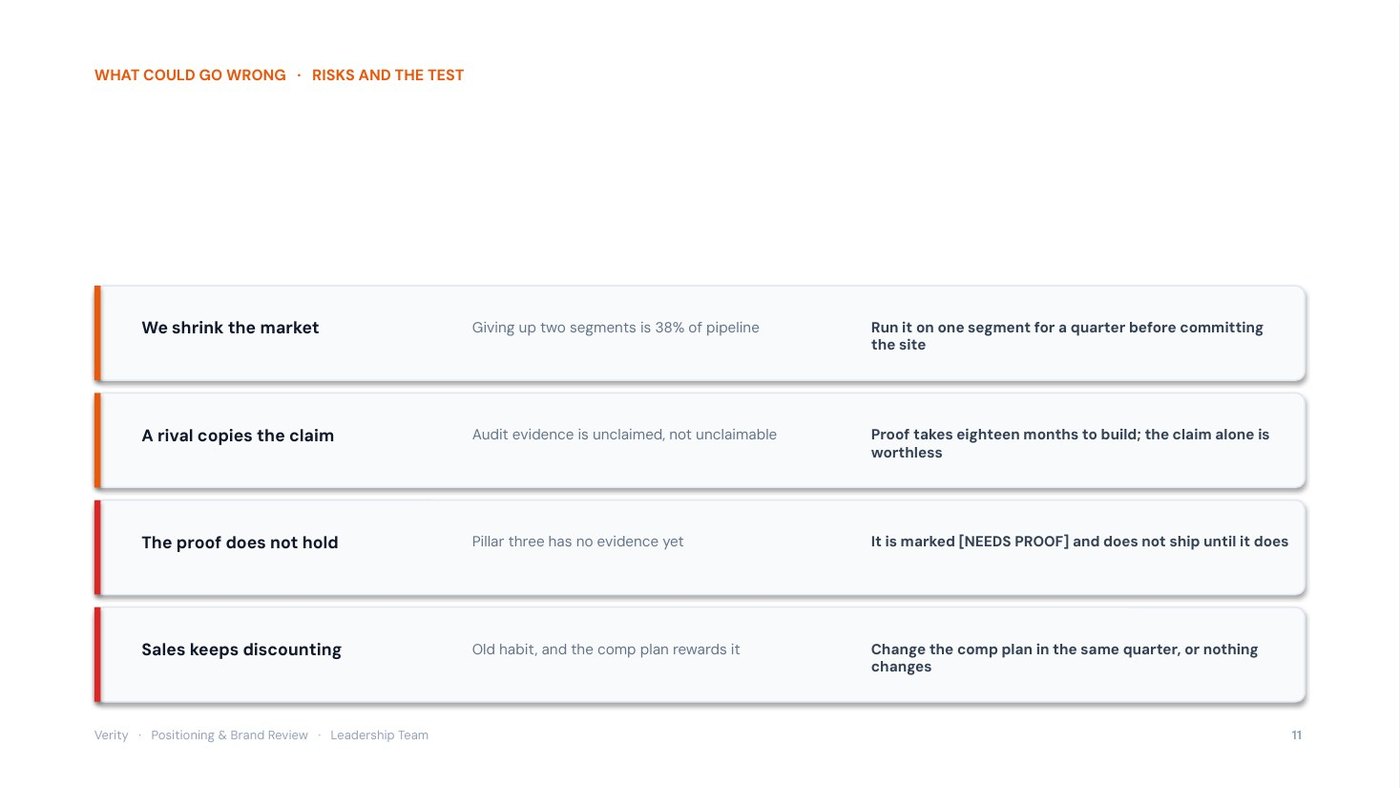
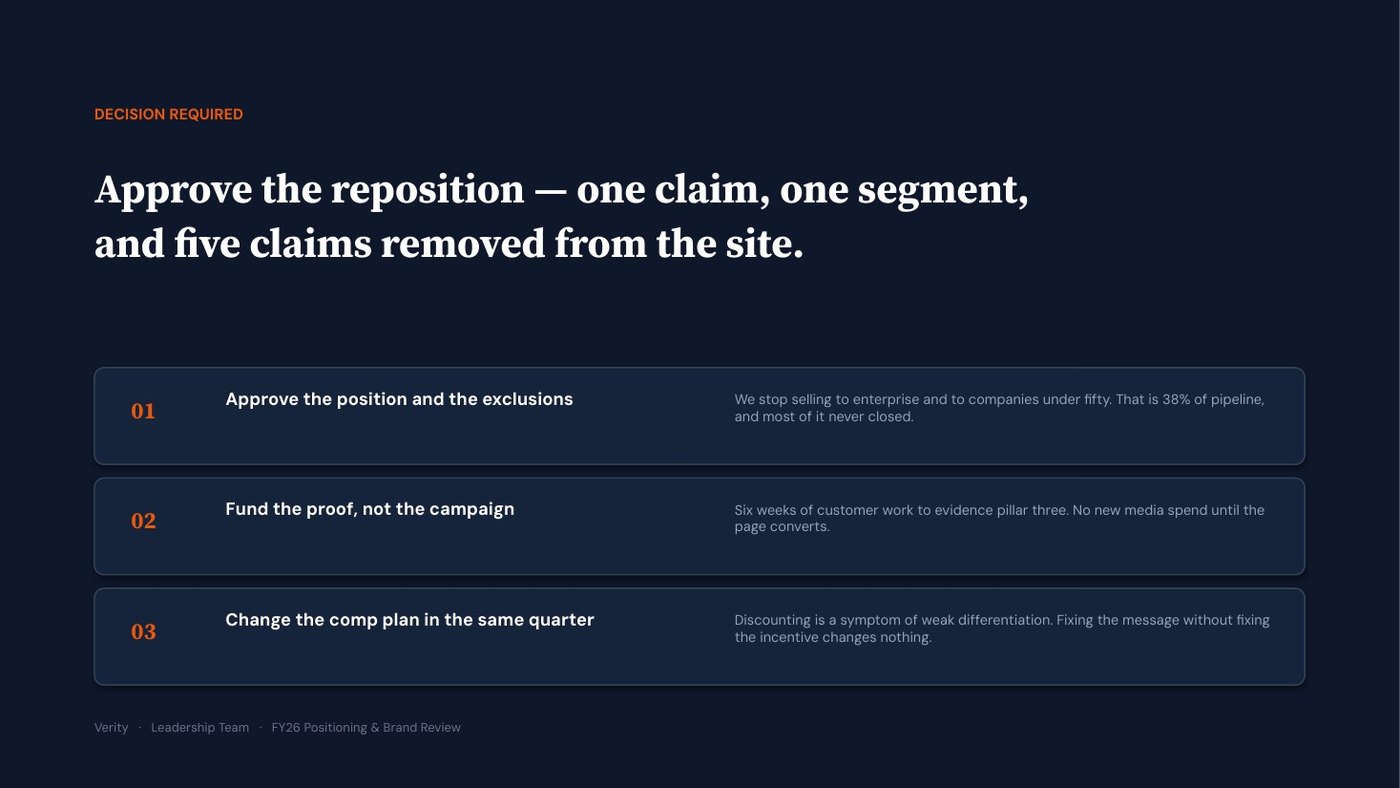
Below is Verity’s, twelve slides, unedited.
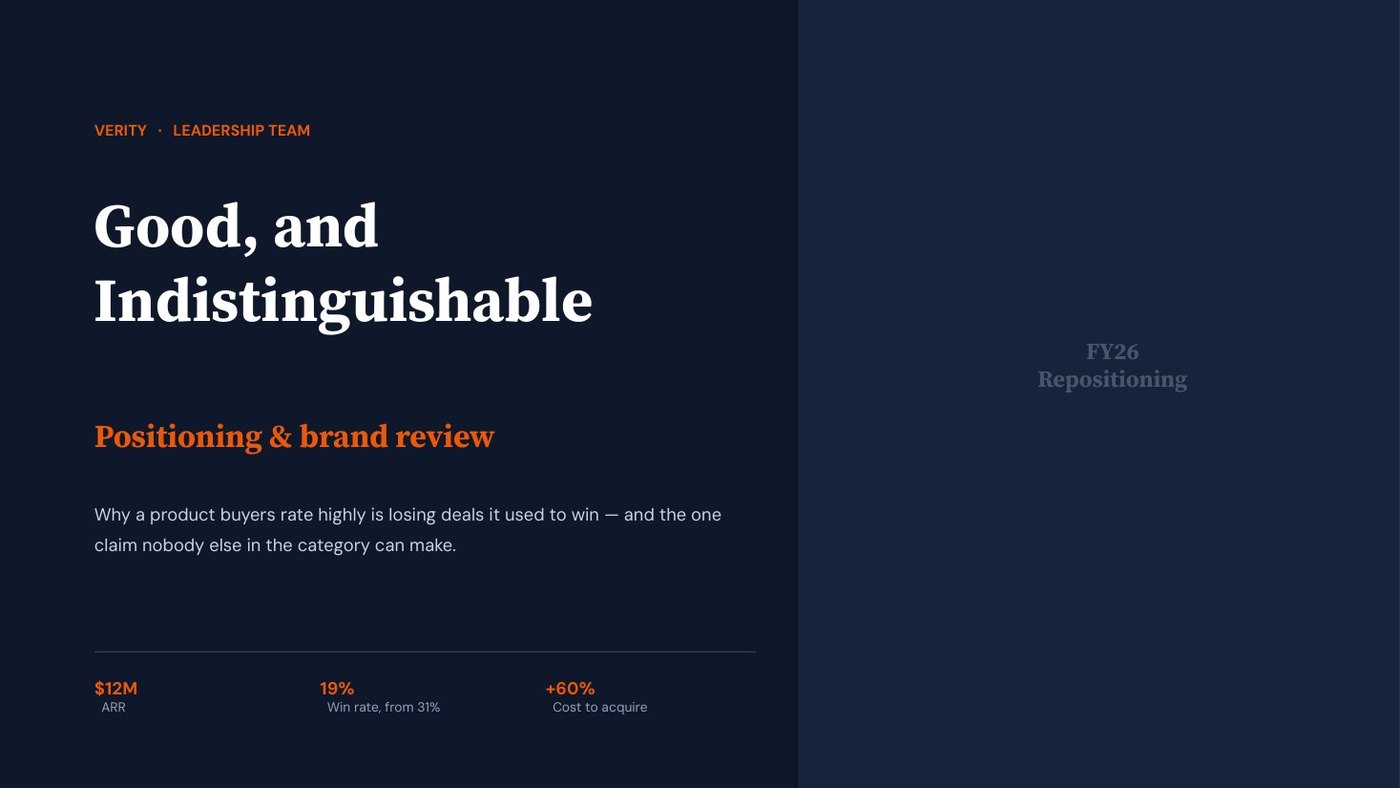
Verity is a fictional company, so every number here is ours to show you. Generated in the NOVA house style.
Built in
as a real .pptx with native, editable charts. Or take both generators together in the bundle, $25.