01Plan your life
Your Life Plan: The Decades Ahead
Lays out the decades ahead - marriage, children, home, career, retirement - with the dates and the decisions that cannot wait.
See it in Marcus’ examplePrompts for Life · Pack 14 · 10 prompt templates
12 of 12 quality checks passed
The Life Admin & Big Events pack: 10 AI prompt templates for ChatGPT, Claude and Gemini
Get your life admin under control. Tell the life admin prompts what is coming up, and get a life plan with dates, a weekly planner hour by hour, a check of your bills and contracts, a tracker for every renewal, a moving checklist week by week and a wedding plan on budget.
Free guide: Wedding budget: what to do when the quotes exceed it
Real exampleWeek planner · Prompt 03
“Eleven hours of wedding admin landed on top of a normal working week.”
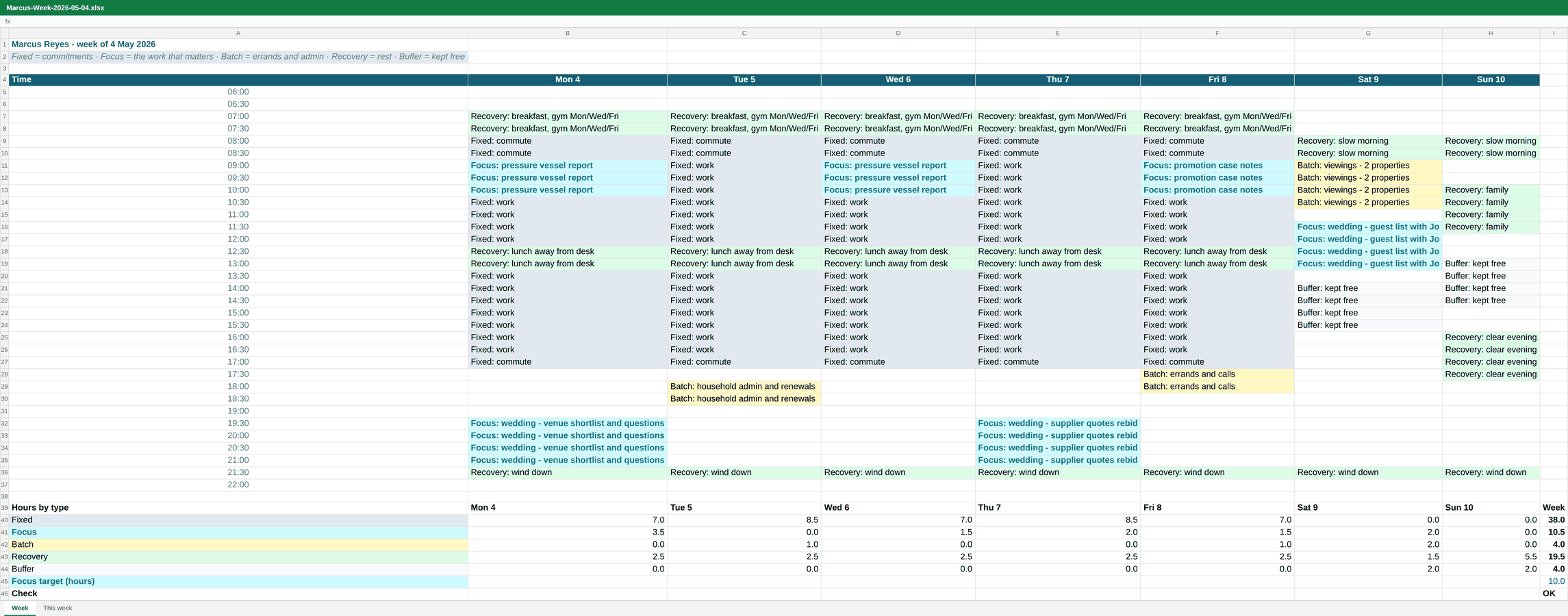
The week of 4 May 2026
Benefits of the life admin prompts
Four things the life admin prompts do, from this week’s plan to the wedding day.
Every milestone gets a date, and every date gets its lead time: notice periods, renewals and booking windows counted backwards.
The decade sets the years, the year sets the months and the month sets the weeks, so every week moves you toward the bigger goals.
Get three written quotes for any big job, the scope in writing and the full cost with fees and cancellation terms, before you sign.
The trackers record what you hold, where it is and when it expires, never passport, ID or card numbers, and never passwords.
What is in the pack
Each life admin prompt works on its own. The prompt asks for what is needed and, in Claude, returns a finished Excel or Word file. Run the one you need, or run all ten in order.
Lays out the decades ahead - marriage, children, home, career, retirement - with the dates and the decisions that cannot wait.
See it in Marcus’ exampleTurns the life plan into this year’s goals, and this year into months with dates and checkpoints.
See it in Marcus’ exampleBuilds the week as a timed plan: fixed commitments, the work that matters, errands batched, and rest placed on purpose.
See it in Marcus’ exampleTurns one goal into ordered steps, each with a date, an owner and what it depends on.
See it in Marcus’ exampleAudits what the household pays, renegotiates or cancels what it should not, and gets comparable quotes for work on the home.
See it in Marcus’ exampleRecords where every important document is, and builds the file someone else would need if you could not act.
See it in Marcus’ exampleBuilds the calendar of everything that expires, with the lead time each renewal actually needs.
See it in Marcus’ examplePlans the search, the viewings, the offer and the paperwork, with the dates and the professionals each step needs.
See it in Marcus’ exampleRuns the move: quotes, notice periods, address changes, packing, and the day itself.
See it in Marcus’ examplePlans the occasion to a budget: the guest list, the suppliers, the timeline and the day itself.
See it in Marcus’ exampleWorked example
Marcus Reyes is a 35-year-old mechanical engineer in Raleigh, North Carolina. He and his partner Jo got engaged in February 2026, want a first home and expect to start a family within three years. By March the wedding quotes had reached $34,600 against a $28,000 budget, his passport had three months of validity left at the date of the honeymoon, six of the fourteen documents they needed could not be found, and $470 a year was going out on contracts that had rolled past their term. Nothing had a date on it. Here is what the ten prompts did with the decade ahead, the week in front of him and the paperwork in between.*
Prompt 01 · Plan your life
What Marcus brought · an engagement and no plan
“We’re engaged. We want a house and children, and I’ve never thought past next year.”
What the prompt returned
Wedding October 2026, first home September 2027, first child 2028-29, with the mortgage term set to end before age 65.
Takeaway: put the events on a timeline with dates, and move the flexible ones around the deadlines that cannot move.
A life plan is a timeline, not a wish list: each event carries a year, the money and time it needs, and what it makes harder afterwards. Some deadlines are set by biology, contract or law — fertility, mortgage terms, pension years, visa timelines — and those are the ones that cannot be moved later.
Prompt 02 · Plan your life
What Marcus brought · three goals and no dates
“Wedding, deposit, and a promotion I want to go for. All in 2026.”
What the prompt returned
Four goals for 2026, with the promotion application moved to January 2027 and two milestones moved out of May.
Takeaway: hold three to five goals a year, and check no month is asked to carry more than it can.
A year plan holds three to five goals, each with a measure and a date, drawn from the life plan. Milestones are placed by working backwards from their deadline with the lead time each needs, so a month that holds more than its weeks allow is visible before the year proves it.
Prompt 03 · Plan your life
What Marcus brought · a week with eleven hours of wedding admin
“Eleven hours of wedding admin landed on top of a normal working week.”
What the prompt returned
10.5 hours of focus blocks — 4.5 on work, 6 on the wedding in three blocks — errands batched into two slots, and Sunday kept clear.
Takeaway: put the fixed commitments in first, block the work that matters, and batch everything small.
Time blocking places work in the week as an appointment with a start time, because a list without times competes with everything else in the day. Batching groups errands and admin into named slots instead of letting them interrupt the day.
Prompt 04 · Plan your life
What Marcus brought · a deposit target
“$42,000 deposit for a house in September 2027. We have $18,500.”
What the prompt returned
Nineteen months, $23,500 to find: $1,240 a month, with the pre-approval, the survey and the legal work dated backwards from completion.
Takeaway: work backwards from the deadline, name the dependencies, and keep the slack before the date, not after it.
Backward planning starts at the deadline and works back, so the first step has a date rather than a hope. People underestimate how long tasks take — the planning fallacy, described by Kahneman and Tversky — so the slack sits before the deadline, not after it.
Prompt 05 · Run the household
What Marcus brought · a year of statements
“Our broadband, phone and home insurance just renew themselves.”
What the prompt returned
Broadband $22 a month above the current rate, phone $8, insurance $110 a year: $470 a year, each with its notice period and the date to act.
Takeaway: check every contract against today’s price, and never compare quotes until the scope is identical.
Most households overpay because contracts roll over: the introductory rate ends, the price rises, and nobody looks. Quotes are only comparable when the scope is identical, so a like-for-like comparison names the same work, materials, warranty and timeline for every bidder.
Prompt 06 · Run the household
What Marcus brought · fourteen document types
“If something happened to me, Jo wouldn’t know where anything is.”
What the prompt returned
Fourteen document types registered by location, six of them missing or out of date, and a one-page file naming the accounts, the people and the first three calls to make.
Takeaway: record what exists, where it is and who can reach it, and never the numbers themselves.
An emergency file lists what exists and where it is — never the contents. Access to accounts is arranged through a password manager’s emergency access or a sealed written record held somewhere secure, never in a note, an email, or a chat with an AI tool.
Prompt 07 · Run the household
What Marcus brought · eleven things that expire
“Passport, licences, cards. I have no idea what expires when.”
What the prompt returned
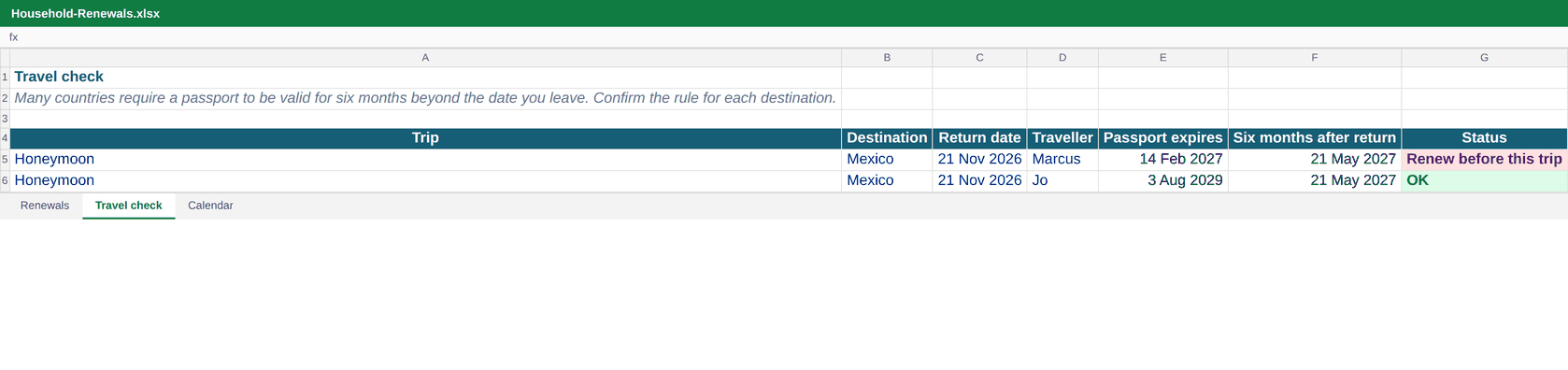
Eleven items registered with expiry dates, lead times and a start-by date each. The passport expires three months after the honeymoon, against a six-month validity rule.
Takeaway: track the date to start each renewal, not the date it expires, and check every trip against the six-month rule.
Renewals fail on lead time, not on the expiry date: a passport can take weeks in peak season, a licence may need a test, and many countries require a passport to be valid for six months beyond the date you leave.
Prompt 08 · Handle the move
What Marcus brought · a first purchase
“First house, September 2027, and we don’t know what order anything happens in.”
What the prompt returned
Twelve viewings against one scoring sheet, running costs compared in full, and the post-offer timeline dated backwards from a September completion.
Takeaway: score every property on the same sheet, compare the full monthly cost, and date the process before you offer.
A home search has three parts: what you can commit to, what you will accept, and the process that follows an accepted offer. Deals fail in that last part, and they fail on dates: survey, mortgage conditions, contract, deposit and insurance each have their own clock.
Prompt 09 · Handle the move
What Marcus brought · two removal quotes
“Two removal quotes, $1,900 apart, and a lease with a notice period we hadn’t read.”
What the prompt returned
The quotes rebuilt on the same inventory and insurance, a 60-day notice found in clause 12, and an eight-week countdown with 24 organisations to tell.
Takeaway: read the notice period before booking the date, and rebuild every quote on the same inventory.
Moves go wrong on notice periods and on the people nobody told. Removal quotes are only comparable when they cover the same inventory, access and insurance, and a deposit comes back on evidence: photographs, meter readings and an inventory check.
Prompt 10 · Mark the occasion
What Marcus brought · $34,600 of quotes
“$34,600 of quotes against a $28,000 budget, and we hadn’t booked anything.”
What the prompt returned
The gap closed to $25,200, leaving a $2,800 contingency inside the $28,000 budget.
Takeaway: fix the guest list first, compare suppliers on identical scope, and hold ten per cent back.
Cost follows the guest list, so the list is fixed before anything is booked. Suppliers are compared on what is included rather than on headline price, every booking is judged on its deposit and cancellation terms, and about ten per cent is held back as contingency.
Three things from Marcus’s ten prompts: the week planner from prompt 03, the renewals tracker from prompt 07, and the wedding budget from prompt 10.
The week of 4 May 2026
Fixed commitments, focus blocks, batches, recovery and buffer
Everything that expires
Start-by dates, status, and the travel check

Everything that expires
Start-by dates, status, and the travel check
Wedding budget — October 2026
Quotes against the plan, category by category
| Category | Quoted | Planned | What changed |
|---|---|---|---|
| Venue and catering | $19,600 | $15,400 | 140 guests to 110, at $140 a head |
| Saturday date premium | $2,100 | $0 | Moved to Friday |
| Photography | $3,400 | $2,200 | Smaller package, 6 hours |
| Bar | $3,900 | $2,450 | Beer, wine and two cocktails |
| Flowers | $2,100 | $1,650 | Rebid on the same scope |
| Music, cake, stationery, rings | $3,500 | $3,500 | Unchanged |
| Total | $34,600 | $25,200 | Contingency $2,800 · budget $28,000 |
The guest list first. At $140 a head, thirty guests were $4,200. Nothing was booked until the list was fixed.
Deposits and cancellation terms. Each supplier was compared on deposit, cancellation window and what the price included, not on the headline figure.
$9,400 removed before a single deposit was paid, and $2,800 held back for what changes.
Prompt output, formatted for this page. In Claude each prompt returns it as a finished Excel or Word file; in other AI tools the prompts return the same content as tables and text; the figures come from whatever you paste in. Marcus Reyes and the companies named are fictional, so every number here is ours to show you.
Yes. The weekly planner prompt builds your week hour by hour: fixed commitments, the work that matters, errands grouped together and rest placed on purpose. In Claude, every prompt ends with a finished Excel or Word file.
Yes. The wedding prompt plans the occasion to your budget: the guest list, the suppliers, the timeline and the day itself, with written quotes compared before you sign.
No. The trackers record what you hold, where it is kept and when it expires, never document, licence or card numbers, and never passwords.
No. Legal, tax, tenancy and property rules differ by country and state. Check anything important with a professional before you act.
Pack 14 · Life Admin & Big Events
* Marcus Reyes, the people named and all figures on this page are fictional and used for illustration only. Output depends on the information you supply and the AI tool you use. Legal, tax, immigration, tenancy and property rules differ by country and state; nothing here is legal or financial advice. The prompts record what you hold and when it expires, never document, licence or card numbers.
Nine packs for everyday life, from career and money to travel and health, each written to the same standard with its own worked example.