Prompts for Life · Pack 16 · 10 prompt templates

Learning & Skills
AI Prompt Templates

Ten prompts for studying, passing and being able to use it. Every session ends in recall rather than rereading, every mock comes early enough to change the plan, and progress is a score rather than an hour.

ChatGPT, Claude & Gemini Instant download No subscription Lifetime updates Best in Claude: a study plan, flashcards and slides

Plan the study, understand it, test it, produce the work

Run any prompt on its own, or run all ten in order. Each output feeds the next, building one Study Brief that holds the plan, the weak topics, the scores and the work produced.

Four rules in every prompt

These are what stop the AI handing you a revision timetable, a summary you will never reread and a citation that does not exist.

Recall, don’t reread

Every session ends by retrieving from memory: testing yourself is what builds recall. Rereading and highlighting are not counted as study time.

Space it, don’t cram

Reviews are scheduled at widening intervals - a day, three days, a week, two weeks - and the schedule is built at the start.

Test early, test often

A full mock comes in the first weeks, not the last, because the score tells you what to study. Every wrong answer is traced to a cause.

Progress is a score, not an hour

Progress is measured by what you can do: a score, a finished piece of work, a conversation held. Hours studied measure effort, not learning.

One resit, all ten prompts

Amara Okonjo is a 41-year-old healthcare administrator in Atlanta. In February 2026 she failed a project management certification after 84 hours of study, almost all of it rereading and highlighting; two of the three domains came back below target and the $555 exam fee was gone. She resat in July, and in the same year she had a 2,000-word assignment to write, a ten-minute talk to give to her department, and Spanish to learn for her clinic. Here is what the ten prompts did with the plan, the mocks, the assignment and the talk.*

84 hours

of study, almost all rereading and highlighting

2 of 3

domains below target at the first attempt

58%

on her first mock, against a 70% pass mark

$555

the exam fee, payable again on a second failure

Step 1 · Plan the study

Study Plan & Schedule

Builds the plan from now to the deadline: what to cover each week, when to review, and what the exam day itself looks like.

Backward planningReview intervalsExcel plan

What Amara brought · sixteen weeks and six hours

“Sixteen weeks to the resit. I can find about six hours a week.”

What the prompt returned

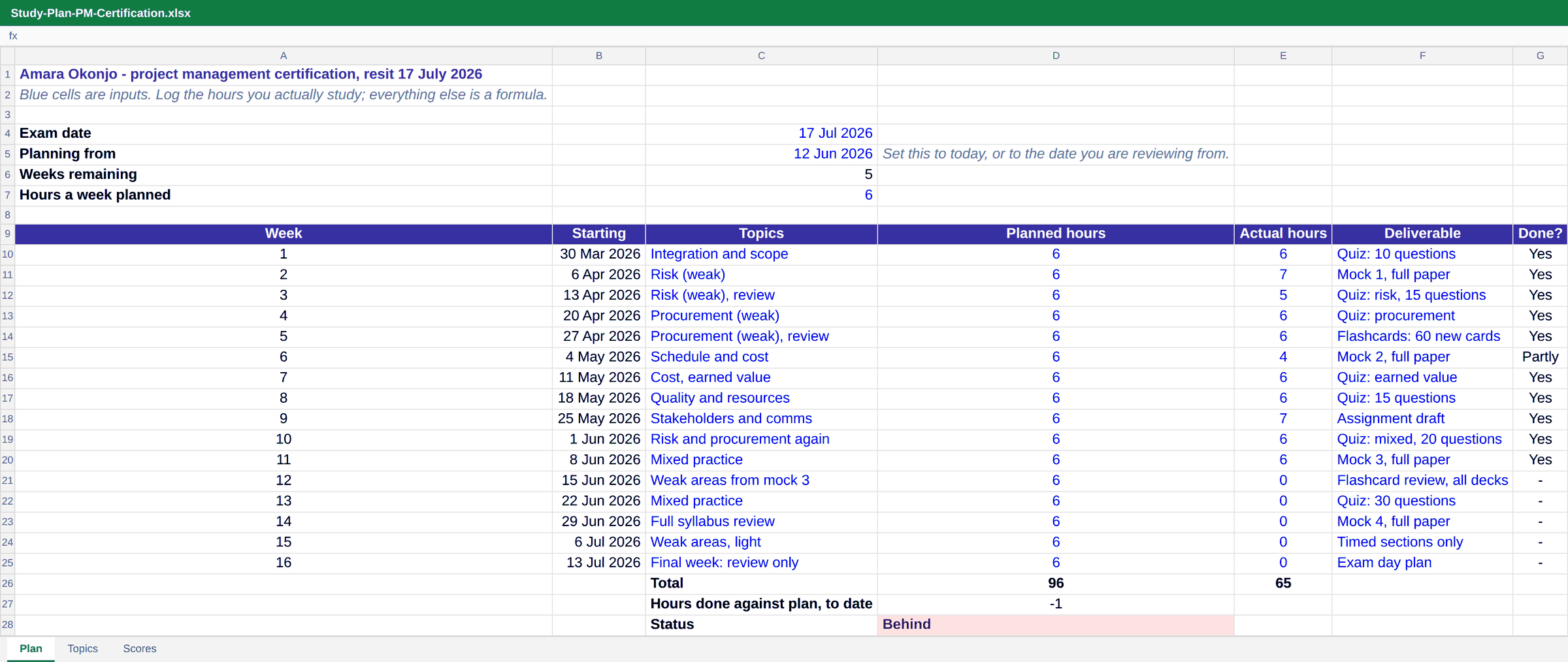
96 hours against a syllabus of about 90, with three topics marked new, a review schedule, and four mocks starting in week two.

Before84 hours, almost all rereading and highlighting
Hours available16 weeks × 6 = 96, minus one week lost to work
Weak topicsrisk and procurement: 27% of the exam, both rated 2 of 5
The planone deliverable a week, four mocks, the first in week two

The analysis · 84 hours of study and a failed exam

A study plan works backwards from the deadline, in hours that actually exist in the week. Reviews are scheduled at widening intervals from the start, because material is forgotten on a curve, first measured by Hermann Ebbinghaus, and a plan without scheduled review teaches everything twice.

  • Hours that exist: six a week, on the days she named, minus the week she would lose. A plan built on ten hours a week would have failed in February for the same reason.
  • 27% of the exam: risk and procurement carry more than a quarter of the marks and were her two weakest topics. The plan gives them four weeks, not a fair share.
  • Every week ends in evidence: a quiz, a mock or a piece of work, so a week that produced nothing is visible at the time rather than in July.

Takeaway: work backwards from the deadline in hours you really have, and schedule the reviews before you start.
Step 2 · Plan the study

Reading List & What to Skip

Decides what to read, watch or work through, in what order, and what to leave out entirely.

Core and referenceSkip listCoverage check

What Amara brought · a provider’s reading list

“The provider lists nine books and a 40-hour video course.”

What the prompt returned

Two core sources: the official guide worked through in order, and the question bank. The video course kept as reference, three books skipped.

Recommendedabout 90 hours of material for a 96-hour plan
Corethe official guide and the question bank
Referencethe video course, for two topics only
Skippedthree books, with the reason for each

The analysis · 90 hours of recommended reading inside a 96-hour plan

Most courses recommend far more than anyone can read, and the skill is knowing which sources carry the marks. Sources are ranked by what they are for: the one you work through, the one you consult, the practice you do, and the extra you read only if time allows.

  • Practice over reading: the question bank went in the core list. For this exam, questions answered predict the score better than pages read.
  • The skip list has reasons: two books covered an older version of the syllabus and one repeated the official guide.
  • Two gaps found: no source covered two syllabus topics properly, which is exactly what you want to know in week one.

Takeaway: pick two core sources, name what you are skipping, and check every syllabus topic is covered by something.

Step 3 · Understand the material

Notes & Summaries

Turns a chapter, lecture, video or article into notes you will actually use, with the questions to test yourself on.

CompressionDefinitionsRetrieval questions

What Amara brought · ninety minutes of video

“Ninety minutes of video on risk management, and four pages of transcription.”

What the prompt returned

A five-sentence summary, the process as eight numbered steps, eleven definitions, and ten retrieval questions with the answers held back.

Before4 pages of transcription, never reopened
Now1 page: summary, steps, definitions, limits
The limitswhat the source says the method does not cover
Questions10, with the answers kept separately

The analysis · Four pages of transcript that were never read again

Notes are only worth making if they are used again: a wall of transcription is a copy, not a note. Good notes compress a source into its structure and end with questions that force you to retrieve them later.

  • Answers held back: the questions are useless if the answer is on the same page. They are kept separately so the note can be used as a test.
  • Limits and exceptions: the conditions a method does not cover are where exam questions live, so they get their own section.
  • Marked, not smoothed: two passages she could not explain were marked rather than paraphrased, and went straight to prompt 04.

Takeaway: compress the source, keep the limits, and finish with questions whose answers live somewhere else.

Step 4 · Understand the material

Concept Explainer

Explains the thing you cannot follow, at the level you need, and then checks whether you have actually got it.

Three levelsAnalogy and its limitsExplain it back

What Amara brought · two terms she kept mixing up

“I cannot keep contingency reserve and management reserve apart.”

What the prompt returned

Both in plain words, one analogy with the point where it fails, a worked example from her own project, and the one question that separates them in an exam.

The confusiontwo reserve types, mixed up in three mocks
Plain, then workingunder 100 words, then the exam-level version
The analogywith the point where it breaks named
The checkshe explained it back; the correction caught what she missed

The analysis · One confusion that cost marks in three separate mocks

An explanation works when the learner can restate it in their own words, which is the test at the heart of the Feynman technique. The prompt explains at three levels, then asks you to explain it back and corrects what you get wrong rather than repeating itself.

  • Where the analogy breaks: a comparison that holds for the first sentence and fails in the second is worse than none, so the failure point is named with it.
  • The separating question: the one question whose answer differs between the two ideas is what makes the distinction stick in an exam.
  • It changes approach, not volume: asked again, the prompt explains differently rather than repeating the same words more slowly.

Takeaway: get it in plain words, find where the analogy fails, then explain it back and be corrected.

Step 5 · Practise and test

Flashcard Generator

Turns your notes or syllabus into flashcards that test recall, ready to import into a flashcard app.

One idea a cardCloze deletionCSV import

What Amara brought · eleven topics

“Eleven topics, and I keep forgetting the ones I studied first.”

What the prompt returned

240 cards across eleven topics: definitions as cloze cards, 60 scenario cards, 18 confusion pairs, exported as a CSV for Anki.

The problemtopics studied in March, forgotten by May
Card typesdefinitions, cloze, scenarios, confusion pairs
Not cardedwhat she already answered correctly every time
The file240 cards as a CSV, imported in one step

The analysis · Topics studied first were forgotten first

A good card tests one thing, asks for recall rather than recognition, and is answerable in seconds. Cloze deletion — a sentence with one term removed — suits definitions and formulas. Cards only work on a schedule of widening intervals.

  • 60 scenario cards: the exam asks you to apply the idea to a situation, so 60 cards do that rather than asking for a definition.
  • 18 confusion pairs: cards built specifically to force the distinctions she kept losing, including the two reserve types.
  • One import: the CSV has Front, Back and Tags columns and goes into Anki in a single step, tagged by topic.

Takeaway: one idea a card, ask for recall not recognition, and review on widening intervals.

Step 6 · Practise and test

Practice Quiz

Quizzes you on one topic at the right difficulty, marks your answers, and tells you what to restudy.

Application levelStrict markingError trace

What Amara brought · one weak topic

“Quiz me on procurement. Ten questions, exam level.”

What the prompt returned

Ten scenario questions, marked one by one: 6 of 10, with three wrong answers traced to one confusion between two contract types.

Score6 of 10 at exam level
The trace3 wrong from one confusion, 1 from misreading
Not a whole topicthe restudy list named two contract types
Nextthree harder questions, and a repeat date

The analysis · A weak topic that turned out to be one confusion

Good questions test understanding rather than recognition: plausible wrong answers, applied to a situation, with no clues in the wording. Bloom’s taxonomy is the ladder — remember, understand, apply, analyse — and most exams sit at apply, where most practice questions do not.

  • Every wrong answer gets a cause: not known, misread, confused, or careless. Four causes need four different fixes.
  • Strict marking: a nearly-right answer is marked wrong, with exactly what was missing. A generous marker in June is an expensive one in July.
  • Harder, not easier: questions she got right easily came back one level up, because that is where the marks she was losing sat.

Takeaway: quiz at application level, mark strictly, and trace every wrong answer to its cause.

Step 7 · Practise and test

Mock Exam & Detailed Review

Runs a full timed mock, marks it, and turns the wrong answers into an error log that says what to study next.

Full conditionsError logPlan change

What Amara brought · her first mock

“First mock, 120 questions. 58%, and the pass mark is 70%.”

What the prompt returned

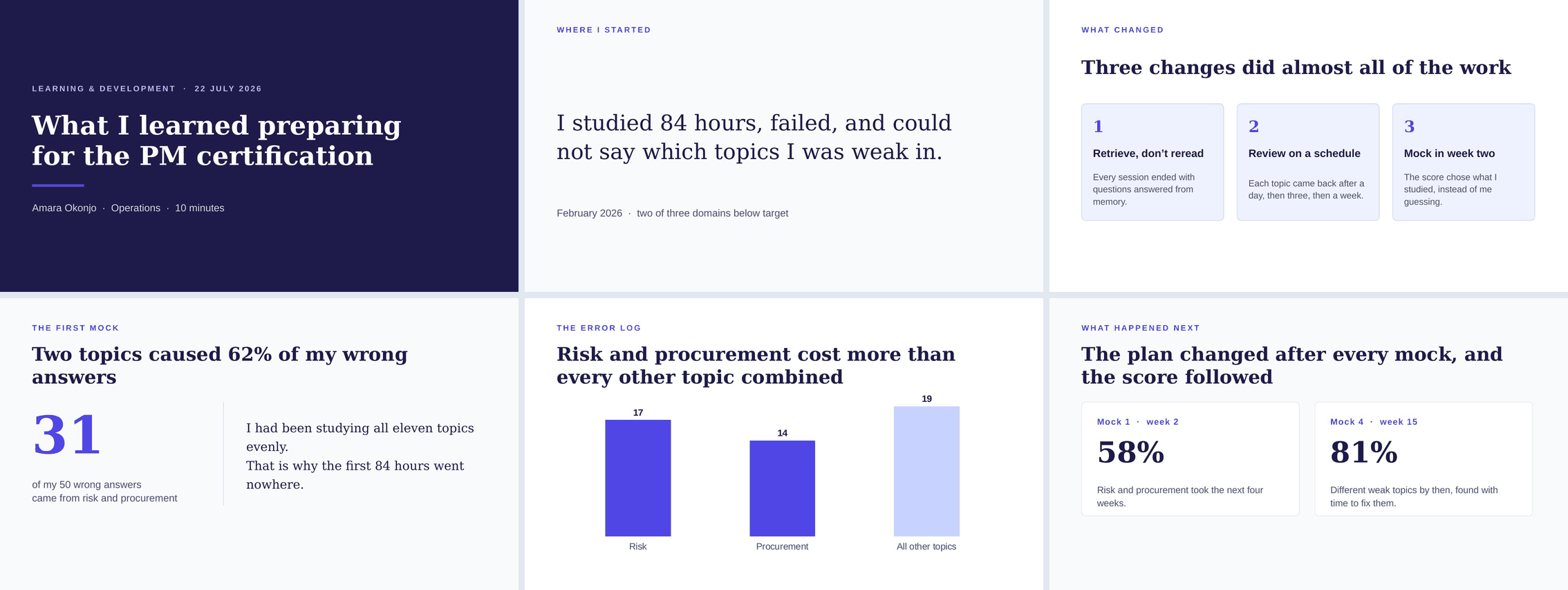
70 right, 50 wrong. 31 of the 50 — 62% — came from risk and procurement; 9 more were careless slips on questions she knew.

Mock 1, week 258% against a 70% pass mark
The clustersrisk 17 and procurement 14: 31 of 50 wrong answers
The habit9 careless slips, all in the last 20 questions
Mock 4, week 1581%

The analysis · 58% with eleven topics and no idea which to study

A mock is only useful under real conditions: the full question count, the real time limit, no notes. The marking matters more than the score, because every wrong answer has a cause and the causes cluster.

  • 62% from two topics: the error log turned a syllabus of eleven topics into a plan with two, which is what the next four weeks attacked.
  • Nine slips at the end: all in the last 20 questions, which is a pacing problem, not a knowledge one. The fix was timing, not study.
  • 58 to 81: four mocks, each one changing the plan. The last came two weeks before the exam, with time to act on it.

Takeaway: sit the mock early under real conditions, and let the error log rewrite the plan.

Step 8 · Produce the work

Essay & Assignment Writer

Plans and writes the assignment: the argument, the structure, the full draft and the citations, from your sources.

Criteria mapThesisNo invented sources

What Amara brought · a 2,000-word assignment

“Two thousand words on risk management in a hospital setting, five sources, due in nine days.”

What the prompt returned

The question unpacked, a thesis she could defend, an eight-paragraph structure with word budgets, and a full draft citing only her five sources.

The riska generic essay that answers the topic, not the question
The criteriaeach one mapped to where it would be satisfied
The draft2,000 words, one claim per paragraph
Marked gaps3 × [NEED SOURCE], filled from her own workplace data

The analysis · Nine days, five sources, and a question she had read as a topic

An assignment is marked against its criteria, so the criteria are read before a word is written. A strong essay has one arguable thesis and paragraphs that each carry one claim with its evidence.

  • The command word: "evaluate" is not "describe". Unpacking the question showed half her planned content was off-topic.
  • Nothing invented: the prompt cites only the sources she supplied. Every unsupported claim is marked [NEED SOURCE] rather than given a plausible reference.
  • Three gaps, filled by her: the marked gaps were filled from her own hospital's incident data, which is what the rubric rewarded most.

Takeaway: read the criteria first, argue one thesis, and never let a citation appear that you cannot open.

Step 9 · Produce the work

Presentation & Speech

Writes the talk — class presentation, work update or wedding speech — to the time you have, with the slides if you need them.

140 words a minuteFive slide layoutsThe questions

What Amara brought · ten minutes and no slides yet

“Ten minutes to my department on what I learned, with slides.”

What the prompt returned

1,400 words: a 30-second opening, three sections with word budgets, and eight slides — a dark cover, two statement slides, two card slides, a number callout, a chart of her error log and a dark close — each with an action title.

The budget10 minutes × 140 words = 1,400, set before writing
Slide countone slide per 60 to 90 seconds: eight
The number slideher error log: 31 of 50 wrong answers from two topics
Delivered9 minutes 40, with the five likely questions prepared

The analysis · Ten minutes, and a draft that ran to nineteen

Time is words: spoken delivery runs at about 140 words a minute, so a ten-minute talk is roughly 1,400 words. The slides follow the words, at one slide per 60 to 90 seconds, in five layouts only: title, statement, list, number and closing.

  • The budget comes first: her first draft was 2,700 words, which is nineteen minutes. The prompt says so plainly and cuts scope rather than speeding her up.
  • Action titles, not labels: every title states the point of the slide - "Two topics caused 62% of my wrong answers", not "Results" - so the deck reads on its own.
  • Occasions without slides: a toast, a eulogy or an award speech gets no deck at all, and the prompt says so rather than making one anyway.

Takeaway: set the word budget from the minutes, let the slides follow the words, and keep the script off the screen.

Step 10 · Produce the work

Language Practice

Runs the daily practice: the words that matter for your situation, conversation at your level, and correction as you go.

Frequency and situationConversationPatterns, not lists

What Amara brought · Spanish for her clinic

“I need Spanish for my clinic, not for a textbook.”

What the prompt returned

120 words and phrases grouped by the situations she actually meets, a conversation at beginner level with translation, and corrections grouped into three recurring patterns.

Beforean app, six weeks, and colours and animals
The words120, grouped by reception, appointments and forms
The conversationat her level, with translation until she no longer needs it
The corrections3 recurring patterns, not 20 separate mistakes

The analysis · Six weeks of app streaks and nothing she could use at work

Progress comes from input you can almost understand and from speaking before you are ready, what Stephen Krashen called comprehensible input. Vocabulary is chosen by frequency and by your own situation, not by textbook order.

  • Her situations, not the syllabus: reception, appointment times and consent forms. The words she needs at 9am, rather than the ones an app teaches in week one.
  • Corrected after, not during: a learner corrected mid-sentence stops speaking, so the corrections come at the end, grouped by pattern.
  • Three patterns: twenty mistakes traced to three rules. One evening on those three was worth more than twenty separate corrections.

Takeaway: learn the words your own situations need, speak early, and fix patterns rather than individual mistakes.

The finale · what prompts 01, 07 and 09 produce

What Amara built

Three things from Amara’s Study Brief: the study plan from prompt 01, the mock error log from prompt 07, and the talk and slides from prompt 09.

Sixteen weeks to the resit

Hours planned against hours done, and the review dates by topic

Study-Plan-PM-Certification.xlsx
96 hours · 4 mocks

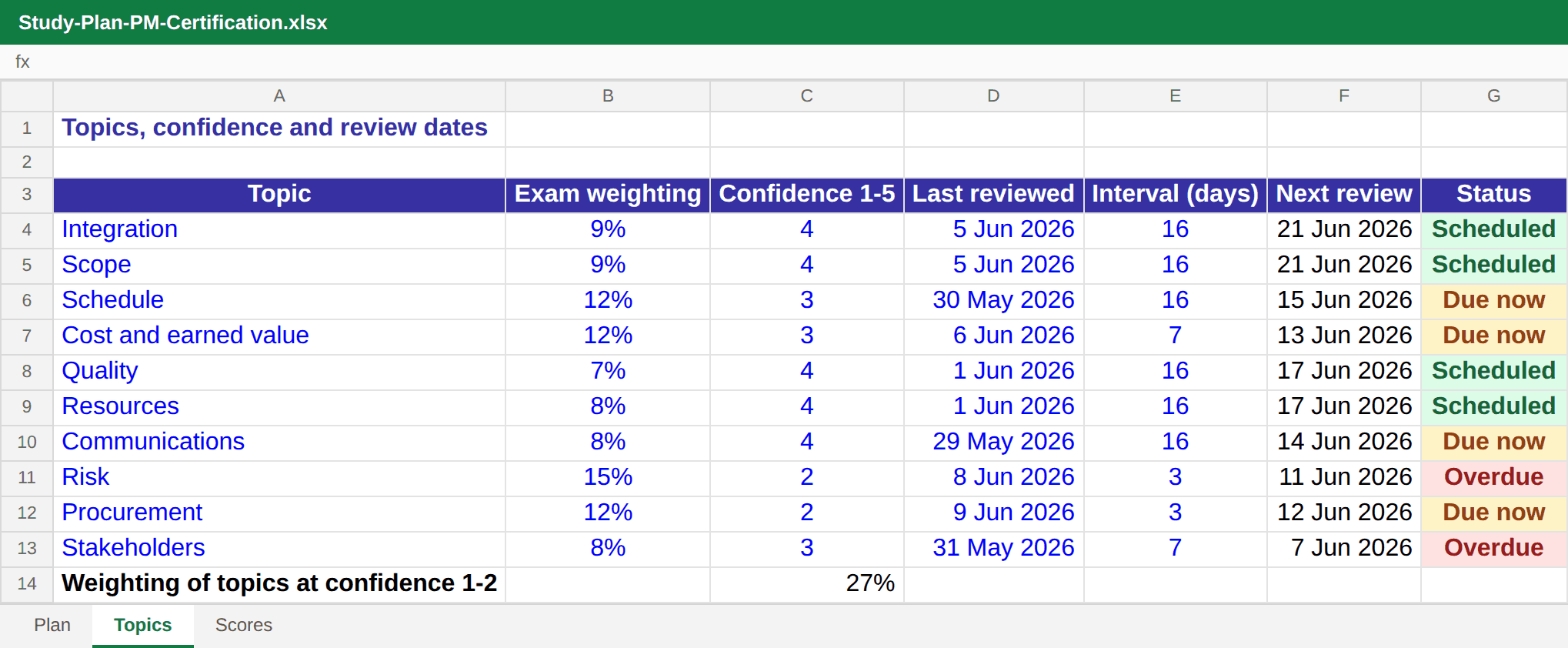
Study plan in Excel: sixteen weeks with topics, planned and actual hours, a deliverable each week and an on-track statusTopics sheet: exam weighting, confidence, last reviewed, interval and next review date with overdue and due-now status
The Excel plan built in Claude to prompt 01’s specification. Prompt 05 exports the 240 cards as a CSV for Anki.

Mock 1 — 58%, and what it was made of

120 questions, 70 right, 50 wrong

Pass mark 70%
Mock 4: 81%

TopicExam weightingWrong answersMain causeWhat changed in the plan
Risk15%17Two reserve types confusedWeeks 3 and 4, plus 40 cards
Procurement12%14Contract types not knownWeeks 5 and 6, plus 60 scenario cards
Cost and earned value12%6Formula slips under timeTimed sections only
Schedule12%4Misread two questionsPacing, not study
All other topics49%9Careless, last 20 questionsPacing, not study
Total100%5062% from two topicsFour weeks reallocated

The pacing problem. Nine of the careless errors fell in the last 20 questions, so the fix was timing rather than revision.

The trend. 58%, 66%, 74%, 81% across four mocks, with the plan rewritten after each one.

Two topics, not eleven. The error log turned a whole syllabus into four weeks of work.

Ten minutes to her department

1,400 words, eight slides, script in the speaker notes

Talk-PM-Certification.pptx
Delivered in 9:40

Six of the eight slides: a dark cover, a statement slide, three cards, a number callout with the figure 31, and a bar chart of wrong answers by topic
The deck built in Claude to prompt 09’s slide rules and house style: action titles, cards instead of bullet lists, one number callout, a native chart, and the spoken script in the notes.

Prompt output, formatted for this page. In other AI tools the prompts return the same content as tables and text; the figures come from whatever you paste in. Amara Okonjo is fictional, so every number here is ours to show you.

Pack 16 · Learning & Skills

Ten prompt templates, one running brief

  • A study plan to the deadline, built in Excel in Claude, and a reading list with a skip list
  • Notes you will reuse, and an explainer that makes you explain it back
  • Flashcards as an importable file, practice quizzes, and full mocks with an error log
  • Essays and assignments from your own sources, talks to the minute with slides, and language practice
  • Text file and formatted PDF · ChatGPT, Claude and Gemini · best in Claude

$15

One-time purchase · instant download

Get the pack

* Amara Okonjo, the certification and all figures on this page are fictional and used for illustration only. Output depends on the information you supply and the AI tool you use. AI answers can be wrong or out of date: check anything you will be examined on against your own course material, and follow your institution’s rules on the use of AI tools in assessed work.

More Prompts for Life

Nine packs for everyday life, from career and money to travel and health, each written to the same standard with its own worked example.

See all Prompts for Life
Back to The Prompt Library