Prompts for Life · Pack 18 · 10 prompt templates

Health & Fitness
AI Prompt Templates

Ten prompts for training you can keep up, meals you will actually cook, and the health admin nobody handles: appointments, results, screening and the bills. General information, never medical advice.

ChatGPT, Claude & Gemini Instant download No subscription Lifetime updates Best in Claude: a progress tracker and an appeal letter

Train, eat, handle the health admin

Run any prompt on its own, or run all ten in order. Each output feeds the next, building one Health Brief that holds the plan, the results and the questions you asked.

Four rules in every prompt

These are what stop the AI handing you a calorie target, a diagnosis, or a training plan that hurts on day three.

Start from what you can do today

The baseline is measured, not assumed, and the plan is built on the days and equipment you actually have.

Progress slowly, on purpose

Small planned increases, with a deliberate easy week every fourth. Most new-training injuries come from doing too much too soon.

Food is added, not just removed

Meals are built around what you will actually cook and eat. No calorie or macro targets, no weight-loss rates, no goal weight, no banned foods.

Know when this is out of its depth

Pain, symptoms, medication, pregnancy and conditions belong with a professional. Nothing here diagnoses or changes a treatment.

One year, all ten prompts

Nia Carter is 44, works at a desk in Seattle and has two children under ten. She signed up for a 10K in May and had trained twice in five weeks, both times too hard to repeat. Her starting point was 1.2 miles in 20 minutes with walking breaks. She cooked two planned meals a week and ordered in four times. A blood panel sat unread in a patient portal, two routine checks were overdue, and $860 of a claim had been denied for a reason she had never read.*

2 in 5 weeks

training sessions, both too hard to repeat

1.2 miles

in 20 minutes, her honest starting point

$860

of a claim denied, for a reason she had not read

2 checks

overdue, and a blood panel she could not read

Step 1 · Train

Training Plan

Measures where you are today and builds the weeks to your goal, then adjusts it each month from what you actually did.

Screening firstMeasured baselineEasy week every fourth

What Nia brought · a 10K she had signed up for

“I’ve signed up for a 10K in May. I’ve trained twice in five weeks and both times I could barely walk the next day.”

What the prompt returned

Baseline 1.2 miles in 20 minutes with walking breaks; 14 weeks on three days a week, starting at 20 minutes of walk-run and adding five minutes a week, with weeks 4, 8 and 12 easier.

Before2 sessions in 5 weeks, both too hard to repeat
Screeningno flags; one note to raise with her doctor about the back
Week 120 minutes of walk-run, three times
The build+5 minutes a week, with weeks 4, 8 and 12 easier

The analysis · Two sessions in five weeks, both too hard to repeat

A plan starts from a measured baseline and the days that genuinely exist in the week. It progresses in small planned steps with an easy week every fourth, because most injuries in new training come from doing too much too soon.

  • Screening before planning: chest symptoms, dizziness, injuries, conditions, pregnancy and medication are asked about first, and anything flagged holds the plan until a doctor has been spoken to.
  • Three days, not five: she has two children under ten and a desk job. A plan built on five days would have been abandoned by week three.
  • The goal is a distance, not a weight: no calorie target, no goal weight, no rate of loss. The measure is 10K without stopping, on 16 May.

Takeaway: measure where you are, plan on the days you really have, and build in the easy weeks from the start.
Step 2 · Train

Today’s Workout

Builds tonight’s session from the time you have, the equipment in the room and how you actually feel.

Minutes availableWorks around a niggle15-minute version

What Nia brought · 35 minutes and a stiff back

“Thirty-five minutes, at home, kettlebell and a mat, and my lower back is stiff from the desk.”

What the prompt returned

A 6-minute warm-up for the hips and back, three rounds of a hinge, a push and a carry, no loaded rotation, and a 15-minute version if the children wake up.

The constraint35 minutes, one kettlebell, a stiff lower back
Worked aroundno loaded rotation; hinge pattern kept light
Effort guidein words: able to say a sentence, not a paragraph
The fallbackthe same session at 15 minutes

The analysis · The evening that usually becomes a skipped session

A session is built backwards from the minutes available, and around what hurts rather than through it. Anything sharp, new, swelling or worsening ends the session and goes to a clinician instead.

  • Dull and familiar, or sharp and new: the prompt asks which, because the answer decides whether there is a session at all.
  • Effort in words, not zones: able to talk, able to say a sentence, unable to speak. No heart-rate straps required.
  • The 15-minute version: written in advance, so a disrupted evening produces a short session rather than none.

Takeaway: fit the session to the minutes and the body you have tonight, and keep a short version ready.

Step 3 · Train

Fitness Test & Progress Tracker

Gives you a repeatable set of home tests and a tracker that shows whether the plan is working.

Repeatable testsEight-week retestExcel tracker

What Nia brought · eight weeks of training

“How do I know if any of this is working?”

What the prompt returned

Five tests, repeated every eight weeks under the same conditions: the mile went from 14:20 to 12:05, press-ups from 6 to 11, sit-to-stand from 14 to 19, resting heart rate from 74 to 68.

1 mile14:20 → 12:05
Press-ups and sit-to-stand6 → 11 and 14 → 19
Resting heart rate74 → 68
What changed in the planstrength held, running volume raised

The analysis · Eight weeks of training and no way to tell

A test is only useful if it can be repeated the same way: same route, same rest, same shoes, same time of day. Measurements are of what the body can do, and the tracker has no weight, body-fat or calorie column anywhere.

  • Conditions recorded with the result: the park loop, 7am, a rest day before. Without them the second test measures the weather.
  • Beyond normal variation: the prompt says which changes are real and which are within day-to-day noise, so the plan is not rewritten on a bad morning.
  • The plan follows the numbers: strength was progressing, running was not, so the next block raised running volume and held the strength work.

Takeaway: pick a few tests you can repeat exactly, retest every eight weeks, and change the plan from the trend.

Step 4 · Eat

Weekly Meal Plan

Plans the week’s meals around the time you have, the people you feed and what you will actually cook.

Minutes per eveningShared componentsNo targets

What Nia brought · two adults, two children

“Two of us and two children under ten. I cook maybe twice a week and order in four times.”

What the prompt returned

Five dinners matched to the minutes each evening actually has, two of them 15 minutes, with one roast chicken feeding Tuesday and Thursday, and Friday left as a takeaway night on purpose.

Before2 planned meals a week, 4 takeaways
Monday and Wednesday15-minute meals: the evenings with least time
Shared componentone roast chicken, two dinners
Fridaytakeaway, in the plan rather than a failure

The analysis · Two planned dinners and four takeaways a week

A meal plan fails when it assumes an hour every evening, ignores what the household will eat, or bans the things people like. This one sets no calorie or macro targets, no weight-loss rate and no goal weight, and calls no food forbidden.

  • Matched to the evening: Monday and Wednesday are the short evenings, so those are the 15-minute meals. That single change is what made the week survive.
  • One dish, two finishes: where adults and children eat differently, the plan gives one dish finished two ways rather than two dinners.
  • A hard limit in the prompt: if the request is for a very restrictive plan, or anything suggests disordered eating, the prompt stops and points to a doctor or a registered dietitian.

Takeaway: match each night’s meal to that night’s real cooking time, and plan the takeaway night in.

Step 5 · Eat

Shopping List

Turns the meal plan into one list, ordered by aisle, with what you already have taken out.

By aisleCupboard checkSwaps decided

What Nia brought · five dinners to buy for

“Five dinners, two adults, two children, and I never know what’s already in the cupboard.”

What the prompt returned

38 items by aisle with quantities for four, eleven removed after the cupboard check, and three swaps decided in advance.

Beforetwo trips a week and things bought twice
The list38 items, ordered produce to frozen
Already had11 items removed
Midweek3 fresh items on a short top-up list

The analysis · Three shop visits for one week of meals

A list works when it is ordered the way the shop is laid out, quantities match the servings, and the cupboard has been checked first. Substitutions are decided in advance, because deciding in the aisle is how a plan becomes three unrelated purchases.

  • Quantities per serving: stated so they can be checked, rather than guessed at the shelf.
  • Swaps in advance: three items her shop often lacks came with a decided alternative, so a gap did not end the plan.
  • A top-up list: the fresh things are bought midweek, which is why Thursday’s dinner still works.

Takeaway: check the cupboard first, order the list by aisle, and decide the swaps before you go.

Step 6 · Eat

Recipes From What You Have

Turns what is actually in the kitchen into dinner tonight, without a shopping trip.

Use firstThree optionsAllergy check

What Nia brought · what was in the fridge

“Half a roast chicken, some spinach going off, rice, and half a jar of curry paste.”

What the prompt returned

Three options with times; the 20-minute one used the chicken, the spinach and the paste, with a note that the rice must be cooled quickly and reheated once only.

Going offspinach, two days past its date
Three options20, 35 and 50 minutes
Food safetycooked rice: cool fast, reheat once
Used upthe chicken, the spinach and the paste

The analysis · A fridge with dinner in it, and a takeaway ordered anyway

Most households have more usable food than they think, and throw away what they could not see a use for. The prompt builds around what is there and what needs using first, and asks for nothing that cannot be substituted.

  • What to use first: the spinach decided the dish, which is the opposite of choosing a recipe and shopping for it.
  • Allergies restated: every allergy given is restated and checked against the recipe, with a note to check labels yourself.
  • Food safety where it matters: rice, poultry and reheating carry specific notes rather than being left to assumption.

Takeaway: cook from what needs using first, and let the fridge choose the recipe.

Step 7 · Health admin

Doctor’s Appointment Prep

Turns your symptoms, history and worries into one page you can hand over in a ten-minute appointment.

One-line summaryDated timelineRanked questions

What Nia brought · twelve minutes

“Twelve minutes with my doctor about the back, and last time I forgot half of it.”

What the prompt returned

One page: the problem in a sentence, eight dated entries from the first episode in November, what she had tried, and seven questions with the one about the numbness first.

Last timehalf the history reconstructed from memory
The timeline8 dated entries, November to February
The questions7, ranked, none answerable yes or no
Said firstthe thing she was actually worried about

The analysis · Ten minutes spent rebuilding a history she could have written down

A preparation sheet states the problem in a sentence, gives the history in dates, and puts the most important question first. The prompt prepares facts and questions only: it does not diagnose, suggest a cause or recommend a treatment.

  • The worry, said out loud: what she was actually afraid of went into the first minute, in one sentence, instead of the corridor afterwards.
  • Questions that cannot be answered yes or no: including what happens if nothing is done, and what would change the advice.
  • The after note: what was decided, who does it and by when, recorded the same day while it is still accurate.

Takeaway: write the history down in dates, rank the questions, and say the real worry first.

Step 8 · Health admin

Your Test Results Explained

Explains what each line of a test result means in plain words, and turns it into questions for your clinician.

Plain wordsReference rangesTrend, not verdict

What Nia brought · a blood panel in a portal

“A blood panel sat in the portal for six weeks because I couldn’t read it.”

What the prompt returned

Fourteen lines explained in plain words, each shown against its own reference range and against her 2024 results, with seven questions ranked for her appointment.

Beforeunopened for six weeks
Each linewhat it measures and what moves it
The trendeach value against her 2024 panel
The output7 ranked questions, no interpretation

The analysis · Six weeks of not opening a result

A reference range is what a laboratory considers usual for most people, not a target, and it differs between laboratories. The prompt explains what each thing measures and shows the trend. It never says what a result means for your health.

  • Described, not judged: a value is reported as in range, above or below. It is never called good, bad, worrying or fine.
  • No treatment advice, ever: the prompt will not suggest starting, stopping or changing a medication or supplement. That belongs to the clinician who ordered the test.
  • Far outside the range: the only thing the prompt will say is that it should be raised with a clinician promptly.

Takeaway: understand what was measured and how it has moved, then take the questions to the person who ordered it.

Step 9 · Health admin

Health Checks & Screening Schedule

Lists the routine checks and screening that apply to you, what each involves, and when to book them.

What applies at your ageOverdue and dueBooking calendar

What Nia brought · no record of anything

“I have no idea what I’m supposed to have done at 44.”

What the prompt returned

The checks usually offered at her age in her country, each marked to confirm: two overdue, one due within three months, the rest scheduled and spread across the year.

Overdue2, including one she had forgotten existed
Due soon1, within three months
Everything elsespread across the year, not one month
Every itemmarked [CONFIRM] with the programme or her doctor

The analysis · Two overdue checks nobody was tracking

Routine checks are missed because nobody holds the list: dental, eyes, blood pressure, vaccinations and the national screening programmes all run on different intervals. Those rules differ by country and change, so everything is marked to confirm.

  • Never told what you need: the prompt presents what is generally offered and sends the eligibility question to a clinician or the national programme.
  • Spread on purpose: the booking calendar avoids six appointments in one month, which is how a schedule survives contact with a working year.
  • Questions for the doctor: particularly where family history or a condition changes which checks apply, and from what age.

Takeaway: hold the list yourself, book what is overdue, and confirm eligibility with the programme rather than a prompt.

Step 10 · Health admin

Medical Bills & Insurance Claims

Checks a bill or a denied claim against the policy, finds the errors, and writes the appeal.

Denial decodedDuplicate linesWord appeal letter

What Nia brought · a denial letter

“$860 denied, and the letter has a code I don’t understand.”

What the prompt returned

The denial reason decoded, a duplicated $210 line found in the itemised bill, and an appeal letter citing the referral she had obtained, with the deadline 31 days away.

Denied$860, reason code CO-15: referral missing
The billline 4 duplicates line 2: $210
The evidencereferral issued 17 days before the appointment
Recovered$1,070: the $860 approved and the $210 removed

The analysis · $860 denied for a reason nobody had read

A large share of medical bills contain errors, and a denial is not a final answer. Most have a stated reason, a deadline and an appeal route, and a factual appeal with the evidence attached succeeds far more often than a phone call.

  • The code meant something: CO-15 means the referral was missing or invalid. Hers existed but had not been included on the submitted claim, which is a fixable clerical failure.
  • The duplicate nobody spotted: line 4 repeated line 2: same code, same date, same $210. It was only visible on the itemised bill, which had to be requested.
  • Only from the documents: the prompt never guesses a billing code or a policy term, and marks unclear wording [CHECK POLICY].

Takeaway: get the itemised bill, decode the denial reason, and appeal in writing with the evidence attached.

The finale · what prompts 03, 08 and 10 produce

What Nia ended up with

Three things from Nia’s Health Brief: the progress tracker from prompt 03, her blood panel explained by prompt 08, and the claim appeal from prompt 10.

Five tests, every eight weeks

Same route, same time of day, same rest the day before

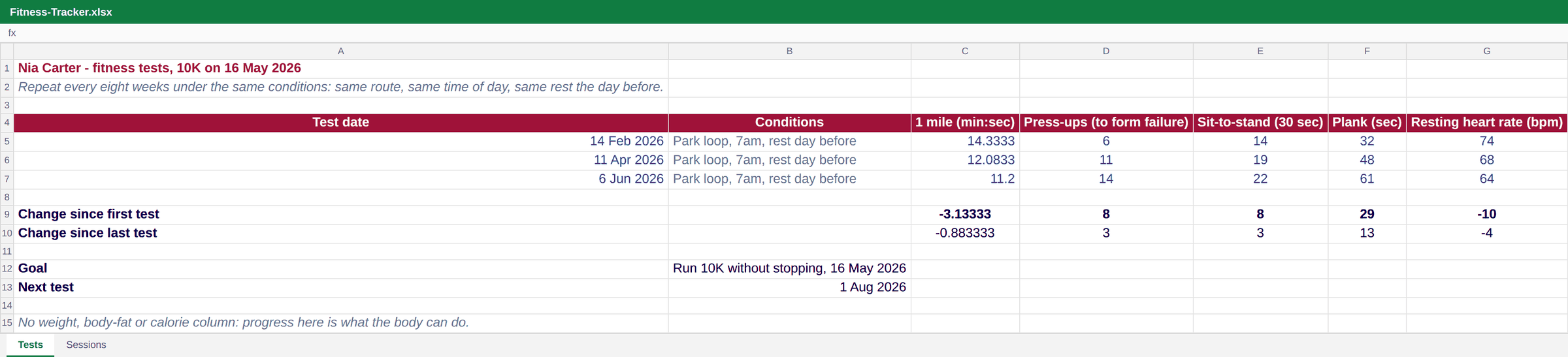
Fitness-Tracker.xlsx
No weight column anywhere

Fitness tracker in Excel: test dates, conditions, mile time, press-ups, sit-to-stand, plank and resting heart rate, with change since the first test
The Excel tracker built in Claude to prompt 03’s specification, with a sessions sheet counting minutes a week and any pain noted.

The blood panel, in plain words

What each line measures, against its own reference range and her 2024 results

7 questions ranked
No interpretation, no diagnosis

LineResultReference rangePreviousWhat it measures
Haemoglobin A1c5.6%Below 5.7%5.4% (2024)Average blood sugar over about three months
LDL cholesterol142 mg/dLBelow 100 mg/dL128 mg/dL (2024)One of the cholesterol carriers
HDL cholesterol54 mg/dLAbove 50 mg/dL51 mg/dL (2024)The other main carrier
Triglycerides118 mg/dLBelow 150 mg/dL132 mg/dL (2024)A fat carried in the blood
Ferritin18 ng/mL15–150 ng/mL34 ng/mL (2024)How much iron is stored
Vitamin D, 25-OH21 ng/mL30–100 ng/mLNot tested (2024)Measured as 25-hydroxyvitamin D
TSH2.4 mIU/L0.4–4.0 mIU/L2.1 mIU/L (2024)A thyroid signalling hormone

Described, never judged. Each value is reported as in range, above or below. Nothing here is called good, bad or worrying, and nothing is interpreted for her health.

The trend is the point. Two values moved between 2024 and 2026, which is the kind of thing a single reading cannot show and a clinician will want to see.

The output is questions, not answers. Seven, ranked, including which results should be repeated and when — for the clinician who ordered the test.

Appeal against a denied claim

The reason decoded, the evidence attached, the deadline named

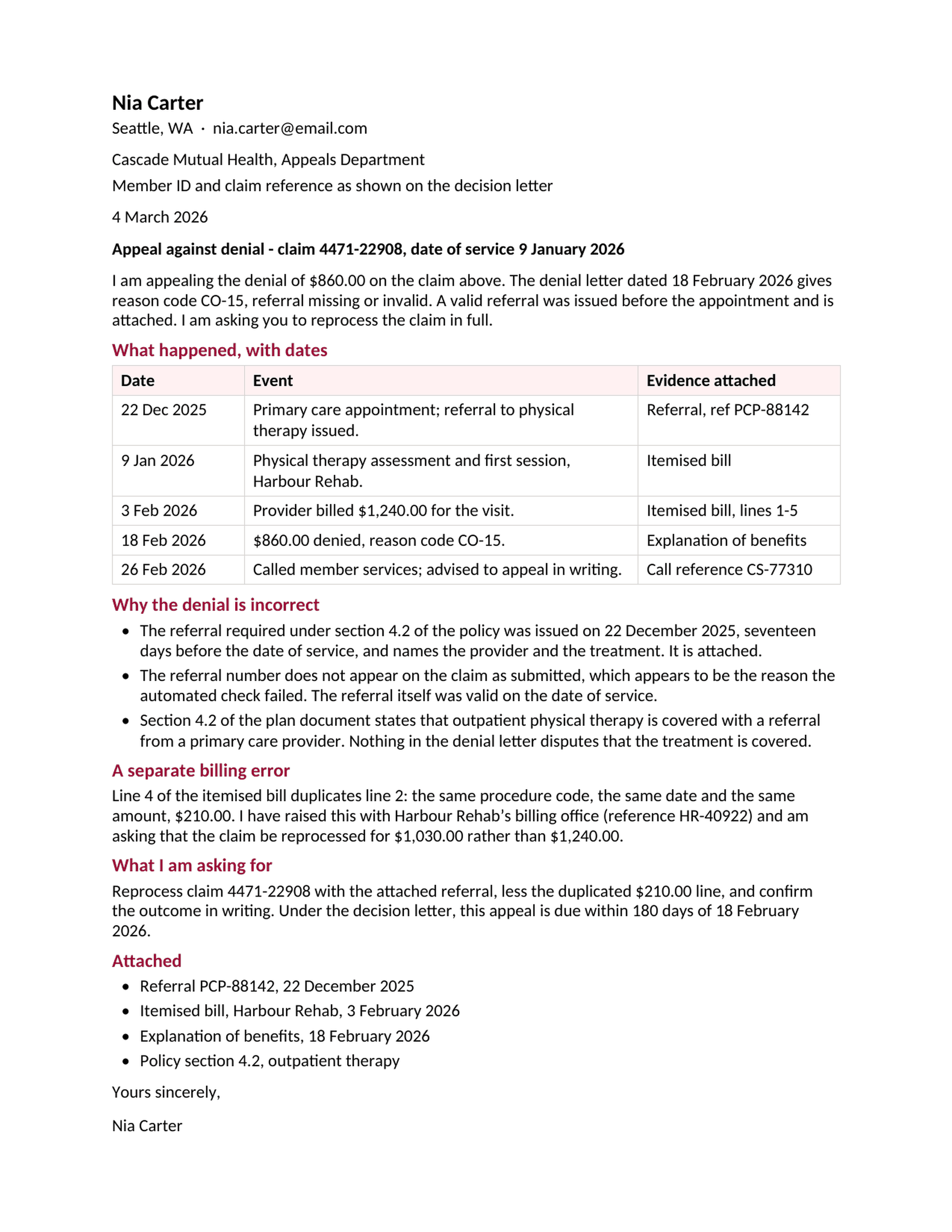
Appeal-Cascade-Mutual-2026-03-04.docx
$1,070 recovered

One-page appeal letter: the denial reason, a dated timeline, why the denial is incorrect, a duplicated billing line and the outcome requested
The Word letter built in Claude to prompt 10’s specification, written only from the documents Nia pasted in.

Prompt output, formatted for this page. In other AI tools the prompts return the same content as tables and text; the figures come from whatever you paste in. Nia Carter, her results and the insurer named are fictional, so every number here is ours to show you.

Pack 18 · Health & Fitness

Ten prompt templates, one running brief

  • A training plan from a measured baseline, tonight’s workout, and an Excel progress tracker
  • The week’s meals, one shopping list by aisle, and dinner from what is already in the kitchen
  • Appointment prep, test results explained in plain words, and a screening schedule
  • Medical bills and denied claims checked, with the appeal letter built in Word in Claude
  • Text file and formatted PDF · ChatGPT, Claude and Gemini · best in Claude

$15

One-time purchase · instant download

Get the pack

† These prompts give general information only. They do not diagnose, do not replace a qualified clinician, and never tell you to start, stop or change any treatment. They set no calorie targets, no weight-loss rates and no goal weight. If you have symptoms, a condition, are pregnant or take medication, speak to a professional before changing how you train or eat. * Nia Carter, her results, the insurer named and all figures on this page are fictional and used for illustration only. Screening programmes and appeal rights differ by country and change: confirm them with your own programme, clinician or policy.

More Prompts for Life

Nine packs for everyday life, from career and money to travel and health, each written to the same standard with its own worked example.

See all Prompts for Life
Back to The Prompt Library