01Target
Career Assessment: Choose Your Target Role
Turns your experience into one target role, with the evidence that you can win it and the pay it commands.
See it in Dana’s examplePrompts for Life · Pack 10 · 10 prompt templates
12 of 12 quality checks passed
The Career & Job Search pack: 10 AI prompt templates for ChatGPT, Claude and Gemini
Get ready for every step of your job search. Tell the job search prompts what you have done and which job you want, and get a résumé with a number in every line, a LinkedIn profile, a cover letter written for one employer, interview answers built from your own stories and a plan to negotiate your salary.
Free guide: A cover letter with ChatGPT that doesn’t read as AI
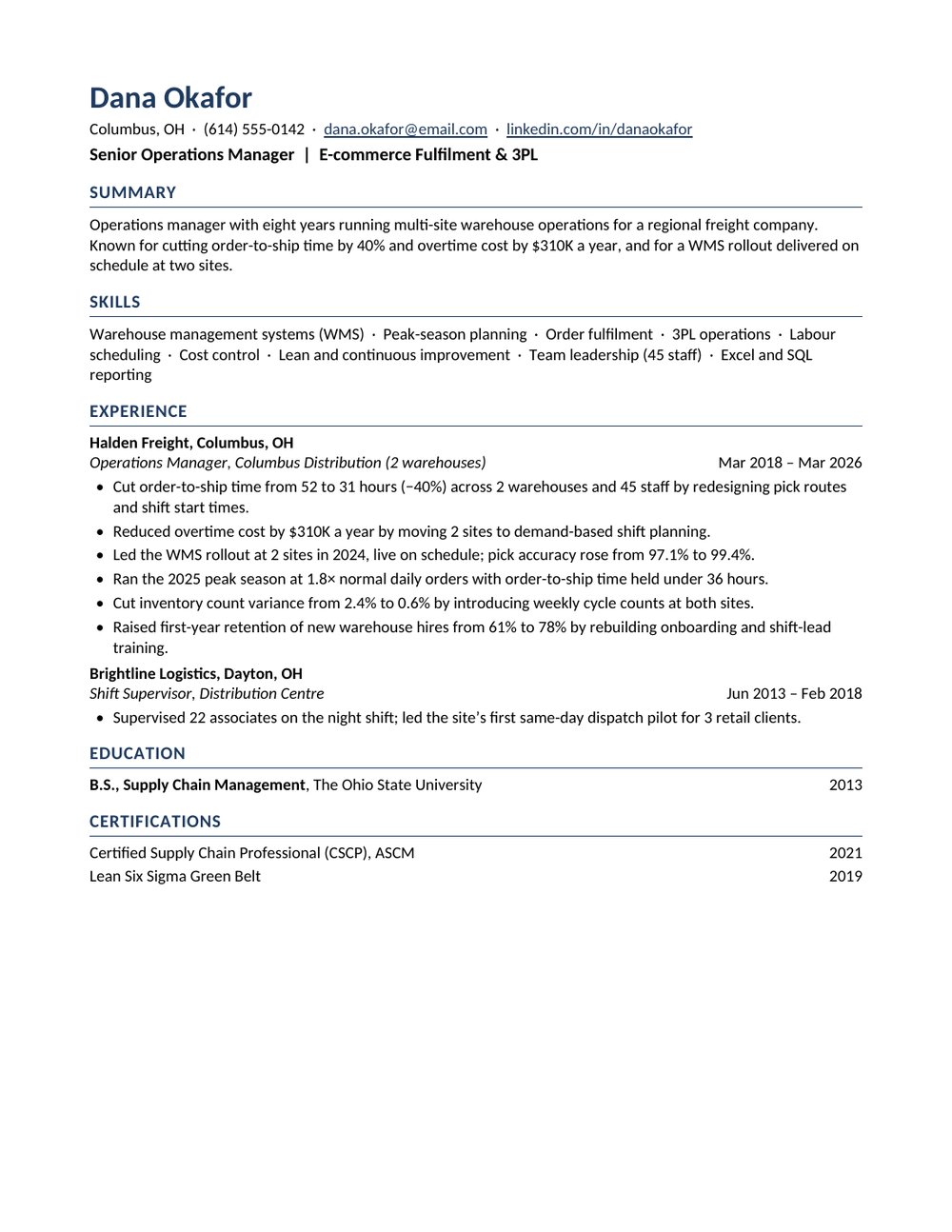
Real exampleWord résumé · Prompt 03
“Responsible for warehouse operations and a team of 45.”
Dana Okafor — Senior Operations Manager
Benefits of the job search prompts
Four things the job search prompts do for every application, from the first résumé line to the salary talk.
Each résumé line carries a number, a named result or a fact an employer can check. Empty words like “results-driven” are cut, and a missing number is asked for, never made up.
Each résumé and cover letter is written for one role at one employer, in the words of the job listing. A generic application tells the hiring manager you did not read theirs.
The interview prompts build a bank of true stories in STAR form (Situation, Task, Action, Result), run a mock interview and score your answers.
The offer and salary negotiation prompts value the full package, base pay, bonus, retirement match, equity and benefits, and compare it with market pay before you answer.
What is in the pack
Each job search prompt works on its own. The prompt asks for what is needed and, in Claude, returns a finished Word or Excel file. Run the one you need, or run all ten in order.
Turns your experience into one target role, with the evidence that you can win it and the pay it commands.
See it in Dana’s exampleBuilds a ranked list of employers to target, and reads market pay for your role from the listings and data you paste.
See it in Dana’s exampleRewrites your résumé so every line states a measured result, then builds it as a best-practice Word document.
See it in Dana’s exampleRewrites your LinkedIn profile so recruiters searching for your target role find you and contact you.
See it in Dana’s exampleWrites a one-page cover letter for one listing, matching its top requirements to your proven results, as a Word document to match the résumé.
See it in Dana’s exampleWrites the outreach messages and call plan that turn people you know into introductions and referrals.
See it in Dana’s exampleBuilds a bank of true stories in STAR form, mapped to the questions the target role’s interviewers will ask.
See it in Dana’s exampleRuns a realistic mock interview, scores each answer against a rubric, and rewrites the weakest answers.
See it in Dana’s exampleValues each offer as total compensation, and compares it with your floor, the market and your goals.
See it in Dana’s examplePlans and scripts the counter-offer: the number, the evidence, the words and the fallback positions.
See it in Dana’s exampleWorked example
Dana Okafor ran operations for two warehouses at Halden Freight in Columbus, Ohio, for eight years. Her role was eliminated on 13 March 2026. Over the next 11 weeks she sent the same résumé and the same cover letter to 140 operations jobs, reached 3 first-round interviews and received no offers: 11 weeks without pay, $20,300 at her old salary of $96,000. On 1 June she started again with one target role. Here is how the ten prompts took her from that search to a signed offer at $109,000, one step at a time.*
Prompt 01 · Target
What Dana brought · her résumé and notes
“Eight years running warehouses. I’ve applied to any operations manager job I could find — 140 of them.”
What the prompt returned
One target: Senior Operations Manager in e-commerce fulfilment or third-party logistics. Her three interviews all came from that kind of role.
Takeaway: choose the target from the results you can prove, then aim every application at it.
A target role is a specific title, level, industry and location that a candidate can prove they are ready for today. Third-party logistics (3PL) companies run warehousing and shipping for other businesses.
Prompt 02 · Target
What Dana brought · 31 job listings
“I pasted 31 listings for senior operations roles around Columbus, and two salary surveys.”
What the prompt returned
Median posted midpoint $104,000. WMS experience appears in 24 of the 31 listings; her résumé never used the term.
Takeaway: read pay and requirements from many listings before writing a single application.
Market pay is read from the midpoint of many posted pay ranges, never from one listing. A requirements pattern counts how often each requirement appears across listings, so the résumé can answer the common ones first.
Prompt 03 · Position
What Dana brought · her résumé
“Responsible for warehouse operations and a team of 45.”
What the prompt returned
“Cut order-to-ship time from 52 to 31 hours (−40%) across 2 warehouses and 45 staff by redesigning pick routes and shift start times.”
Takeaway: put a number in every line, in the listing’s own words, and check every number can be defended.
The XYZ format writes each bullet as: accomplished X, as measured by Y, by doing Z. An applicant tracking system (ATS) is the software employers use to store applications and rank them against the listing’s words.
Prompt 04 · Position
What Dana brought · her LinkedIn profile
“My headline says ‘Operations Manager at Halden Freight’. I haven’t touched the profile since 2019.”
What the prompt returned
“Senior Operations Manager | E-commerce Fulfilment & 3PL | Cut order-to-ship time 40% across 2 warehouses.”
Takeaway: write the headline for the role you want, in the words recruiters search for.
Recruiters find candidates by searching titles, skills and locations, so a profile is ranked on those words before anyone reads it. The headline is the line under your name that appears in every search result.
Prompt 05 · Apply
What Dana brought · Larkspur Home’s listing
“The listing asks for peak-season planning, a WMS rollout and cost control.”
What the prompt returned
A letter of under 200 words that opens on Larkspur’s shipping delays of up to 18 days last December, and answers each requirement with one result.
Takeaway: write each letter for one employer’s problem, and prove each requirement with one number.
A cover letter answers one question: why this candidate, for this job, at this company. It opens with the employer’s problem and matches the listing’s top three requirements to three proven results.
Prompt 06 · Apply
What Dana brought · her contact list
“I have former colleagues at 6 of my 24 target employers, but I haven’t spoken to most of them in two years.”
What the prompt returned
18 messages to former colleagues and people they introduced: 7 replies, 4 informational calls, 2 referrals.
Takeaway: ask for information first, and a referral only after a useful conversation.
An informational interview is a 20-minute conversation to learn how a team works and what it needs; it is not a request for a job. A referral is an employee putting your name forward to the hiring manager.
Prompt 07 · Interview
What Dana brought · her interview notes
“My notes had four stories, and all of them started with ‘we’.”
What the prompt returned
A bank of 9 STAR stories covering 10 competencies, each under two minutes spoken, each ending on a number.
Takeaway: prepare a small bank of true stories, each told in the first person and ending on a result.
The STAR method structures an interview answer as Situation, Task, Action and Result. Behavioural questions (“tell me about a time…”) ask for past examples, and trained interviewers score each answer against set criteria.
Prompt 08 · Interview
What Dana brought · her practice answers
“Score my answers to the questions Larkspur’s panel is likely to ask.”
What the prompt returned
First run: 2.4 out of 5 on measured result. After the three weakest answers were rewritten: 4.1.
Takeaway: rehearse against a written rubric, and fix the pattern that runs through every answer.
A scoring rubric sets out in advance what a weak, adequate and strong answer contains, so the score reflects evidence rather than impressions. This one scores structure, personal action, measured result and relevance.
Prompt 09 · Offer
What Dana brought · two offers
“Corvid Logistics offers $110,000 base. Larkspur offers $104,000 plus a 10% bonus target.”
What the prompt returned
Larkspur is worth $115,120 a year and Corvid $107,300. The lower base salary is the better offer by $7,820.
Takeaway: value every offer in full, with the bonus at its real payout rate, before comparing base salaries.
Total compensation is everything an employer pays for your work in a year: base, expected bonus, retirement match, equity and benefits, less the costs the job adds. Expected bonus is the target multiplied by the historical payout rate.
Prompt 10 · Offer
What Dana brought · Larkspur’s recruiter
“Larkspur’s recruiter called to ask whether $104,000 works.”
What the prompt returned
A counter at $112,000, backed by Corvid’s $110,000 base and her results. Agreed: $109,000 base and a $5,000 signing bonus.
Takeaway: counter once, with one number backed by market pay and your alternative, and confirm it in writing.
BATNA stands for best alternative to a negotiated agreement: what you will do if this negotiation fails. A strong BATNA, such as a competing offer, sets how firmly you can push.
Three documents from Dana’s ten prompts: the Word résumé from prompt 03, the Larkspur cover letter from prompt 05, and the counter-offer email from prompt 10.
Dana Okafor — Senior Operations Manager
E-commerce Fulfilment & 3PL · Columbus, Ohio · hybrid
| Before | Rewritten in XYZ format |
|---|---|
| Responsible for warehouse operations and a team of 45. | Cut order-to-ship time from 52 to 31 hours (−40%) across 2 warehouses and 45 staff by redesigning pick routes and shift start times. |
| Managed overtime and labour scheduling. | Reduced overtime cost by $310K a year by moving 2 sites to demand-based shift planning. |
| Led system implementation project. | Led the WMS rollout at 2 sites in 2024, live on schedule; pick accuracy rose from 97.1% to 99.4%. |
| Handled peak season. | Ran the 2025 peak season at 1.8× normal daily orders with order-to-ship time held under 36 hours. |
Larkspur Home — Senior Operations Manager, Fulfilment
Cover letter · sent as the email body with the résumé attached
Subject: Senior Operations Manager — ran peak at 1.8× volume, order-to-ship under 36 hours
Dear Ms Reyes,
Larkspur’s customers waited up to 18 days for holiday orders last December. I ran Halden Freight’s two Columbus warehouses through the 2025 peak at 1.8 times normal daily orders, and order-to-ship time stayed under 36 hours. Jordan Blake, who worked with me at Halden, suggested I write to you about the Senior Operations Manager role.
Your listing asks for three things, and each is something I have done:
Peak-season planning. I rebuilt our pick routes and shift start times, cutting order-to-ship time from 52 to 31 hours across both sites, before volume nearly doubled.
A WMS rollout. I led the move to a new warehouse management system at two sites in 2024. It went live on schedule, and pick accuracy rose from 97.1% to 99.4%.
Cost control. Moving both sites to demand-based shift planning cut overtime cost by $310K a year.
I would welcome 30 minutes to discuss how I would plan Larkspur’s next peak season.
Yours sincerely,
Dana Okafor
Counter-offer — email to Larkspur’s recruiter
One counter, one number, one fallback
Subject: Senior Operations Manager offer — base salary
Hi Sam,
Thank you for the offer. I’m excited about the role and about helping Larkspur through its next peak season.
Before I accept, I’d like to discuss the base salary. I have a competing offer at $110,000 base. I also bring the WMS rollout your listing puts first: at Halden it went live on schedule at two sites and raised pick accuracy from 97.1% to 99.4%.
With that in mind, I’m asking for a base salary of $112,000. If base is fixed at this level, a signing bonus would close the gap.
Larkspur is my first choice, and I’d like to confirm this week. Could we speak on Thursday?
Best regards,
Dana
Prompt output, formatted for this page. In Claude each prompt returns it as a finished Word or Excel file; other tools return the same content as text and tables. The figures come from whatever you paste in. Dana Okafor is fictional, so every number here is ours to show you.
Yes. The job search prompts ask for your experience and the job listing, then write résumé lines with numbers and a cover letter for that one employer. A missing number is asked for, never made up. In Claude, both come back as Word documents.
The cover letter prompt writes for one role at one employer, in the words of its listing and from your real results, and cuts generic phrases. Read the letter and adjust it to your own voice before you send it.
Yes. Prompt 9 values each offer in full and compares it with the market. Prompt 10 plans the counter-offer: the number, the evidence, the words and the fallback. Nothing on this page is legal, financial or tax advice.
ChatGPT, Claude and Gemini. The pack works best in Claude, where the résumé and cover letter are built as Word documents.
Pack 10 · Career & Job Search
* Dana Okafor, Halden Freight, Larkspur Home, Corvid Logistics, Brisk Parcel, the people named and all figures on this page are fictional and used for illustration only. Output from these prompts depends on the information you supply and the AI tool you use. Pay, benefits and employment rules differ by country and state; nothing on this page is legal, financial or tax advice.
Nine packs for everyday life, from career and money to travel and health, each written to the same standard with its own worked example.